four note friday 2.40 | What is rapid photovoice?

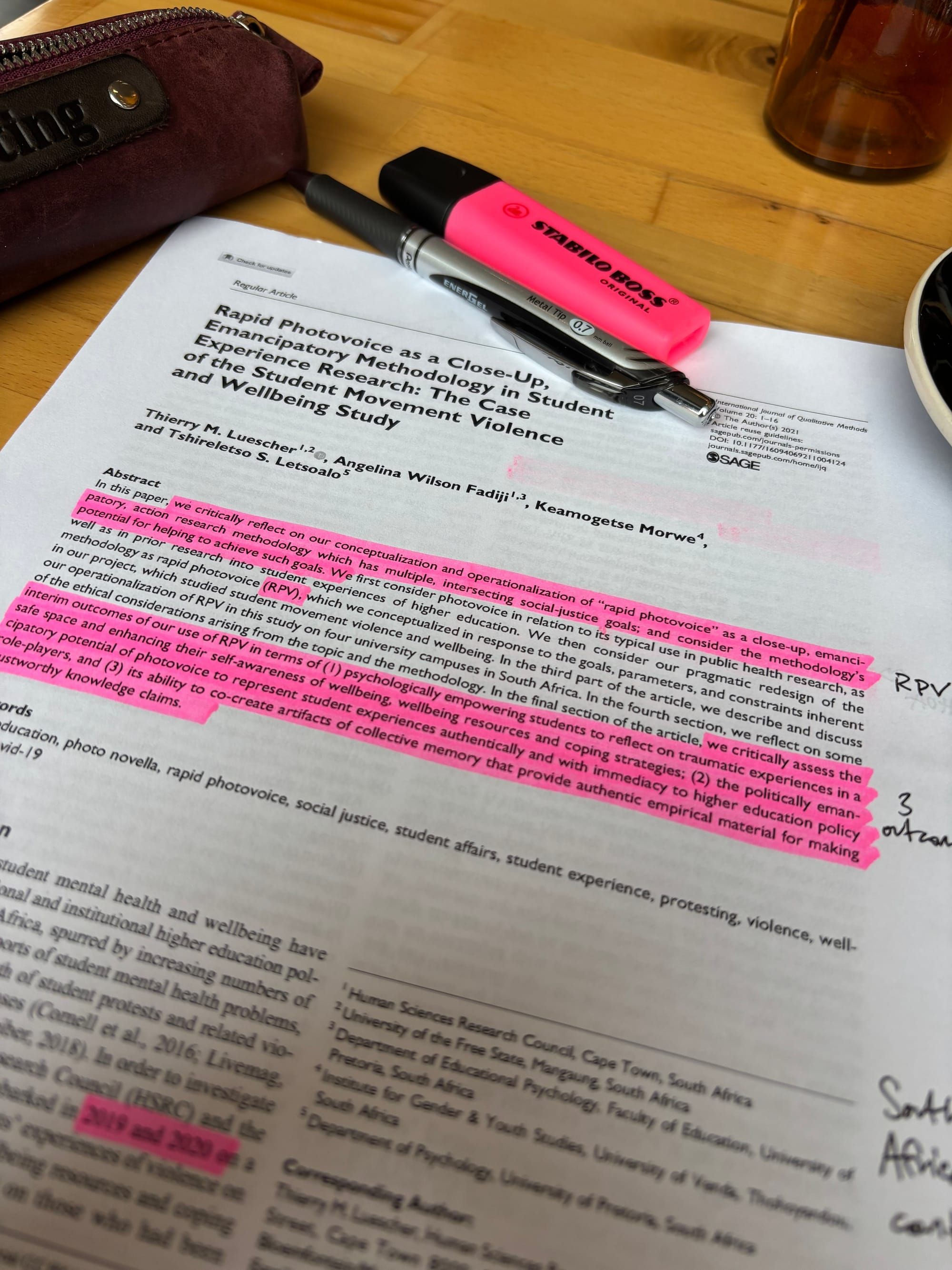
In my ongoing quest for locating as many adaptations and variations of photovoice as possible, this week I happened upon a paper wherein the authors explained rapid photovoice (or RPV). As always, be sure to read the original paper yourself, which is available, thankfully, through open access. It is titled "Rapid Photovoice as a Close-Up, Emancipatory Methodology in Student Experience Research: The Case of the Student Movement Violence and Wellbeing Study" by Thierry M. Luescher, Angelina Wilson Fadiji, Keamogetse Morwe, and Tshireletso S. Letsoalo, which was published in the International Journal of Qualitative Methods in 2021.
The authors explained that they "designed a study to explore students' experiences of violence and aggression in the student movement from a wellbeing perspective" (p. 4). The context was higher education within South Africa. Four institutions served as research sites, a total of 20 students participated, and the project took place across 2019 and 2020.
The purpose of the article was not to report on the findings of the study. The purpose was to share insights about the development and deployment of the photovoice adaptation they termed rapid photovoice. They explained that their "conceptualization and operationalization of photovoice is termed rapid photovoice primarily because the timeframe for introductions, training, data gathering, reflection and discussion, and an initial presentation of the results, was compressed into 3 days" (p. 6). Three days? Yes, three days. Three days within one week. At first, I was surprised at the short duration of the work, but as I read the paper in its entirety, the approach became much more compelling.
In what follows I will outline my four main takeaways from this article, which I found fascinating, nuanced, and well-written. All of my photovoice work has been in the context of higher education, so the paper resonated contextually. It's even given me some news ideas for future projects.
Constraints can lead to innovation.
This is not a new idea. But this article was a beautiful example of how brilliance can come out of tight parameters.
Three constraints affected this project. First, the project had to involve more than one campus. This added complications to the ethics approval processes and consequently cut down on the time available to carry out the study. This added the second constraint, time. Third and lastly, the budget was restrictive. They needed to find ways to save money on the cost of travel and accommodations.
With these three practical constraints to deal with (not to mention the onset of pandemic-induced lockdowns that created a full-stop for the work a few months into 2020), the team decided to host concentrated, three-day, on-site workshops—with the complete process lasting no more than one week.
Organized into a table on page nine, the authors provide a handy schematic outlining the three days, which are each broken down into three sessions. In addition, they share details on what also needs to occur before and after each site visit. One of the highlights for me was the concept of the world café, which took place on each campus during session nine. The world café events gave the students the opportunity to share their work and have discussion with student affairs and services professionals who work on their campus.
A three-day workshop can be an efficient and efficacious way to work with college students.
College students often have a lot going on. Three days is a much lesser ask than than three months. Work expands to fill the space anyway; see Parkinson's Law. Furthermore, if the project is appropriately framed as collective advocacy work complete with real opportunities to make meaningful change that could help others, students will be compelled to participate.
Providing course credit, meals, transportation, and a stipend should also be considered. The time spent working on the project is time students could spend working, studying, or being with their friends and family.
Concentrated focus and effort can yield important outcomes.
Protracted processes and long-term commitments can be difficult for participants. Attrition results. Rapid photovoice can provide a space, a wedge, for participants to focus solely on the project at hand for a concentrated period of time. That can be a rare and precious gift. Across what I imagine to be an intense three days, comprised of 10 sessions in total, an entire photovoice project cycle is completed.
I have already mentioned the breakdown of the process via a table on page nine of the manuscript, but below is an overview. Within these sessions along with the pre- and post-session work they shared in the paper, I can see all eight of the steps I have elucidated elsewhere (see here and here).
Day 1, Session 1: Introductions
Day 1, Session 2: Training (photography and ethics)
Day 1, Session 3: Discussion of research questions and topic at hand
Session 4 (between days): Photography and locating photographs within personal archives
Day 2, Session 5: Talking about photographs
Day 2, Session 6: Drafting captions for the photographs
Day 2, Session 7: Preparing the small-scale exhibition
Day 3, Session 8: Talking about the exhibition
Day 3, Session 9: World café event
Day 3, Session 10: Debrief and future planning
Note. I also found the inclusion of photographs from students' personal archives (camera rolls, social media, messaging platforms) to be fascinating. It makes perfect sense considering the topic being explored. However, ethical considerations must be taken into account here. For example, what happens if there are (other) people in the photographs? What is the difference between private and public spaces? How does consent work in these instances? Answers to these questions must be considered well in advance of the project getting underway.
Both analog and digital technology can have a place in photovoice projects.
It warmed my pro-analog heart to see the infusion of both analog and digital technologies within the rapid photovoice process. While much of the photography was digital, the participants had the chance to work with printed versions of those photographs and the attending captions as they physically built out the small-scale exhibition.
In addition, the groups used WhatsApp to share their images and attending stories back and forth during Session 4. This digital communication was an effective way to prepare for the in-person discussions that were to follow during Day 2.
Let the people and the project drive the tools or methods used within photovoice projects. We must keep our photovoice toolboxes full of items—both analog, digital, and everything in between. If you only have a hammer, as they say. Well, we need more than a hammer.
Have you ever heard of rapid photovoice? It's a close cousin of compact photovoice, to be sure. Yet I found the details within this particular paper to be quite thorough and well-substantiated. After reading this piece, I was itching to try RPV. Indeed, several new ideas were hatched. Have a read for yourself and see what you might think up.
🥹 Thanks for spending a moment with me this Friday.
💌 If you’re new here, welcome! I hope this space becomes one you look forward to each week.
📖 Interested in a book version of these posts? Check out the paperback and ebook!
📬 Have a question you want me to answer in a future post? Reach me at photovoicefieldnotes@gmail.com. I'd love to hear from you.
Thanks again for being here.
Warmly,
Mandy
photovoice field notes
https://www.photovoicefieldnotes.com/