four note friday 2.36 | What is compact photovoice?

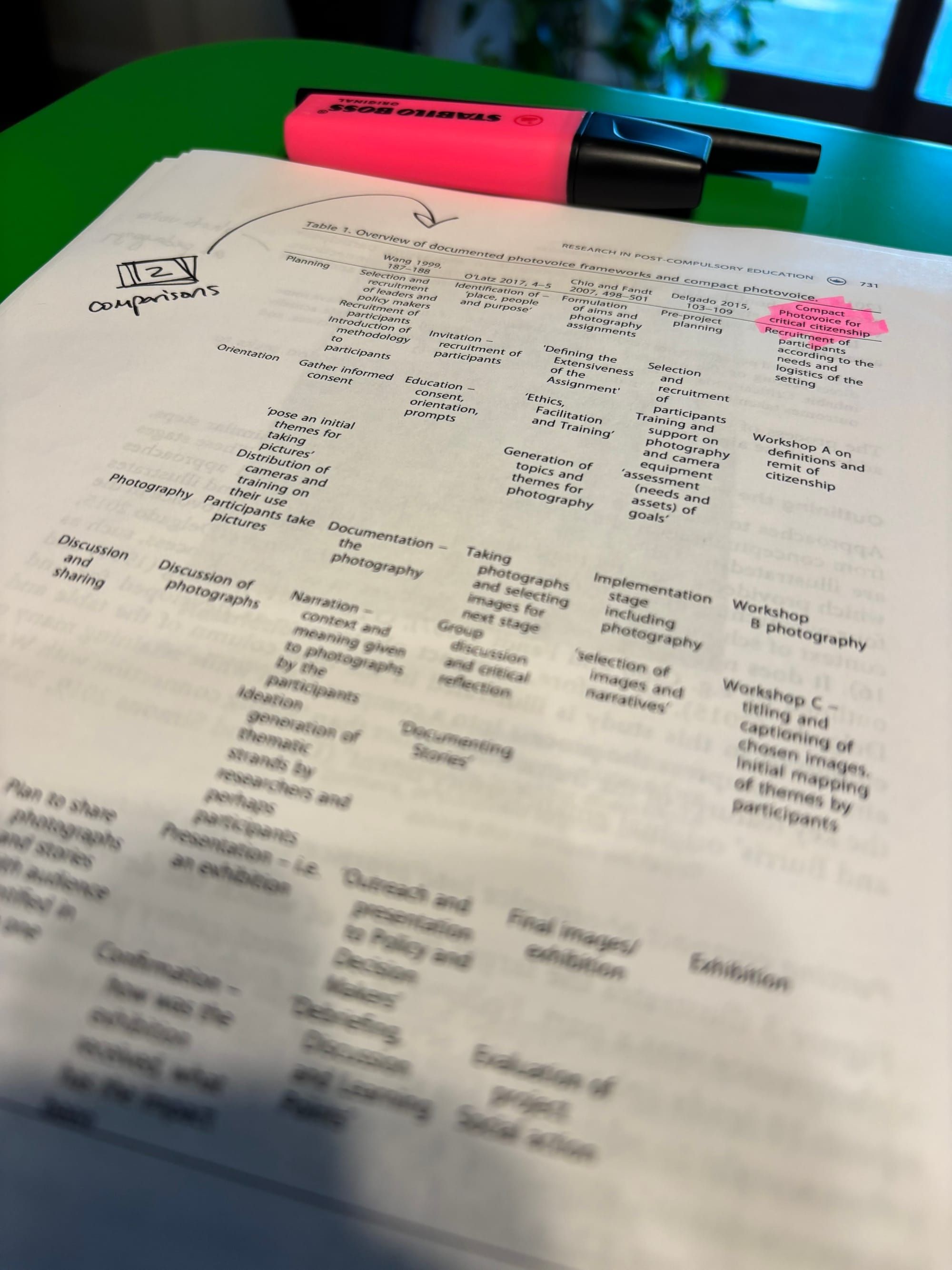
This week's post is focused on a recent article by Penelope Williams titled “'Citizenship is where you are'”: Compact Photovoice as Research Method and Pedagogy for Post-16 Citizenship Education," published in Research in Post-Compulsory Education. Compact photovoice is exactly what it sounds like. Compact photovoice "aims to compress the [photovoice] process into a compact form while retaining many of the key features of the framework" (p. 730). Compact photovoice can be useful within time- and resource-constrained contexts, like schools.
In what follows, I outline my four takeaways from the piece. But, as always, I encourage you to read the original and develop your own takeaways germane to your work. And as an aside, I had to chuckle while reading the article, which changed my name from Amanda O. Latz to Amanda O'Latz. My last name is Latz, and my middle name is Olivia. Simple mistake. Hehe.
True Photovoice Is Hard
It's true. Facilitating a photovoice project from start to finish is difficult. It takes time, energy, and focus. And a lot of coordination. Sometimes, significant financial resources are also needed. This takeaway is essentially the starting point for the author's argument—that true photovoice is nearly impossible to carry out in time- and resource-constrained contexts. Like schools, unfortunately.
Within the piece, Williams stated that the paper was meant to showcase "compact photovoice as a novel and accessible method and pedagogy" (p. 725). First, I would argue that compacting photovoice does not necessarily move it from methodology to method, especially given the way the process is laid out on page 731 of the paper. More on that is coming. And, second, deploying photovoice as a methodology and pedagogy is really hard. LOTS of moving parts to consider.
The project was focused on making space for 16 to 18-year old students in England to engage in critical citizenship education during school. There was a specific focus on place-based pedagogy. The project had the "express purpose of creating a space for reflection where the boundaries between curricular and experiential learning are blurred" (p. 732). Per Strack et al. (2022), this project can be seen as a photovention.
While photovoice, in its truest, fullest, and most comprehensive form, really is hard, compact photovoice—as a methodology and pedagogy—provides a abbreviated alternative. And, according to Williams, little is lost in the truncation of process.
Scholars Articulate Photovoice Steps Differently
On page 731 of the article, Williams included a table outlining and comparing the various ways scholars have articulated the various steps involved in photovoice. When reading the article, this table is a must-study.
While scholars articulate the logistical process of photovoice differently, you'll notice a lot of overlap. Let's focus here on the steps involved in compact photovoice.
Williams laid out five steps involved in "Compact Photovoice for critical citizenship" (p. 731). They are as follows:
◼️ Recruitment of participants according to the needs and logistics of the setting
◼️ Workshop A: definitions and remit of citizenship
◼️ Workshop B: photography
◼️ Workshop C: titling and captioning of chosen images, initial mapping of themes by participants
◼️ Exhibition
In the first column of the table, Williams condenses down the fundamental steps included in all the showcased steps as follows: planning, orientation, photography, and discussion and sharing. The table then includes the following scholars' frameworks: Wang (1999), Latz (2017), Chio and Fandt (2007), and Delgado (2015).
It was fascinating to see the information presented as a visual matrix.
Padlet Is a Viable Online Co-working Space for Photovoice Projects—Especially in Educational Contexts
Within the project featured in the article, Padlet was the online co-working space where all data were collected and housed. Students were provided with a QR code to use for their file uploads. Padlet is a widely used collaborative tool used within education, and its use here makes complete sense. Here is a handy tutorial.
Padlet has been around for quite some time, and it always drops on and off my radar. While I have never used it for any of the projects I have facilitated, I have used Jamboard, a Google product that is now defunct. Padlet recently came back into my radar a few months ago when engaging with Dr. Subarna Basu, who used the tool with Kindergarten teachers as part of her recent photovoice dissertation.
As I think about the details of edition two of my text on photovoice in the context of education, it only makes sense to feature Padlet as a viable tool. It's free, fairly easy and simple, and widely used within the context of education.
Steps as Workshops
As I mentioned above, within the table on page 731, the last column is dedicated to showcasing the steps involved in compact photovoice. Aside from the first (recruitment) and fifth (exhibition) steps, all others were framed as workshops, which works extremely well in a school environment where students can gather in-person and synchronously to make progress on the project.
Setting aside dedicated time during the school day to work on the project certainly supports the curtailed nature of compact photovoice. Participants no longer need to wedge the project into their already busy lives. Project work becomes part of the curriculum, as is typically the case with photovoice as pedagogy.
Even when photovoice is not used pedagogically, creating in-person (or hyflex) workshops dedicated to working through the steps involved can be hugely beneficial to reaching the finish line. Providing a comfortable and resource-rich environment, a hot meal, transportation, childcare, and a stipend can go a long way in encouraging folks' participation in a photovoice project, especially when time is short.
As always, be sure to read this piece yourself to gain a full picture of what is meant by compact photovoice. Understanding and mapping the many ways photovoice has been (and still is being) adapted over time has become a strong interest of mine. And this piece is another interesting piece of the puzzle I am slowly assembling.
🥹 Thanks for spending a moment with me this Friday.
💌 If you’re new here, welcome! I hope this space becomes one you look forward to each week.
📖 Interested in a book version of these posts? Check out the paperback and ebook!
📬 Have a question you want me to answer in a future issue? Reach me at photovoicefieldnotes@gmail.com. I'd love to hear from you.
Thanks for being here.
Warmly,
Mandy
photovoice field notes
https://www.photovoicefieldnotes.com/