four note friday 2.24 | The Second Four Steps of a Photovoice Project
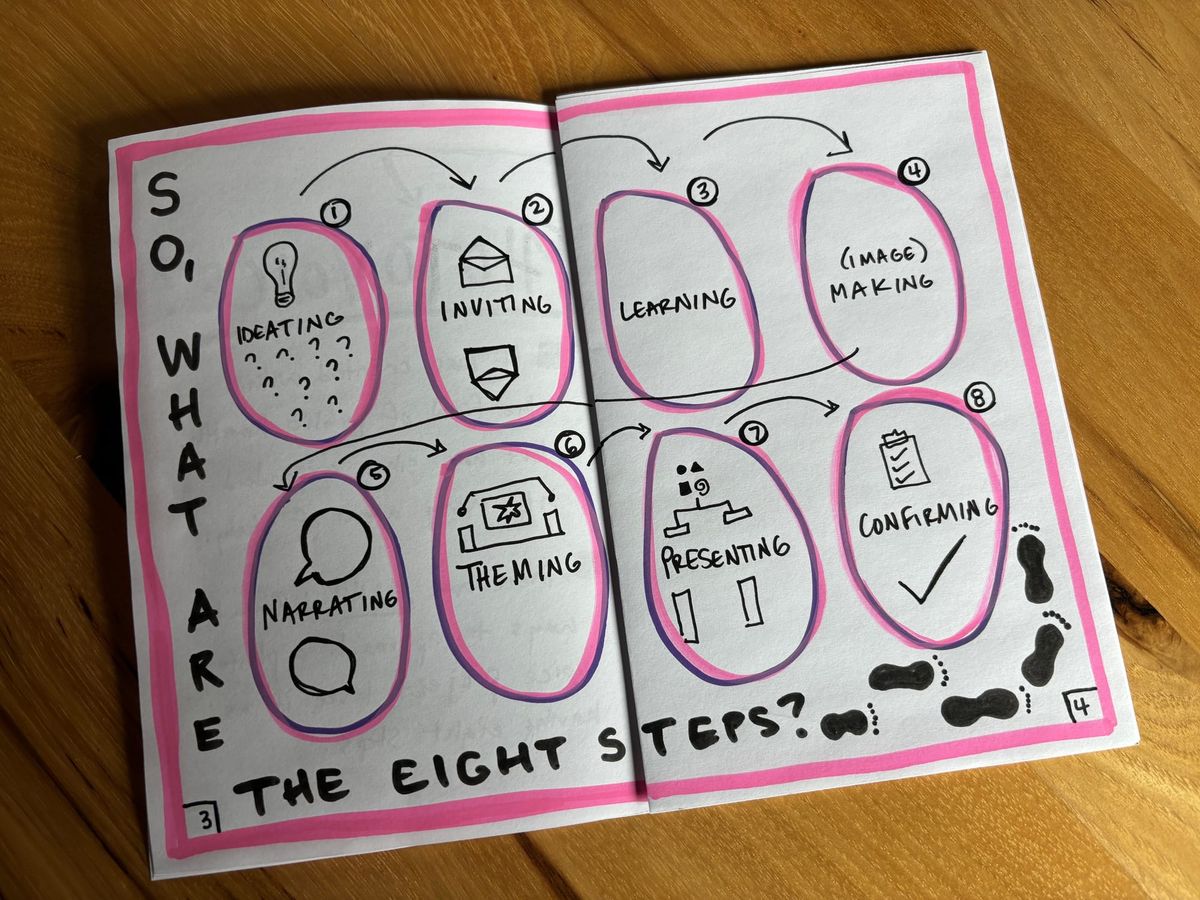
Now that we outlined the first four steps of a photovoice project, it's time to discuss the second four steps. These include narrating, theming, presenting, and confirming. Narrating is about generating voice to accompany the photographs. Theming is about establishing, naming, and defining patterns within the data. Presenting is when the project is placed on display for a variety of audiences. And, finally, confirming is when we see whether any sort of change has taken place following all our project-related efforts.
In what follows, I will again further define each step, provide some reflection questions for you to consider relative to the step, and explain how you might engage with collaborators using the power of menus within the step.
Just like I mentioned last week, these steps can be fuzzy and sometimes defy clear demarcations. In addition, sometimes we must move backward, forward, skip a step, or go out of the order provided here. These steps are simply guideposts that help our mental modeling of a photovoice project. The guideposts are flexible. If a situation calls for something not accounted for here, try it out! The most interesting bits are found within the deviations. No matter what, you will learn something new.
Step 5. Narrating
Let me start with a claim here that may be unexpected. Within photovoice projects, the photographs are not considered data—at least not data to be interpreted by anyone other than the person who took the photograph.
In most photovoice projects, photographs are seen as vehicles for meaning, not data in and of themselves. We might think of them as data antecedents. So, what is typically up for (participatory) interpretation within a photovoice project? That would be the narratives (voice)—written or spoken—that accompany the images (photo).
Photographs taken during the (image) making phase can, no doubt, be interpreted in a wide variety of ways. Yet most of those interpretations are incorrect. Photovoice participants/collaborators/co-researchers are the people whose interpretation of their images are correct. This is absolutely key within the process. As project leader/facilitators, we do not interpret the photographs or assume to know what they mean or represent without hearing from the people who created the images.
How are those narrations generated? This can take a number of forms, examples of which include interviews, focus groups, and caption writing. As is typically the case, consider what will best suit your project and your people.
Reflection questions to consider during the narrating phase:
+ What is the best approach to working with project participants to generate narratives about their photographs?
+ Beyond asking participants to discuss their photographs, are there other questions you would like them to answer?
+ Would individual or group discussions be best?
+ What practical and logistical considerations must be addressed within this step?
+ If engaging with interview or focus groups, how will you later connect the narrations (voice) with the images (photo)? In other words, how will you match the transcripts with the images? Do the images need to be labeled in some way ahead of time?
Ways to leverage menus to invite participation during the narrating phase:
+ List all the potential ways narrations of the photographs could be generated.
+ List the pros and cons associated with the above list of ways narrations of the photographs could be generated.
+ List three pieces of technology that might be necessary to record the narrations. For example, are you using a voice recorder or an app? What about video recording? Do you need microphones, a tripod, a Meeting Owl?
+ List three ways you could label the images so you can easily connect the narratives to the images.
Step 6. Theming
The theming phase includes taking into consideration all data collected through the project and deciding on a handful of common themes that get at the heart of what has been collectively conveyed through the data. Depending on your project and the people involved, this step may be very participatory. Yet in other cases, an outside data analyst may be invited in to engage in a solo analytical process. I've seen examples of all sorts of theming processes used within photovoice.
Depending on the nature of your project, you may want to borrow analytic processes from other qualitative methodologies or approaches. For example, you might consider reflexive thematic analysis, interpretive phenomenological analysis, or constructivist grounded theory. When making these decisions, consider your goals, the goals of the project, and the nature of your data. If the project is your dissertation, you are going to need to meet the expectations of your committee and/or the examiners—know what those are as early as you can. You will likely need to demonstrate rigor and cognitive-intellectual sophistication, connecting your work with myriad academic traditions. If the project is deeply community-based, fidelity of process is still important, but the external expectations are much different. There are no committee members or examiners. There is an expectant community.
Broadly speaking, a range of three to five major themes is a reasonable goal. If you have just one theme, it may be too all-encompassing to be meaningful. Break it up into smaller, more detailed segments. If you have 17 themes, consider ways to collapse those themes into a fewer number—knowing that each can have one or more sub-themes. Think Goldilocks. And balance between too few and too many.
Reflection questions to consider during the theming phase:
+ How participatory will the theming step be, and why?
+ Who, exactly, will be involved in the theming process?
+ If the process will be highly participatory, what is the best way to facilitate that process?
+ To what extent do you think participants will want to be involved in the theming process?
+ To what extent do you think inviting certain types of participation in this step will cause an undue burden to the participants?
+ Should the theming step take place synchronously or asynchronously? In-person or online? A mix? Why?
+ How will you know then the theming step is complete?
Ways to leverage menus to invite participation during the theming phase:
+ Brainstorm the steps you believe will be a part of the theming process.
+ List three ways to make the theming step more participatory.
+ Consider what the total analysis process will entail, then create a list of all the steps that will unfold. Examples include rereading transcripts to refamiliarize yourself with the narration, in vivo open coding using an inductive approach, deductive coding using a priori codes based on an existing theory, and selective coding.
+ List the pros and cons of the analysis process you intend to use.
+ List all the ways you might physically engage in the theming process. For example, will the steps within the theming phase take place digitally using a spreadsheet housing a code book? Will the coding be done by hand on print outs of the transcripts? Will theming unfold as a series of verbal negotiations led by the participants in a group setting?
Step 7. Presenting
The presenting step occurs toward the end of the project and involves sharing the work with the audiences who need to see it most. In this step, we want to find ways to deliver the project's main ideas, or themes, with as little friction as possible. If we need to connect with teachers, how can we get into schools? If we need to get the attention of neighborhood residents, when does the association meet, and how can we get onto the agenda? If we need to speak with lawmakers, what communication channels do we have available?
One way to think about presenting is the themes-audience-platform triangle. Put differently, considering our the main themes of our project, which platform is best to reach our target audience?
Within my book, I wrote at length about the presenting phase as a photovoice exhibition. Leveraging the museum learning literature, I likened the exhibition to a museum installation and outlined the many necessary considerations. I addressed questions like how will attendees know the difference between a photography exhibition and a photovoice exhibition? How will attendees know how to physically navigate the exhibition space? And, how can the exhibition be made interactive so as to really engage attendees in the content?
There are all sorts of ways to present the work. Think exhibition, slidedeck, traveling gallery, website, social media channel, pamphlet, poster, video, infographic, billboard, book, zine, and beyond. Examples are here, here, and here. Again, imagine the theme-audience-platform triangle and make decisions based on congruence between those three elements.
Reflection questions to consider during the presenting phase:
+ What is the best way to get our project's findings to the people who need to need to see them?
+ What form(s) will the presentation take?
+ Knowing the exhibition will be heavily visual, what other senses would we like to engage, and how would we do that? For example, how could audio enhance the visual?
+ Consider the who, what, when, where, why, and how of the presentation(s).
+ Which of the images and narratives need to be highlighted within the presentation? Which image-narrative amalgams will generate visceral reactions within a potential audience?
Ways to leverage menus to invite participation during the presenting phase:
+ List the key audiences for this project.
+ List all the potential (plat)forms the exhibition could take to maximize impact.
+ List all the physical and digital considerations necessary to create the presentation(s).
+ List ways to organize the presentation. By theme? By participant? By importance?
Step 8. Confirming
The confirming steps take place when we step back from the project and take stock of whether change was catalyzed or affected through the efforts of the work. This step is not often showcased within the literature. Most published studies stop short at the theming phase and consider the publication the presentation. Here is an interesting example of going beyond presenting and toward confirming.
To fully understand the efficacy of photovoice, we must move to and through the eighth step. Recall that photovoice is a form of critical participatory action research. We must assess whether any action has taken place as a result of our efforts.
Research projects often beget more research projects. New questions arise as we generate new information. So, during the confirming phase, we may find ourselves in the throes of another project, potentially re-entering the eight steps anew or using other means to further understand the post-project and post-presenting action(s).
Examples of confirming include tracking policy changes and understanding how those changes have affected the lived experiences of those impacted by the policy, circling back to project participants and engaging in dialogue regarding what has happened since the project's end, and resurveying or reengaging with the community with the intent of noticing changes in results, outcomes, or experiences.
Reflection questions to consider during the confirming phase:
+ What is the best way to understand the impact of our project, and why?
+ Who needs to be involved, and why?
+ How will this step unfold?
+ How will you know when to stop the process?
+ What are your strategies for bringing the project to a close?
+ Is participant off-boarding necessary? Why, or why not?
+ How might I feel when the project is ended? What can I do to prepare?
Ways to leverage menus to invite participation during the confirming phase:
+ List the three most feasible ways to engage the confirming step.
+ List all the potential people who should be invited into this phase or who need to be involved.
+ List all the potential steps involved in the confirming process.
+ List three things to look out for that indicate the step is coming to a close.
+ List all the pros and cons to off-boarding those involved in the project.
+ List three ways to formally end the process to bring about a sense of closure for all involved.
As you can see based on this two-part series focused on the eight steps involved in the photovoice methodology, the process is complex. It involves a lot of advanced planning—as well as in-project reflection and decision-making. These steps are guideposts, to be incorporated as it makes sense for your project.
What are your thoughts on these eight phases? Does this updated thinking resonate with you? What would you revise, add, or delete? In what ways has your work or your reading converged or diverged from these steps?
The more prepared you are at the start of a photovoice project, the easier it is to improvise with confidence along the path. The need to make changes and be flexible are inevitable parts of any research study. In fact, the things spurring on those changes are often the most important elements of the work. It is my hope that early and consistent engagement with these eight guideposts allows you to move through the project with confidence, poise, and a keen attentiveness to all involved.
🥹 Thanks for spending a moment with me this Friday.
💌 If you’re new here, welcome! I hope this space becomes one you look forward to each week.
📬 Have a question you want me to answer in a future issue? Reach me at photovoicefieldnotes@gmail.com. I'd love to hear from you.
Thanks for being here.
Warmly,
Mandy
photovoice field notes
photovoicefieldnotes.com