four note friday 2.35 | Using Photovoice in the College Classroom, Part 3

The first week of classes is now wrapped up at my institution. Syllabi have been reviewed, students have been introduced, and some initial discussions have taken place. Learning journeys are underway.
That said, it is time to wrap up this trio of posts dedicated to using photovoice in the college classroom. Following on from posts 2.33 and 2.34, this post includes guidance on and examples of deploying the final four steps in the photovoice process.
Narrating
The narrating step is all about creating contexts wherein participants tell stories about the photographs they created in response to the prompts guiding the project. Some methods used under the methodological umbrella of photovoice to create narrations include photo elicited focus groups, photo elicited interviews, image captioning, and participant-generated video or voice notes. While we might think we know what other person's photographs mean, it is not our place to interpret participants' photographs. That's their place.
Within my Community Colleges and Diversity course—our case study, or example, for this trio of posts—we used photo elicited interviews. The students in my course who had a community college faculty match coordinated dates, times, and locations for their one-to-one photo elicited interviews.
Each student facilitated their interview using a semi-structured interview guide (see below) complemented by a small photo album containing their match's images. Each photograph was pre-numbered using garage sale stickers to guide the exchange. Again, we had to have a way to connect the images with the interview transcripts excerpts.
Here is the interview guide we used:
[SCRIPT] Thank you for agreeing to meet with me for this interview. This interview will last approximately 60 minutes. Do you have any questions before we start the interview? Let us begin.
Warm Up Interview Prompts/Questions.
Tell me about your career path.
How long have you been teaching at [college name]?
Are you employed full-time or as an adjunct instructor?
What classes do you teach?
How many classes are you teaching this semester?
Are your classes online, face-to-face, or blended?
Tell me a little bit about your students.
[SCRIPT] Let’s now move on to talking about your photographs.
Engagement with and discussion of photographs and prompts:
How do you approach teaching and learning?
Who are you as a teacher?
Who are your students?
How do you define student success?
Describe your relationships with students.
What are your students’ greatest assets?
What are your students’ biggest challenges?
What is the best part of teaching at a community college?
What is the most challenging part of teaching at a community college?
[SCRIPT] Thank you. Let’s now move on to some closing questions.
Closing Interview Prompts/Questions.
What was being a part of this project like for you?
Did you learn anything about yourself and/or others through this project?
How did you decide what to photograph?
Was the project difficult for you? Why or why not?
What was your favorite/least favorite moment throughout this project?
Did you enjoy being a part of this project? Why, or why not?
Do you plan to have involvement in the photo exhibition?
How do you identify in terms of race/ethnicity and gender/sex?
What is your age?
May I contact you in the future if there are questions or need clarification about your images or interview?
Is there anything else you would like to share with me at this time?
[SCRIPT] Thank you so much for your time. I really appreciate your willingness to engage in this interview with me. If you should have any questions about this research project, please be in touch at any time. Thank you again, and please have a great day!
Theming
The theming phase of the process includes making sense of the data generated throughout the project. What were the main themes within the data corpus? This was tough for us as a class because by the time all data were collected, it was quite late in the semester.
Once students completed their interviews, they uploaded their audio files into our shared Box folder. They each also completed a brief reflection paper based on their interviews, sharing how it went, what they learned, and what really stood out to them.
Because we were so short on time as the end of the semester approached—along with our planned exhibition—we were only able to dip our toes into the theming process as a whole class. As such, our exhibition materials were roughly organized by photography prompt, not thematically.
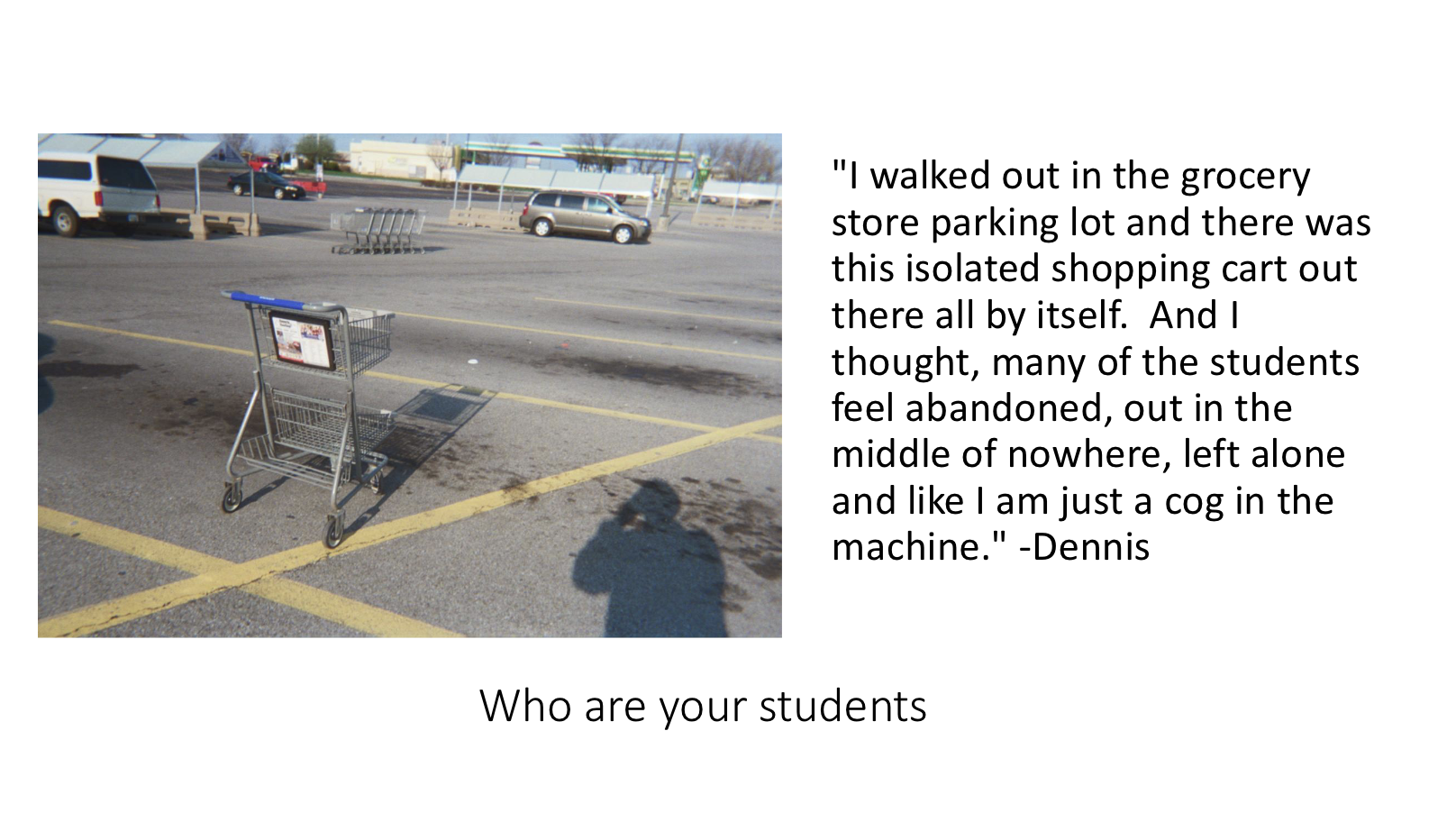
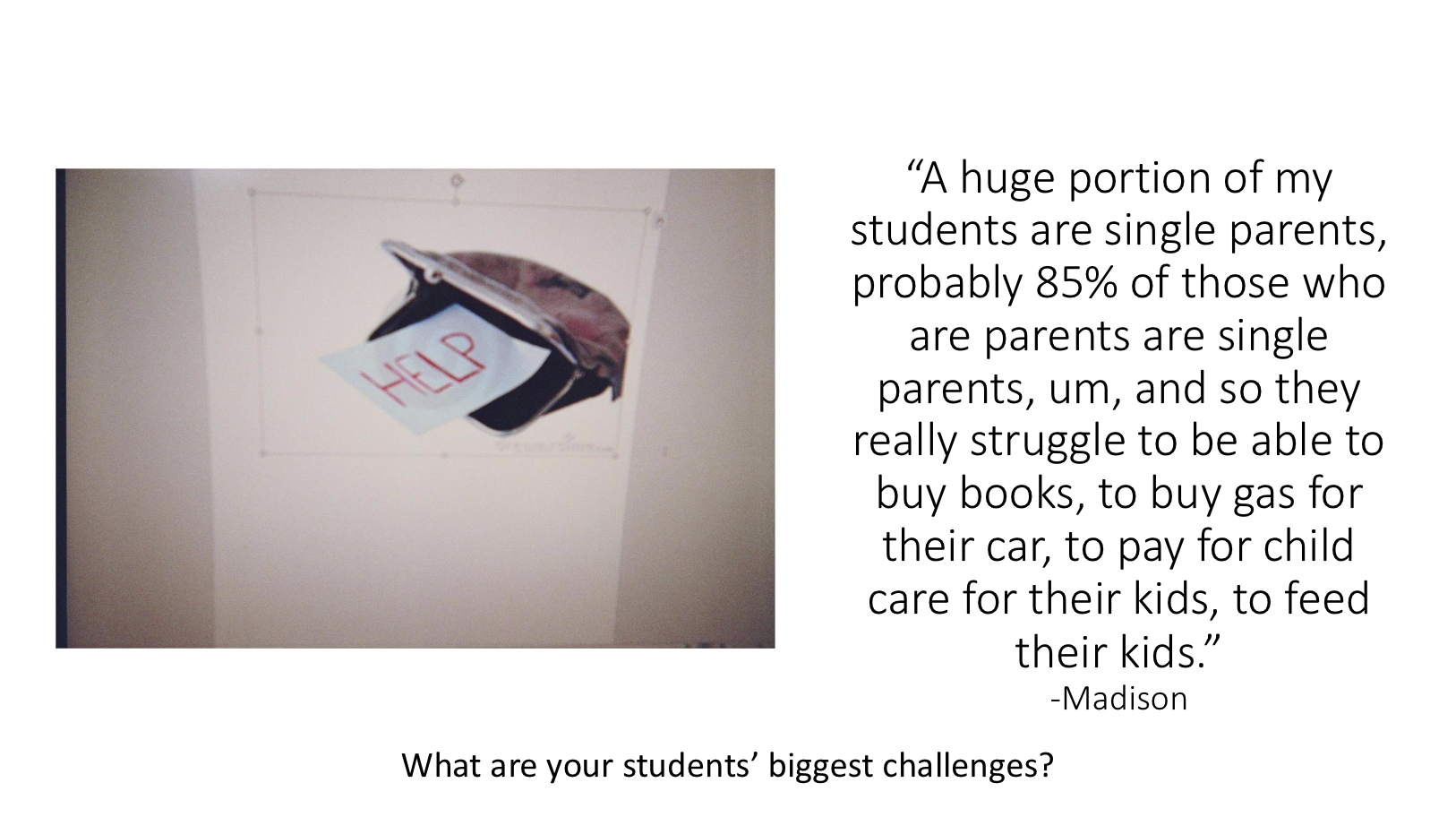
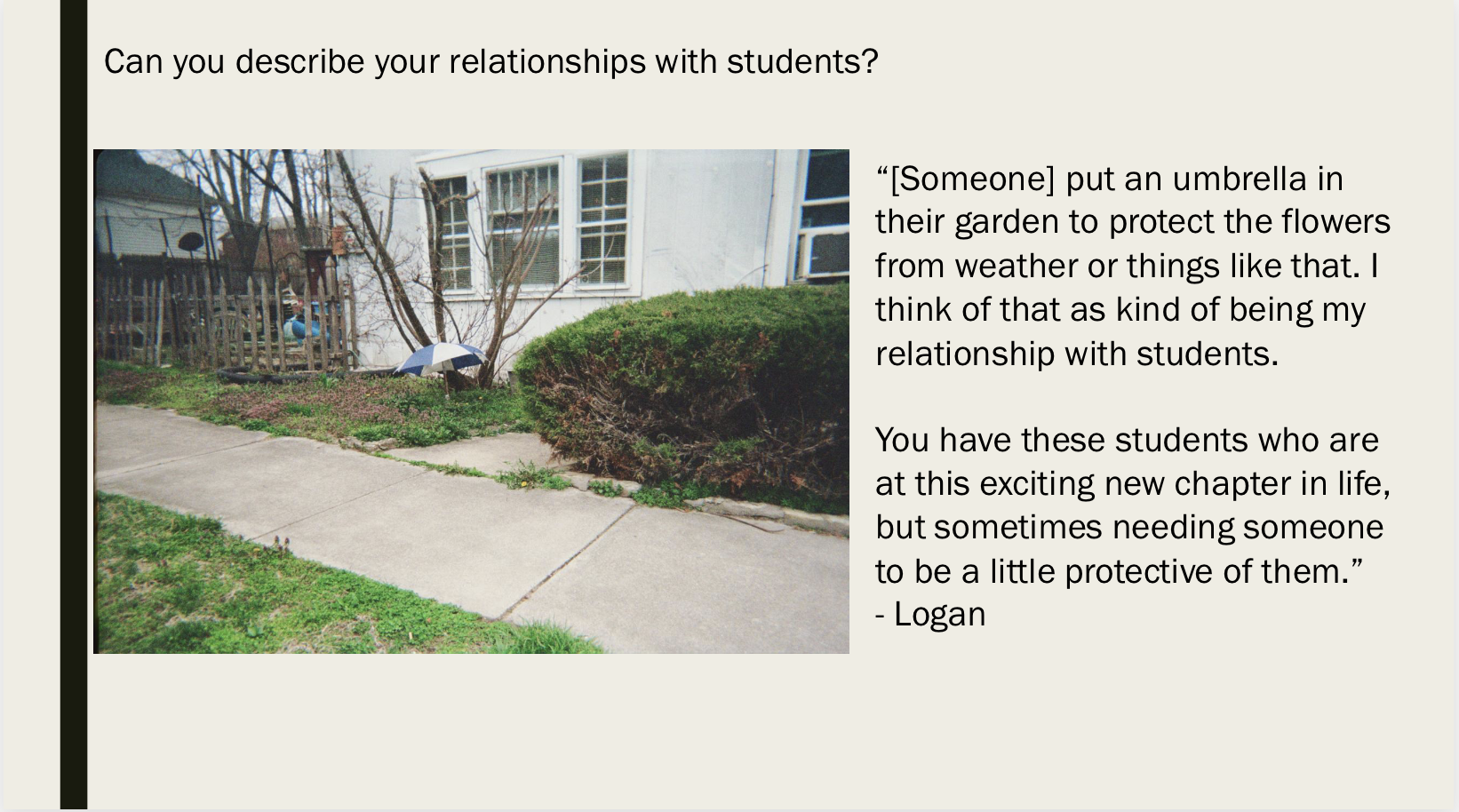
We did not have the time to fully transcribe, clean up, and analyze the interview data. Instead, I asked each student to create a slidedeck showcasing what they saw as the highlights of the interview with their match. Each slide contained an image, an interview excerpt about that image, and the photography prompt to which their match was responding. These slidedecks became the main contents of our exhibition. Some examples are below.
Presenting
The presentation phase of our project rolled out in several steps over time. We hosted the exhibition as planned, and it was well-attended. We were so thrilled to see the institution's Provost among the attendees.
We used my 2017 text and the lessons learned from past practice to plan and manage the event. This involved a lot of moving parts, but with so many students in the class, we were able to divide tasks and make the event happen. Teams were created and focused on the following areas: promotional materials; exhibition space; and exhibition agenda. We later also established teams to work on the presentation of images and text and food/drinks/decorations.
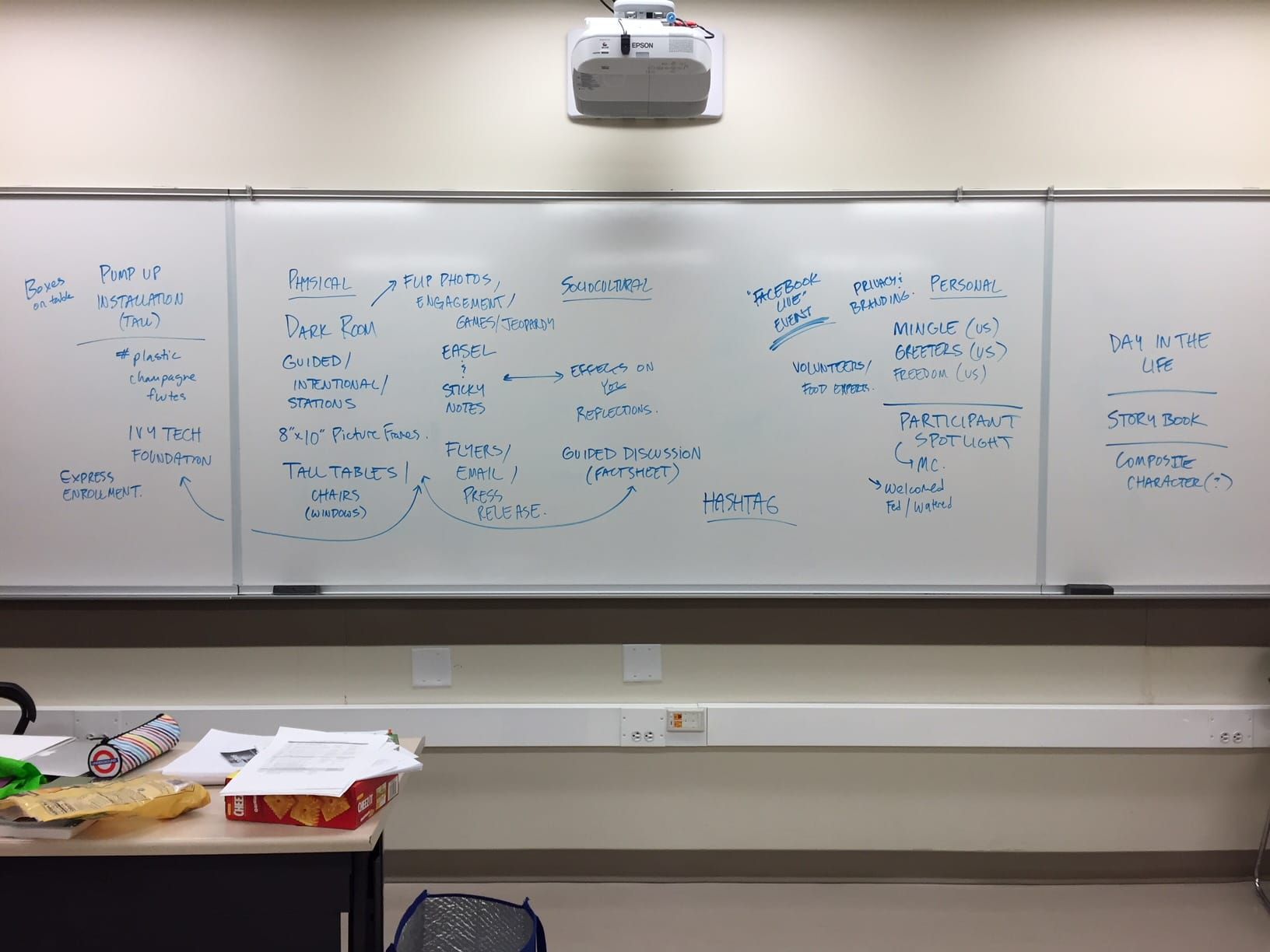
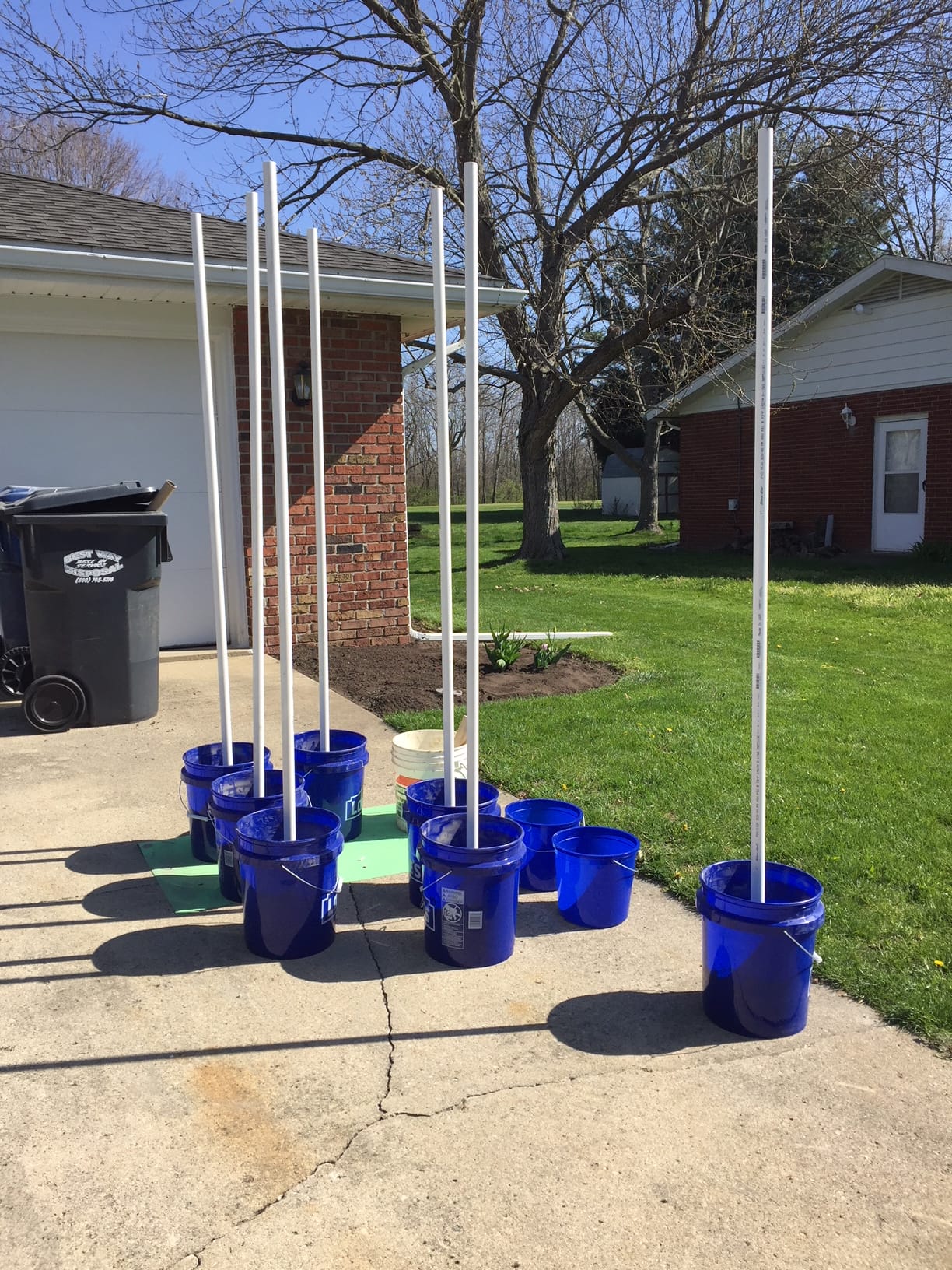
We sent a lot of emails, collaborated through a file sharing platform, and even make a couple trips to Lowe's (see the header image above and image below) to literally build components of our installation.
The exhibition took place during finals week of our spring 2018 semester. And once the semester and academic year were complete, many of the students were off to take their next steps—summer internships, new jobs, full-time work. For many of the students involved, the end of the semester/year represented their exit from the project. And that was completely okay. No ongoing work or involvement was mandatory or expected. And handful of doctoral students were interested in bringing the project to a broader audience, however.
Together, we decided on a direction for the work and presented the project at the annual Council for the Study of Community Colleges conference and then later published the work as a journal article in New Directions for Community Colleges. And the project continues to have an afterlife as I am still thinking and writing about it for new audiences.
Confirming
One of the strongest critiques of photovoice work is the lack of commentary about whether anything happened as a result of the project. Remember, photovoice is a form of critical participatory action research (CPAR). CPAR work is meant to instigate action, yet much of the published photovoice scholarship fails to comment. Often, little is explained beyond the exhibition, which is seen as the crescendo—and the project's end.
I do not have a grand success story to share here. While I know my students learned a great deal and our community college faculty partners enjoyed participating, I do not have evidence to substantiate the claim that something (else) happened as a result of the project. It may exist. I just do not have it.
When I first conceived of this project, my grand vision was to use the photographs and narrations to create an art installation consisting of artful faculty pedagogical love letters to students, which would exist in the new campus building being built at the time. Many community college students enter college with a lot of fear and trepidation. I thought this kind of intentional arrangement of space and messaging to those students could make a difference. Perhaps their fear could be interrupted.
But as it happens, people move on in transition, support wanes, and other responsibilities creep in to flood space. While we did good work and there was a lot of momentum behind the project, the grand vision was not met. But that does not mean the project was a failure—quite the contrary. It's reverberations continue to move around in the world. It's happening right now.
Have you used photovoice pedagogically in your course(s)? If so, what have I written that resonated with your experiences? While I am going to close this multi-part series for now, some posts in response to the photovoice-as-pedagogy literature are in the queue.
🥹 Thanks for spending a moment with me this Friday.
💌 If you’re new here, welcome! I hope this space becomes one you look forward to each week.
📖 Interested in a book version of these posts? Check out the paperback and ebook!
📬 Have a question you want me to answer in a future issue? Reach me at photovoicefieldnotes@gmail.com. I'd love to hear from you.
Thanks for being here.
Warmly,
Mandy
photovoice field notes
https://www.photovoicefieldnotes.com/