four note friday 2.41 | Was the Prima Faces Project photovoice?

I've been a huge fan of the play Prima Facie, written by Suzie Miller, since the play came out. Before I was a huge fan of Prima Facie, I was a huge fan of Jodie Comer, the actor who starred in the one-woman play for three long runs—in London, New York City, and in smaller cities across the United Kingdom and Ireland. I've seen the show live several times and in each of the aforementioned locations, the last being Canterbury.
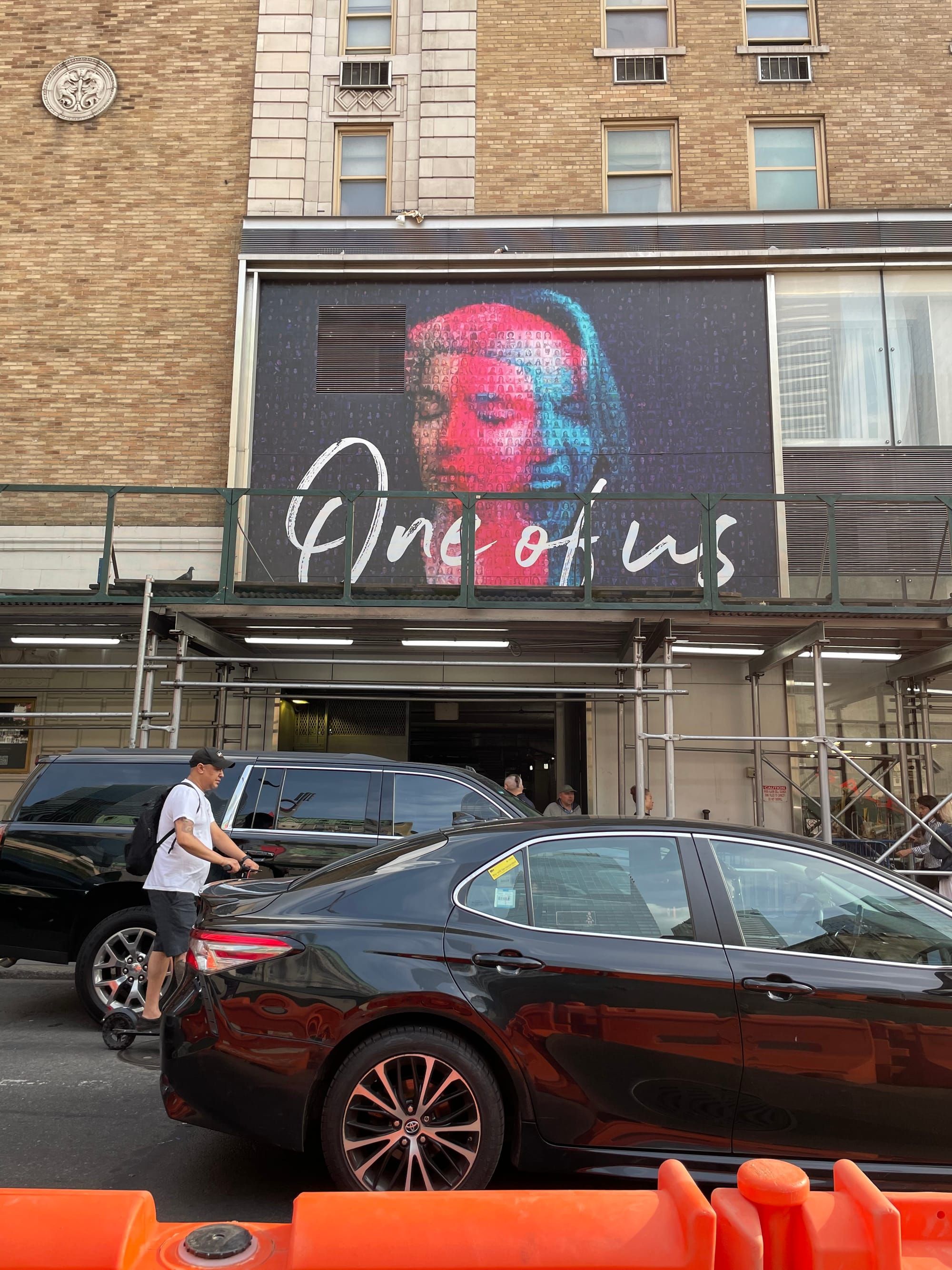
Something special unfolded during the lead up to the Broadway debut that seriously caught my already rapt attention—the creation of a public and participatory art project containing photographs, well, selfies, of those who consider themselves members of the play's fanbase. They called it Prima Faces. See here as well.
Prima Facie is about sexual assault (SA). The setting is Sydney (and later London). The entire play is enacted by a single character, Tessa, a barrister (lawyer), who defends those accused of sexual assault. But then she herself is assaulted. Tessa changes. The storyline shifts. The remainder of the play is all about Tessa's experience with the criminal justice system. The ending is not happy. The ending is somehow—hopeful?
The play and Jodie Comer won all the awards. And, yes, that includes a Tony. The play—written by Suzie Miller, directed by Justin Martin, and enlivened by Jodie Comer—was not just good. It was evocative. It was visceral. It demanded the audience's full attention.
It also moved people. Really moved people. It made visible so much of the invisible pain, agony, and suffering SA survivors endure. It also made visible the incredible courage, strength, and resolve of survivors. The story arc is brilliant. And even in this increasingly digital age, the play moved people to write letters. To Jodie. To Suzie. To the whole production team. And those letters often depicted fans' own SA stories.
The response was so overwhelming that Prima Faces was created to provide a more formal outlet—a safe landing space—for these stories. The resultant art piece, in which the photographs were reconfigured into a dot matrix version of the play's key image—two striking and contrasting images of Jodie's/Tessa's face, was used as an awareness-building tool and mechanism to bring attention to the larger societal systems/structures that enable SA and block accountability for perpetrators. I should also note here that this play supported charities (see here and here) such as the Schools Consent Project and Everyone's Invited.
In many ways, this play contributed to the ongoing #MeToo movement. And the momentum carries on still, as the play has recently been adapted for film, in which Tessa is played by Cynthia Erivo. It's set to premiere in theaters in November of this year.
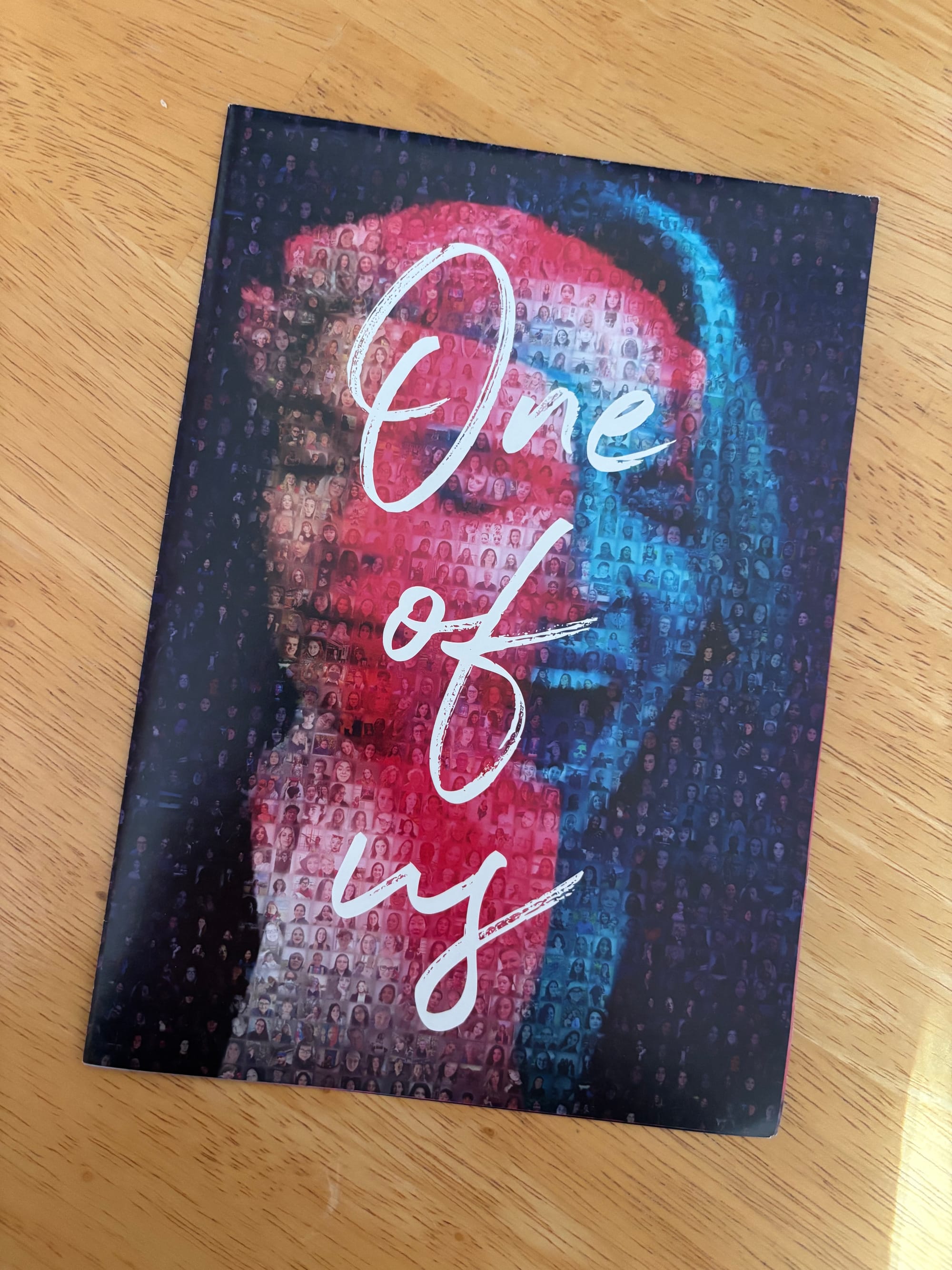
As I have watched all this unfold over the past few years, I've been asking myself whether the Prima Faces project was a photovoice project. And my answer is sort of, but no, not really. The project does not call itself photovoice, but there are similarities. According to the website, the artwork is "[a] merging of the play and the community of voices it has created all saying in solidarity that ON THE FACE OF IT SOMETHING HAS TO CHANGE" (para. 4).
In what follows, I share some ongoing thoughts related to Prima Faces and photovoice—the overlap and the differences.
Art can affect social change just as much if not more than research.
This art project and the various installations were very powerful. Art often communicates in ways no other medium can. The art associated with the play (Comer's face in contrasting duplicate with the pink, blue, and black color palette) became recognizable—and even iconic—over time. The Prima Faces Project capitalized on that allure, literally visually depicting Tessa's story as a composite of so many others. Leveraging the existing art in this way was brilliant.
While it is nearly impossible to pinpoint the direct social effects of the art project, evidence exists to suggest that many people were impacted by the performance, many people voluntarily participated in the project, and the play provided material support, funding, for charities teaching about consent and providing spaces for survivors' stories to safely land.
In many ways, this play and the Prima Faces art piece have affected social change just as much if not more than any research project—including photovoice projects.
Socially engaged art does not require systematic inquiry.
In contrast, photovoice does require systematic inquiry. The Prima Faces Project was not a dissertation. It is not being written about in the peer-reviewed academic/scholarly literature. While the work likely involved the curation of images and written accounts, there was no theming or analysis or interpretive work informed by some extant theory/ies.
And that is all perfectly okay.
This socially engaged art project wanted faces, which could be accompanied by words placed into a textbox. There were no photography prompts, there was no training, and there were no explicit methodologically-grounded aims.
Again, all this is perfectly okay.
The art did work in the world. There was no need for systematic inquiry because that was not the point. Prima Faces was not envisaged as a critical participatory action research project. It was framed as a formal response to an overwhelming informal response. According to the website, the project was incepted because of "[t]he volume of people sharing their stories because of seeing the production has simply been overwhelming" (para. 2).
All that overwhelm needed no systematic inquiry. The message was clear: this play is deeply moving people, and those people want to share how the contents of the play are mirroring the contents of their lives.
Research is not the answer to every question. Sometimes the answer is already there. It just needs amplification.
Photographs do something very different than words.
It is one thing to read about text-based descriptions of a tree, for example, versus seeing an image of a tree. Describing a tree in words is hard (see here). Showing someone an image of a tree is easier.
There's lot of neuroscience out there about our brain's interactions with images and/versus text. Images have an allatonceness (see here and here) that text simply does not. An image can jar us in a moment, while it takes text a bit longer to have the same effect. Seeing an arresting image can imprint upon the body in an instant. Text, again, takes more time to consume and metabolize.
Those involved in the Prima Faces project leveraged what photographs/images can do in the same way photovoice projects leverage the visual. Simply, an image can elicit a visceral response in ways text alone cannot—at least not as efficiently. Images catch attention, something vital for both socially engaged art and photovoice.
Online photovoice is effective when working with a large number of people, but some things will be lost along the way.
Scaling comes at a cost. In many ways, the Prima Faces Project reminded me of a large-scale online photovoice project. The unsolicited response to the play was overwhelming. So, a structure into which a solicited response could be contained, managed, and leveraged was created.
The experience of receiving and reading loads of unsolicited letters is a lot different than receiving and reviewing loads of responses to an online form.
Consider the differences between a small-scale and in-person photovoice project with 10 people compared to an online photovoice project with 1,000 participants. Do we want depth or breadth or both?
What gets lost along the way when we go for breadth and not depth? The letters represented depth and breadth. The online form represented breadth.
The contents of those letters probably did not include selfies or a short enough bit of text to fit neatly into an text box with a character limit. Those letters could have contained drawings or doodles. The paper may have been textured or perfumed. The handwriting contained in the letters may have said something about the writer. Those letters may have contained lush details or poems instead of prose.
While breadth is not lost through large-scale online photovoice work, depth falls off abruptly. There is nothing inherently wrong with online photovoice, but what are the aims of the inquiry, and what kind of data are necessary to meet those aims?
There are always trade-offs in research. Projects have to end. Time runs out. Funding runs out. People leave or become enmeshed in other things. What are we willing to lose? What must be preserved no matter the cost?
What do you think? Where do you pinpoint the overlaps and divergences here? In what contexts and circumstances might a project like Prima Faces be more appropriate than a photovoice project? And how do we recognize those contexts and circumstances?
🥹 Thanks for spending a moment with me this Friday.
💌 If you’re new here, welcome! I hope this space becomes one you look forward to each week.
📖 Interested in a book version of these posts? Check out the paperback and ebook!
📬 Have a question you want me to answer in a future post? Reach me at photovoicefieldnotes@gmail.com. I'd love to hear from you.
Thanks again for being here.
Warmly,
Mandy
photovoice field notes
https://www.photovoicefieldnotes.com/