four note friday 2.33 | Using Photovoice in the College Classroom, Part 1

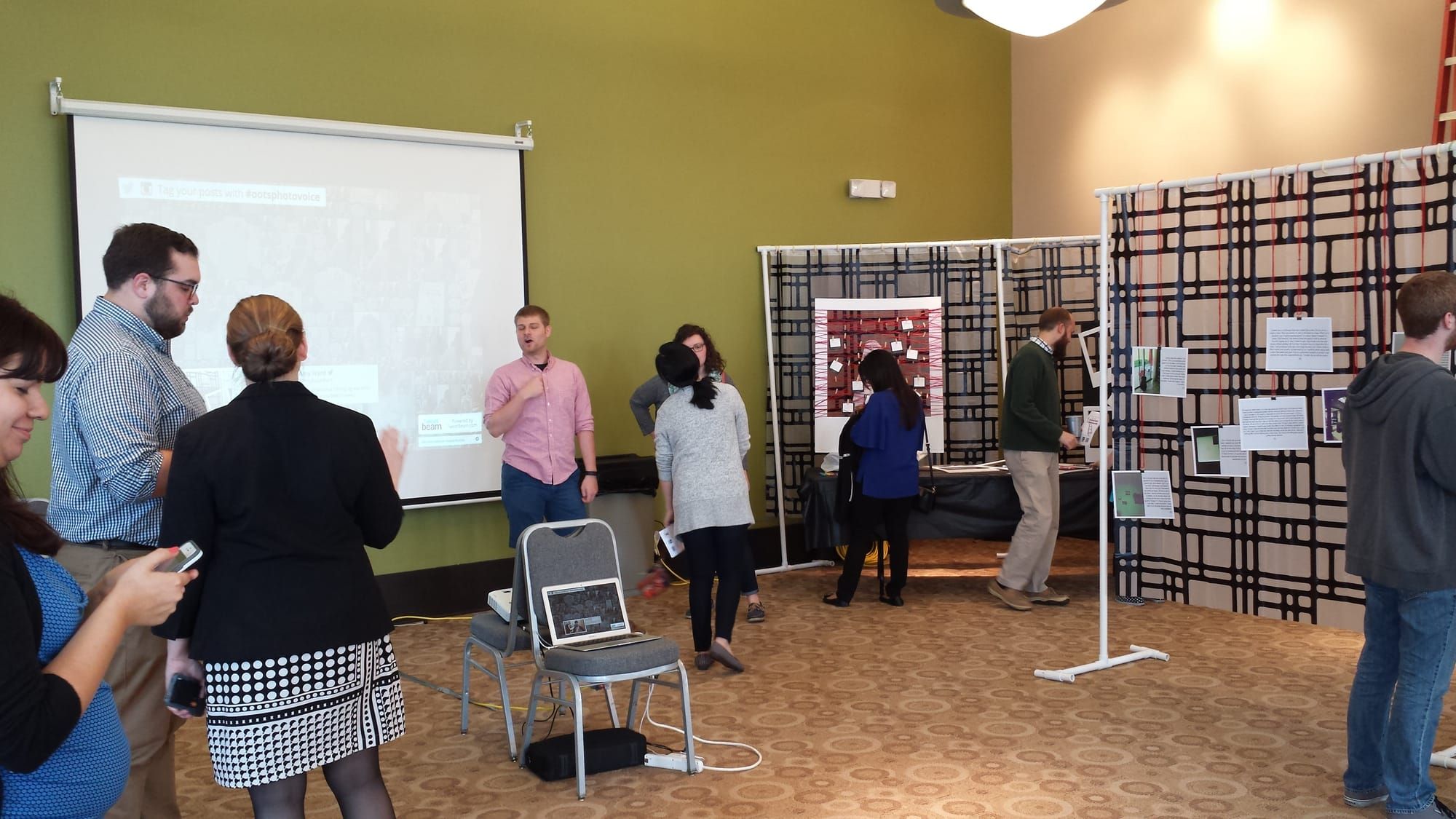
With the start of the new academic year upon us, I wanted to create a multi-part series about using photovoice as a pedagogical tool in the college classroom. My focus here will be on postsecondary education, but I have written about the photovoice as pedagogy within the middle grades. You can check out that resource here.
I have been teaching and working within higher education for the past 25 years, and I am always thinking about innovative ways to engage students in the learning process. Since 2013, I have been teaching a graduate-level course titled Community Colleges and Diversity. And in 2014, 2016, and 2018, I deployed photovoice as a pedagogical vehicle for a whole-class, semester-long project in service of student learning.
You can take a deep dive on those three projects by reading the following journal articles: here, here, and here.
In this post, I want to offer some important considerations for those who may be interested in using photovoice in their classroom. It can be a complex endeavor that requires a lot of pre-planning and includes a LOT of ambiguity. Students are always weary at first, but when done well, this approach to teaching can yield amazing outcomes you could not have dreamed of on the front end.
Let's get into it.
Is a photovoice project right for your class?
Before launching head-first into a course-based project, the course's learning outcomes/goals, content, modality, timeline must be seriously considered. The conditions must be appropriate.
First, the project must align with the student learning outcomes or goals of the course. Curriculum design involves backward mapping from the learning destination(s). What do you want students to learn, and will a photovoice project help them get there?
Ask yourself how the project will serve as a vehicle for students to reach the outcomes/goals put forward in the course syllabus. What will they actually do in relationship to the project? What will they read? What will they organize? What will they contribute? Who will they work with? What will they make, build, or create? What skills will they develop? What will they know or be able to do once the project has concluded? Do your answers have anything to do with the learning goals?
If you cannot forge a strong connection between the photovoice project and the student learning outcomes/goals, using photovoice as pedagogy may not be a good idea. If the alignment is strong, however, keep building on the idea.
Second, the project must also make sense regarding the content of the course. If you are teaching an accounting course focused on business tax planning, a photovoice project probably won't make a lot of sense. On the other hand, if you are teaching a public health course on environmental health, a photovoice project might be a terrific way to deeply connect students with real-world issues related to the topic at hand.
One way to think about this is to consider how photovoice has been used empirically within the field in which you teach. If there is a strong corpus of literature within your discipline, that is a good sign. Example fields/disciplines with a lot of photovoice studies include public health, health promotion, education, and social work. Example fields/disciplines with very few photovoice studies include economics, botany, engineering, and finance.
Third, course modality will play a significant role in the course-based project's feasibility. Is your course in-person, online, blended, HyFlex? If the course is online, is it synchronous or asynchronous?
A photovoice project can be infused into any course modality, but online asynchronous courses in particular will require a significant amount of pre-planning, transparent communication, flexibility, and organization. It may not be appropriate or realistic to require students to engage with the course—or any course-related activities—synchronously or in-person if the modality is online asynchronous. You must know your students. Full-time work, caring responsibilities, and transportation may be barriers for students. All this needs to be taken into account.
Fourth and lastly, what is the course's timeline? Carrying out a photovoice project within an accelerated four-week course may be a lot more challenging than a full 16-week semester. Photovoice projects take time. Even with a full 16-week semester, there can be temporal challenges. Consider also the number of credits associated with the course. Less should be expected of students within a one-credit course versus a four-credit course.
Do you need permission?
Deploying a photovoice project within a college course can be quite a significant departure from traditional pedagogical approaches. That said, once you have decided that a photovoice project is right for your course, run the idea by your supervisor before getting too far into the planning process.
Beyond your supervisor, you will also want to discuss the work with your institutional review board (IRB) or research ethics board (REB). This is absolutely critical if you want to present or publish the results of the project—or otherwise make the project accessible to various publics.
It may also be necessary to be in conversation with other groups or entities on-or off-campus, such as those part of the group with whom you would like to work. For example, if you are interested in a project focused on access to fresh produce within urban areas, you may want to connect with folks who coordinate, volunteer with, and frequent urban community gardens. Describe your ideas for the work and see if there is interest. It is vital to ask questions, create relationships, and build trust before entering a community—especially when there are power imbalances at play.
What role(s) will your students play?
In much of the literature about photovoice as pedagogy, students are framed as participants in the study, rather than project facilitators. To be clear, this is not how I have used the methodology pedagogically. In my experiences, students have been co-facilitators of the project who work with non-class members as participants. In the examples linked above, my students have worked with community college students and faculty as project participants.
In the work I have done, each student in my class has been matched with a participant (whenever possible), creating a one-to-one data collection/creation situation. My students were expected to orient the(ir) participant to the project, support the image making process, carry out the photo-elicited interview, clean the transcript, and play a part in the analysis process of the total data set.
Photovoice projects that frame students as researchers and participants are also interesting. While not connected to formal classrooms, this is the model used by Dr. Robin Phelps-Ward, who created Action Research Collectives at both Clemson University and Ball State University. Read more about those projects here.
In any case, you must be clear about the role your students will play. Furthermore, you must also be clear about the roles others—including you—will play in the project as well.
What training and/or professional development are necessary?
If you are going to use photovoice pedagogically, you're going to have to learn all about photovoice and you're also also going to have to teach your students all about the photovoice methodology, especially if they are going to co-facilitate the project. And that is no small task.
In addition to supporting students' understanding of the methodology, which includes understanding the underlying theory, conducting photo elicitation interviews and/or focus groups, performing data analysis, and engaging in research dissemination, they may also need research ethics training. This is necessary if the project is to be vetted by the IRB/REB. Ask the IRB/REB personnel at your institution for guidance on this.
The course curriculum will include methodological elements as well as topical content. Curating learning materials related to photovoice will be a new element of course preparation. Build in time and space within your course to ensure students have ample opportunities to learn about photovoice.
Have you used photovoice in your courses? If so, I would love to hear about it. In subsequent posts, we'll dive into a multitude of other topics germane to using photovoice pedagogically inside the college classroom.
🥹 Thanks for spending a moment with me this Friday.
💌 If you’re new here, welcome! I hope this space becomes one you look forward to each week.
📖 Interested in a book version of these posts? Check out the paperback and ebook!
📬 Have a question you want me to answer in a future issue? Reach me at photovoicefieldnotes@gmail.com. I'd love to hear from you.
Thanks for being here.
Warmly,
Mandy
photovoice field notes
photovoicefieldnotes.com