four note friday 2.48 | Tensions in Photovoice

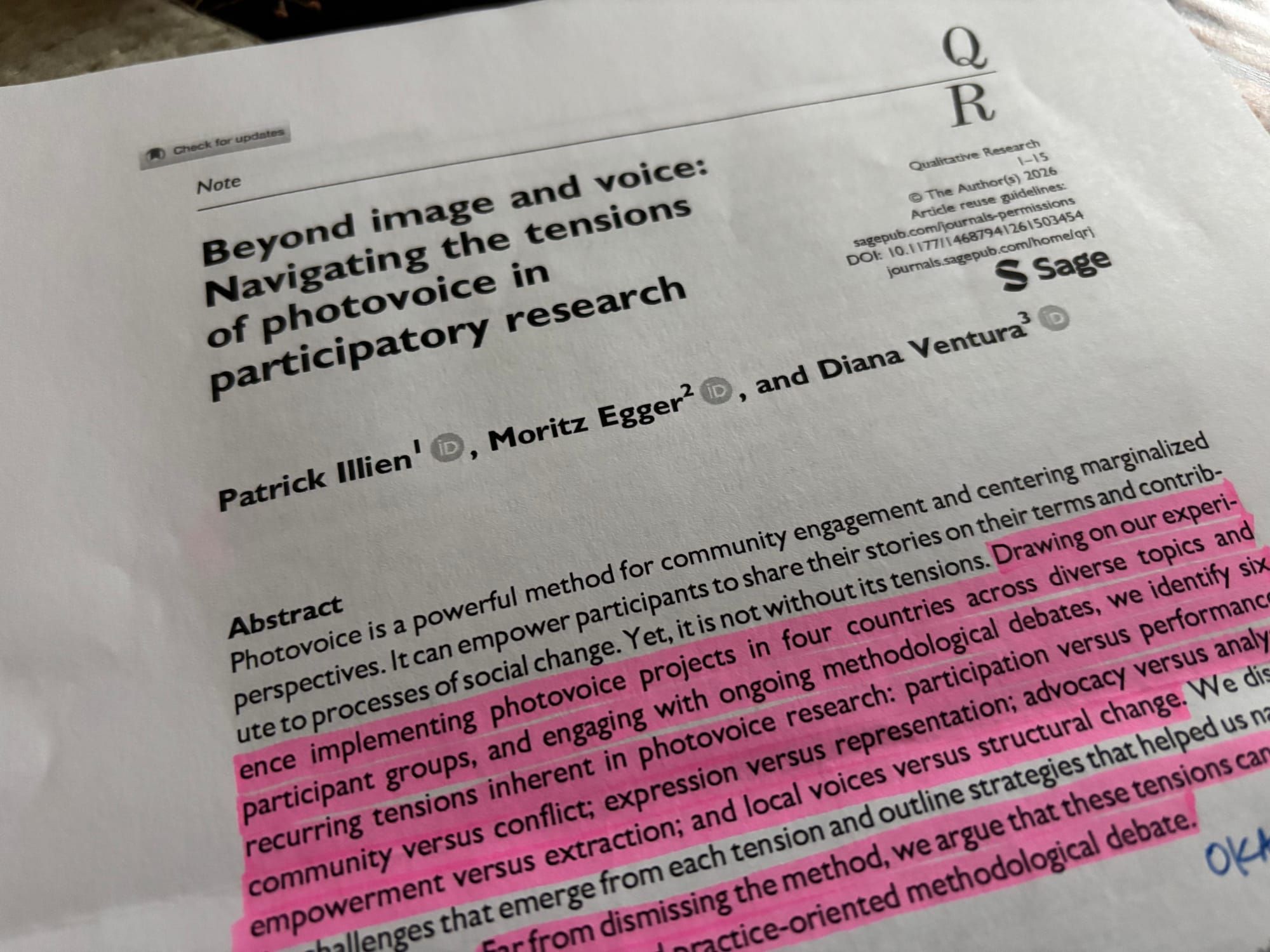
This week's post is inspired by a very recent article titled "Beyond Image and Voice: Navigating the Tensions of Photovoice in Participatory Research" by Patrick Illien, Moritz Egger, and Diana Ventura published in Qualitative Research. As always, read this post and read the original article. It's a good one. The authors list six recurring tensions often present in photovoice projects and discuss those tensions through the lenses of projects they have been a part of. They also provide possible strategies for addressing these tensions. If you have ever worked on a photovoice project where something felt sort of off, this article can be a really useful diagnostic tool.
These six tensions include: participation versus performance; community versus conflict; expression versus representation; advocacy versus analysis; empowerment versus extraction; and local voices versus structural change. The authors do not frame these tensions as a problem. Instead, they argue that dialogue around these tensions can be methodologically productive—can deepen the considerations we must engage when deploying photovoice. I agree wholeheartedly.
Below, I outline four of these tensions. They are as follows: participation versus performance; expression versus representation; advocacy versus analysis; and local voices versus structural change. When reading the piece, these were the four tensions that resonated most with my photovoice experiences.
Participation versus Performance
The involvement of policy makers early on and the potential for participants to aim to please or impress others (performance) may block authentic engagement with the project (participation). The authors asserted that trust is the key to promoting participation instead of performance.
My dissertation was a photovoice project. I defended my dissertation (written document) prior to hosting the photovoice exhibition. So while I engaged with all eight steps of the process (see here and here), some steps occurred after I became Dr. Latz. The presenting and confirming steps took place post-defense.
During the exhibition, I recall some of the participants asking me whether they had done what they needed to do such that I could earn my doctoral degree. While I do not think they performed inauthentically during the study, they earnestly wanted to know whether they had successfully played their part in the process. They had. They were all former students of mine, and I know their participation was an act of solidarity. I'd helped them along their educational journey, and they wanted to help me along on mine. Yet the experience illustrated, in part, this particular tension.
Expression versus Representation
How the project is represented can sometimes be misaligned with what the participants expressed during the narration step. Because photovoice project facilitators/researchers have a heavy hand in the curation of the work—and the exhibition by extension, key themes or findings can be downplayed and/or altogether ignored. They can also be misrepresented. In addition, "participants might struggle to capture meaningful images" (p. 5). For a variety of reasons, there can be times when the images and the narration of those images do not meaningfully connect.
Throughout the course of some of the projects I have facilitated, disposable film cameras were used. The timeframe for this projects was approximately 2009 to 2018—well after disposable cameras were in their prime and film could be readily developed and prints made in an hour.
Participants did not have the opportunity to see their images ahead of the interviews during which they narrated the images. In instances when the images did not look like the participant had intended, there was sincere disappointment. And in some cases, more striking images could have made for more visually striking exhibitions. However, the narrations of the images alongside the images are what made the exhibitions pop. The key was to help exhibition attendees understand what is meant by a photovoice exhibition—which is markedly different from a photography exhibition. Engagement with the captions is key, as the meanings of the photographs are not always self-evident.
While you can emphasize to participants that there is no wrong way to approach their image making, yet visuals are culturally imbued. They are symbolic. They can be celebratory. They can be taboo. And often, participants have been socialized to think in binaries. Right or wrong. Yes or no. One or the other. Photovoice defies either-or thinking, which can bring a unique point of tension.
Advocacy versus Analysis
Photovoice "projects face multiple pressures from practice partners, participants, researchers, and exhibition galleries" (p. 6). On the one hand, strong advocacy efforts can impede the level of analytical depth used to interpret the themes and findings. And on the other hand, deep and nuanced analysis can make the themes and findings illegible to policy makers. The themes and findings of photovoice projects should be mixed and remixed to reach myriad audiences.
While my dissertation was 80k+ words of deep analysis through a constructivist grounded theory approach, the exhibitions I hosted made no mention of the three local constructivist grounded theories developed through the dissertation. Instead, the point of the exhibitions was to shed light on how community college students construct their educational lives. Those constructivist grounded theories were for academic audiences.
On both sides of this false binary, transparency is key. Make your goals, methods, and intentions known. Consider the fruitful possibilities of an analysis that considers advocacy and advocacy that considers analysis.
Local Voices versus Structural Change
How do we honor and amplify local voices while also advocating for broader-level change? Furthermore, how do we compel those in power to listen to the voices of those closest to the issue or topic at hand? We can amplify voices all we want, but that will be for naught if no one is listening.
The authors noted that "we think that there is a tendency to overestimate the impact of photovoice activities" (p. 9). This may be true. Not all policy makers who engage with photovoice project results will have the inclination or power to instigate change. One exhibition may not be enough to spur on change.
However, large-scale structural change may not be the (only) goal of any given project. The authors point out that "by elevating marginalized voices and different epistemologies, photovoice can document injustices, challenge dominant knowledge systems, and critique technocratic approaches to, for example, sustainability" (p. 10). Furthermore, local change is foundational to broader change efforts. Plus, local change is most likely to impact the lives of those who actually participated in the project.
The authors artfully close the article with four lines I found especially useful and hopeful. They are as follows.
Depending on the circumstances, tensions will manifest differently, but if researchers are aware of them, they can embrace them with transparency, rigor, humility, and creativity. There is no one-size-fits-all approach, and the method must be continually adapted through reflexive practice. This helps avoid shallow engagement and results and can turn these tensions into assets. In doing so, photovoice becomes a craft of democratizing knowledge, not just documenting experience. (p. 11)
What tensions have arisen within your work with the photovoice methodology? In what ways do the above tensions resonate with you? Are these (false) binaries tensions in a negative sense, or can they illustrate opportunities for more both/and approaches to inquiry?
🥹 Thanks for spending a moment with me this Friday.
💌 If you’re new here, welcome! I hope this space becomes one you look forward to each week.
📖 Interested in a book version of these posts? Check out the paperback and ebook!
📬 Have a question you want me to answer in a future post? Reach me at photovoicefieldnotes@gmail.com. I'd love to hear from you.
Thanks again for being here.
Warmly,
Mandy
photovoice field notes
https://www.photovoicefieldnotes.com/