four note friday 2.43 | Photovoice and the SHOWeD Method

Earlier this week, I watched a video (recorded webinar) titled Introduction to PhotoVoice: A Tool for Community-Based Health from the Center for Indigenous Health at Johns Hopkins University. It was a fascinating presentation featuring Drs. Jonnie Williams and Dr. Miigis Gonzalez.
One of the elements of the video I found helpful was a discussion about the SHOWeD (see here and here) method as a means of generating conversation about photographs among photovoice project participants/collaborators. In other words, the SHOWeD prompting method can be useful way to facilitate photo elicited focus groups and interviews.
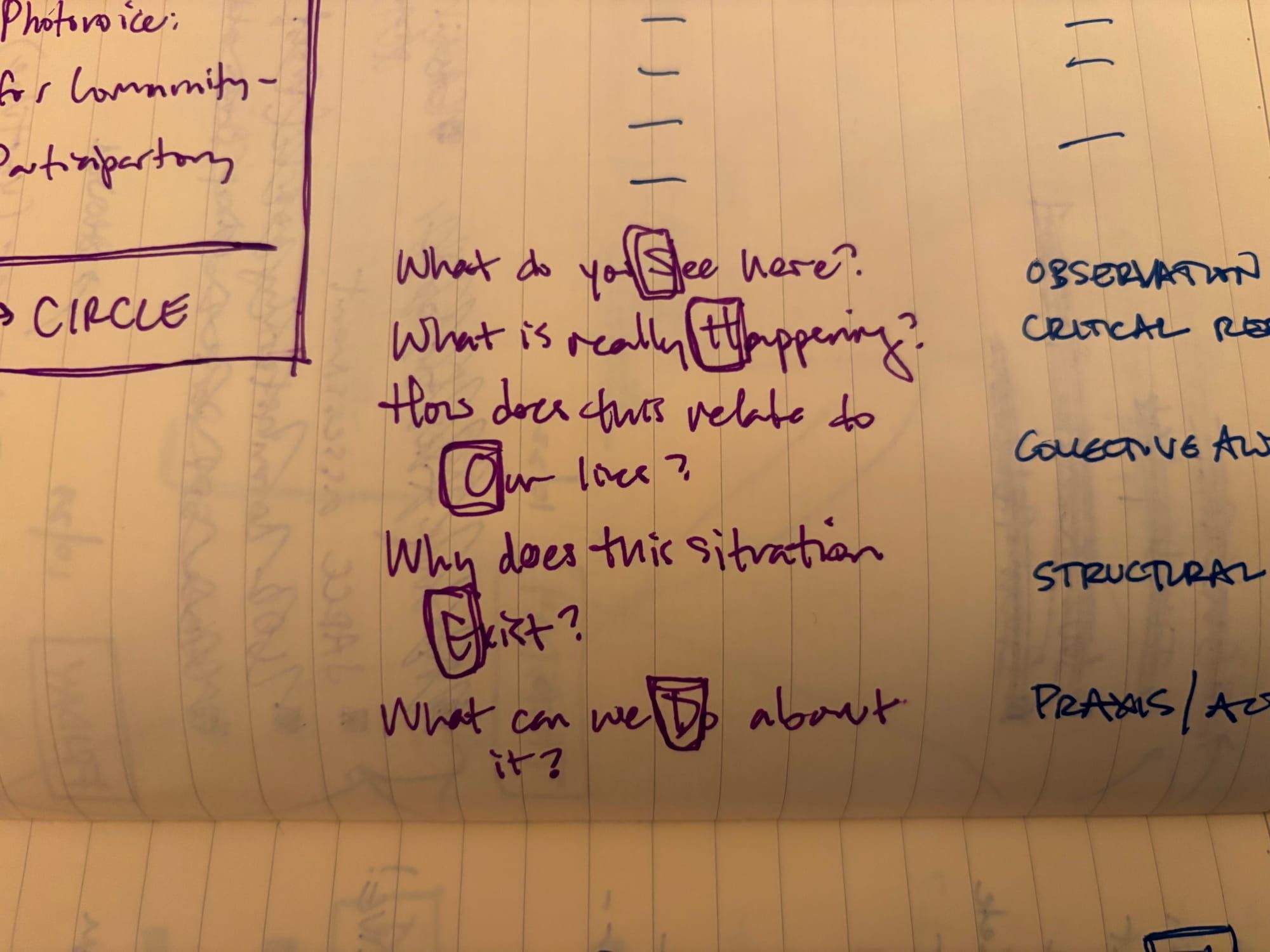
As a refresher, the SHOWeD approach is an acronym derived from the following questions. These questions can be asked as photographs are being shared.
What do you See here?
What is really Happening?
How does this relate to Our lives?
Why does this situation exist?
What can we Do about it?
In what follows, I offer four pieces of commentary on the SHOWeD method, all inspired by the video highlighted above—which you should watch.
The SHOWeD dialogue framework is connected to Freire's work on critical consciousness education.
One of the slides in the webinar showed a side-by-side list of the SHOWeD prompts and tenets of Freire's work on critical consciousness education. I've created a textual recreation of that slide below.
What do you See here? (Observation)
What is really Happening? (Critical Reflection)
How does this relate to Our lives? (Collective Awareness)
Why does this situation exist? (Structural Analysis)
What can we Do about it? (Praxis / Action)
Guiding participants/collaborators through the questions on the left, see above, as they review their or the groups' images can be directly mapped onto the processes involved in developing critical consciousness; see the bold text within the parentheses above.
Critical consciousness building among participants/collaborators is a key aim of the photovoice approach, and the photo elicitation method in conjunction with the SHOWeD dialogue framework is a powerful way to meet that aim.
The SHOWeD method is not always useful or necessary.
The deployment of any given research method can become tenuous and clunky when applied in every context. For example, in my 2017 book on the photovoice methodology, I explained that the SHOWeD method did not work within my dissertation.
When I arrived to the interviews, the participants were ready and excited to tell me stories related to their photographs. We simply reviewed the photography prompts, then they explained the contents of the photographs and how those images were related to the prompts.
While the SHOWeD dialogue framework could have been applied, it would have disrupted the organic flow and relaxed nature of the storytelling. Many of the SHOWeD questions were answered without me asking them.
One interesting item to note here is that upon reflecting on the participants' experiences through my dissertation, I argued (here) that they had not developed critical consciousness. Instead, they developed reflective consciousness. I attributed this to the focal point (the students' individual educational lives, as opposed to a community of students) of the dissertation, however, not the questioning approach.
Using PHOTO instead.
The SHOWeD method is not the only option. There are alternatives. PHOTO (see here and here) is yet another viable mnemonic device and stands for the following:
Describe your Picture. (Observation)
What is Happening in your picture? (Critical Reflection)
Why did you take a picture Of this? (Collective Awareness)
What does this Tell us about your life? (Structural Analysis)
How can this picture provide Opportunities for us to improve life? (Praxis / Action)
In my view, the PHOTO method is very similar to the SHOWeD method, and I have attempted to illustrate this by mapping Freirean concepts to the prompts above—similar to what was provided during the webinar.
As you move forward in your project design, consider which, if any, of the above prompting/questioning methods might work best for your circumstances. Changing course is a possibility with an open-ended semi-structured protocol. It is also keen to ask participants for their input on how best to prompt them to discuss their images.
Sometimes images ask their own questions.
As John Collier, Jr. wrote in 1979, images “ask their own questions which can often yield unpredictable answers” (see here, p. 274, italics in original). The point is that sometimes the images provide all the inspiration necessary to generate questions about their meanings and the intentions of the photographers.
When preparing for a photo elicited focus group or interview, it is easy to browse the images and create our own stories about those images. Those leading projects are often the first to see the participants' pictures. But, we, as project facilitators, cannot assume we know the stories behind the images. We must either make space for storytelling or ask questions that draw the stories out.
Sometimes the photographs themselves will lead us directly toward the questions we must ask as we encourage the participants to make the familiar (to them) strange and the strange (to us) familiar.
In what ways have you used prompts or questions when facilitating a photo elicitation focus group or interview within a photovoice project? Which approach do you think would work best with your project, and why? What other types of prompts or questions might be effective, and in what contexts?
🥹 Thanks for spending a moment with me this Friday.
💌 If you’re new here, welcome! I hope this space becomes one you look forward to each week.
📖 Interested in a book version of these posts? Check out the paperback and ebook!
📬 Have a question you want me to answer in a future post? Reach me at photovoicefieldnotes@gmail.com. I'd love to hear from you.
Thanks again for being here.
Warmly,
Mandy
photovoice field notes
https://www.photovoicefieldnotes.com/