four note friday 2.32 | Takeaways from "Body-ody-ody: Centering the Case of Serena Moon and Endarkened Photovoice"

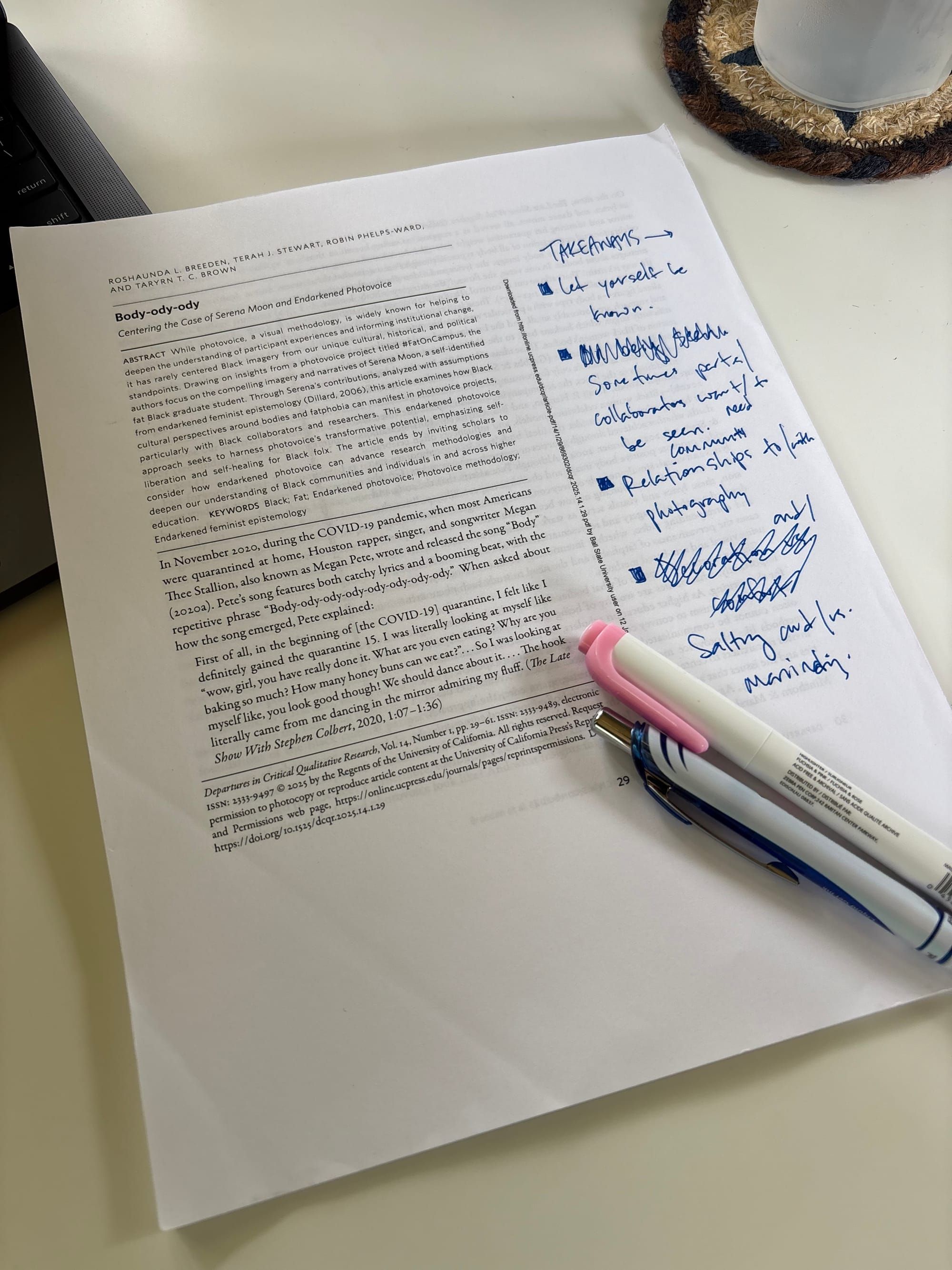
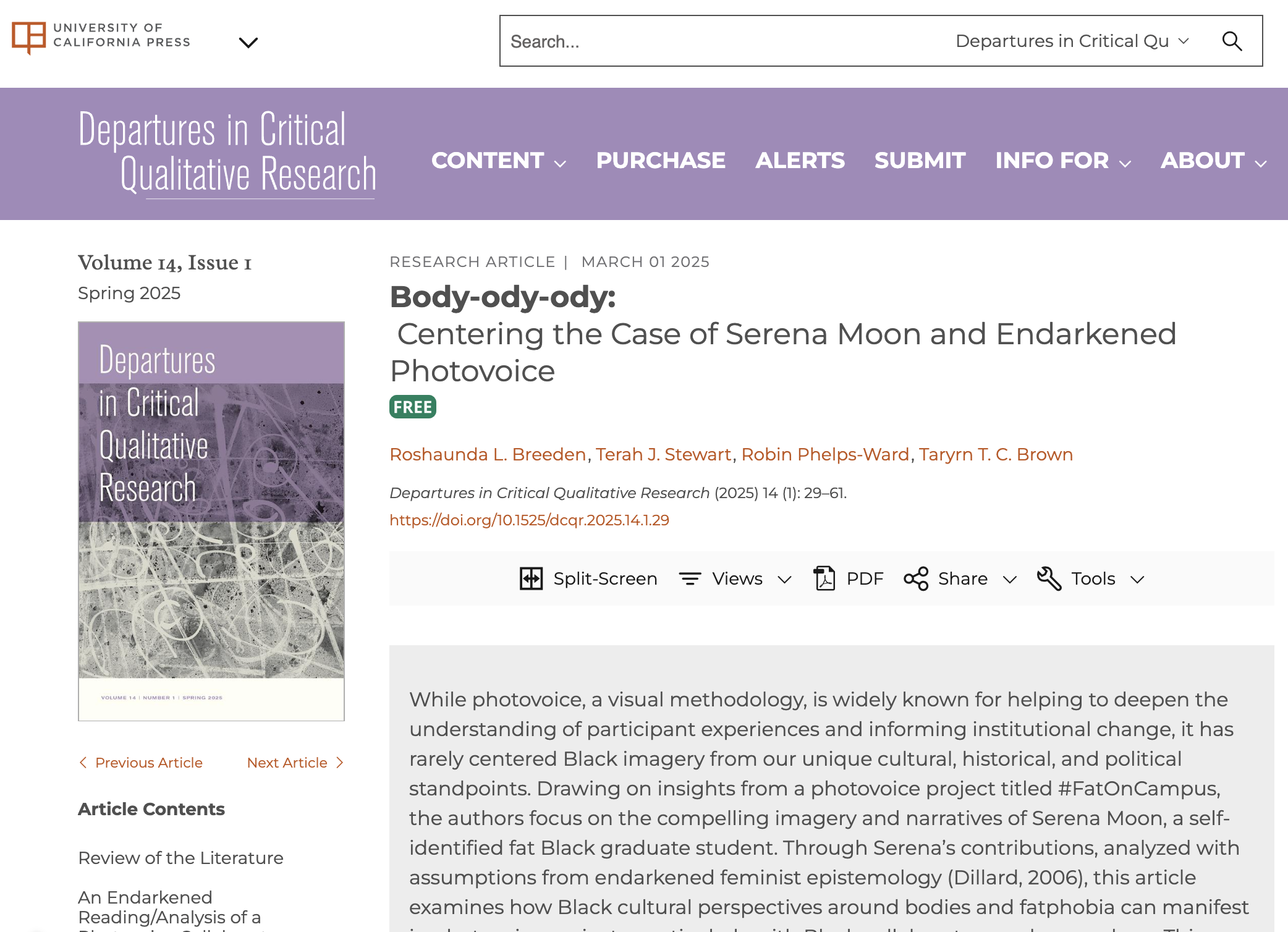
Earlier this week I read an article titled "Body-ody-ody: Centering the Case of Serena Moon and Endarkened Photovoice" by Roshaunda L. Breeden, Terah J. Stewart, Robin Phelps-Ward, and Taryrn T. C. Brown and recently (2025) published in Departures in Critical Qualitative Research. It was a smart and thoughtful piece, giving lots of fodder for deep thinking and reflection.
As always, read the article yourself so you are able to make your own meaning of its messages. The article is open-access and freely available. I will share my four takeaways here, but as Levar Burton used to say "you don't have to take my word for it."
Let me first provide an overview of the piece before getting into the takeaways. The article centers Serena Moon, a collaborator in the #FatOnCampus project. Serena stood out among other project collaborators in specific ways. Uniquely, while most participants took photographs of campus surroundings, including things like classroom seating and residence hall furniture, Serena did largely the same but also placed herself inside the images. While other collaborators kept themselves out of the frame, Serena put herself in it. She would not be invisible.
In the piece, the authors re-examined Serena's interview transcript by placing a new analytical lens on the data: endarkened feminist epistemology, or EFE. This new lens showcased the efficacy of endarkened photovoice with its theoretical tenets grounded in EFE.
Portions of the transcript were shown throughout the article. And following each portion, the authors described how the excerpts resembled or illustrated one or more of the assumptions of EFE. A total of five interview transcripts are showcased and beautifully analyzed through the lens of EFE. There is a lot to learn from this particular section of the paper, which is followed by a Discussion and Implications section and a Conclusion.
So, what were my takeaways? There was so much to love here that I had a hard time getting down to just four notes. Again, block some time in your reading schedule to engage with this brilliant work yourself.
Here is what I am taking away.
As a researcher, let yourself be known.
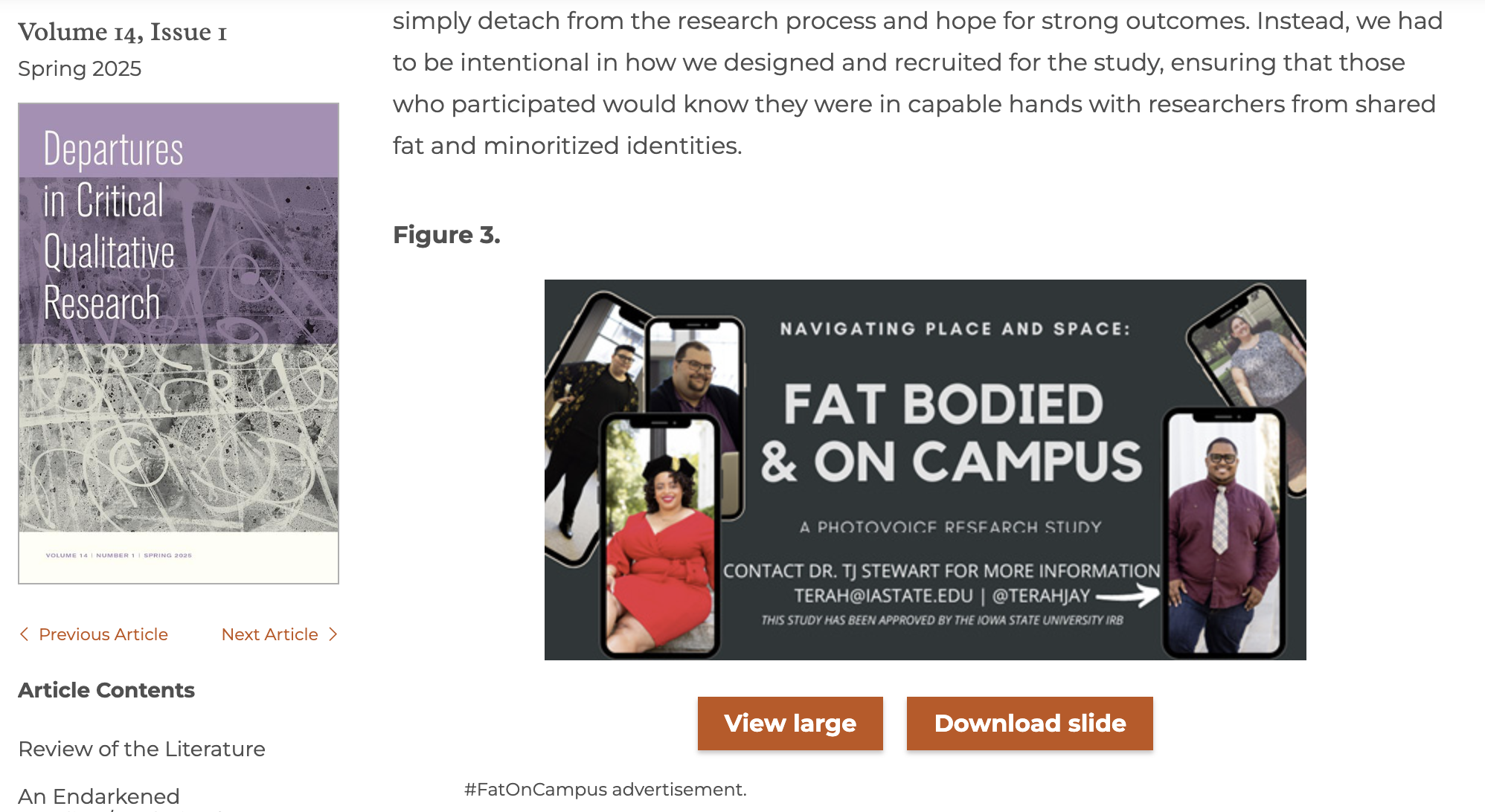
Because photovoice demands those involved in a project be in relationship with one another, we, as researchers-project facilitators must let ourselves be known. In their recruitment materials for the #FatOnCampus photovoice study, Breeden and Stewart included images of themselves (see below). In this way, they signaled empathic understandings of prospective collaborators' experiences. Breeden et al. (2025) explained:
"[W]e designed and recruited for the #FatOnCampus study in a way that communicated trust and solidarity. For example, in recruitment materials, we included photographs of ourselves along with stock photos to relate and communicate with those who share similar bodies and experiences. As a result, collaborators like Serena stated that she, like others, could easily find us and investigate our values as researchers" (p. 42).
This is so important. Any time I have worked with community college students or faculty on a photovoice project, letting folks know that I have deep experience with and respect for the sector has been essential. Communicating that you get it, whatever it may be, is valuable in starting and building a relationship within the context of a critical participatory action research project.
Furthermore, who you are a researcher matters. Your axiological commitments—communicated through your scholarship, online presence, interpersonal relationships, and beyond (certainly not an exhaustive list)—matter. Let yourself be known such that potential participants can make an informed decision about whether they'd like to be in collaboration (i.e., relationship) with you.
How do you do this? One idea is to provide a link to a researcher biography within your recruitment material. Another is to create a recruitment video and introduce yourself in a partially embodied way. And, borrowing from the #FatOnCampus project, you could include a photograph of yourself in the recruitment materials. Think about the context of your project and what might matter to those eligible for the study. Iterate from there.
Sometimes collaborators-participants desire to be seen.
Serena Moon featured herself prominently in the photographs she took for the #FatOnCampus project. As I mentioned above, she refused to render herself invisible within her images.
I've worked on many projects wherein others have done the same. Reading this paper made me think differently about the choices I previously made in response to those who refused invisibility. Research ethics are not neutral.
Confidentiality matters, yet we need to probe at our assumptions about it. Do we disregard photographs that contain whole bodies with full faces in focus? Why, or why not? While Serena Moon appeared in her photographs, her face and other identifying elements (as well as what I think were trademarked/copyrighted imagery/material such as corporate logos) within her photographs were blurred in this article. This represents a visibility compromise. It's one researchers often must make. It represents the nexus of a collaborator's desire to be seen and researchers' responsibility to do no harm.
We must ask ourselves about the potential harms of rendering participants visible and/or invisible. And then we must be in communication (and often in compliance) with institutional review board (IRB) or research ethics board (REB) chairpersons/office staff members, conference leaders, journal editors, and others.
Researcher actions around collaborators-participants' desire to be seen are hard to discern. Critical questions must be asked—of yourself and of others. Get curious, consider the axiological commitments of the work, and act accordingly.
Consider the community's relationship to/with photography/imagery.
All communities have relationships to/with photography/imagery. The key is knowing what that relationship is and honoring it throughout the photovoice project process. Breeden et al.'s (2025) paper includes a section in the literature review titled Black People's Complicated History with Art and Imagery. They wrote that "white-generated imagery through art, photography, and film was and still is used to subjugate and dehumanize Black people" (p. 33). Knowing about and understanding a community's relationship to/with photography and imagery is vital in the context of photovoice.
Earlier this week, I spoke with Dr. Subarna Basu about her dissertation wherein she collaborated with Kindergarten teachers to better understand their experiences with purposeful play using photovoice. We discussed how the teachers had already been using photography throughout their pedagogical practice as a way of documenting purposeful play and student learning (let me tip my hat here to Angela Stockman's work). As such, the methods involved with photovoice were quite natural and intuitive to the teachers involved. This community had an existing relationship photography—and it was very similar to how photography is leveraged in photovoice. Think showing and telling.
That preexisting and generally positive relationship to photography/imagery was a methodological lubricant for Dr. Basu's project. Yet that is not always the case. As we can glean from how photovoice has been adapted over time (with endarkened photovoice being a recent example), not all communities are as receptive or open to photography-enabled documentation or meaning sharing/making.
Know the difference between salting and marinading.
Adding salt to a dish takes a brief moment of time—a few seconds at most. A dash of salt atop a dish just prior to consumption can add a bit of flavor, help a thing taste more like that thing. Yet the seasoning may be uneven and require subsequent dashes throughout the meal.
Yet when a dish is marinaded, it takes a while. A marinate is not simply added; a marinade subsumes the dish. And the marinade does not set on top of the meal—it gets into it, deeply, thoroughly, evenly.
So it goes with theory and research. Breeden et al. (2025) asserted that "aligning with EFE is not about superficially inserting these assumptions into a paper like adding salt . . . it means allowing EGE to genuinely guide (think: marinate) research decisions and power dynamics." (p. 55).
Know, name, and explain the theories guiding your photovoice project. This includes the theories underpinning your deployment of the methodology and the (family of) theories used throughout the project to make sense of your topic.
Theory is not an afterthought. It needs to be a part of the project's entirety. It is the marinade, not the salt.
Like I mentioned above, read the article. It is excellent and will give you much to consider.
In addition, if you are headed to the Association for the Study of Higher Education (ASHE) this fall, please check out the workshop titled Inquiry in the Dark: Discovering, Dissecting and Directing an Endarkened Photovoice Methodology. The first three authors of this article will be facilitating. Do not miss this amazing opportunity!

🥹 Thanks for spending a moment with me this Friday.
💌 If you’re new here, welcome! I hope this space becomes one you look forward to each week.
📖 Interested in an analog or differently digital version of these posts? Check out the paperback and ebook.
📬 Have a question you want me to answer in a future issue? Reach me at photovoicefieldnotes@gmail.com. I'd love to hear from you.
Thanks for being here.
Warmly,
Mandy
photovoice field notes
photovoicefieldnotes.com