four note friday 2.25 | EASNIE Photovoice Project Take-Aways

For the past year or so, I have been working with the European Agency for Special Needs and Inclusive Education (EASNIE) on a large, multi-country, and multi-site photovoice project focused on learner's social-emotional experiences within school environments. It was an amazing experience, and I loved working with all involved, especially Margarita Bilgeri and Katarina Todorva who invited me into the work.
My role in the project was to lead the school representatives through a photovoice workshop, helping them get a sense of the methodology. I also assisted with providing a framework for policy change; see here. The EASNIE website is full of resources related to this work. For example, here is a link to a video I created about working with the photovoice methodology. Here is a link to a handbook on implementing photovoice within school contexts. And, here is a link to a document that showcases the photovoice projects completed across five different European countries.
The project culminated with a final webinar, which took place on June 2, 2026. The recording should be finalized and uploaded to the EASNIE website very soon. It was an outstanding event featuring student-generated presentations. I am very proud of having been a part of this important initiative, which led to meaningful and useful results—all of which honored the students' school experiences and amplified their perspectives and voices.
In what follows, I share four take-aways from my experiences with EASNIE. I am missing the work already and wish I could have been more intimately involved. I am so glad to have said yes.
Say Yes
When I first received the email from Margarita inviting me to the project, I almost said no. Saying no is very hard for me, as it is for many of us in education. Our instinct is to give. But I have been building my no muscle—to the point where no was almost my default at the time. Our time and attention are precious, and I have come to appreciate that more and more as I grow older. But I am so glad I gave the message my attention and time. Upon learning more, I knew it was an opportunity to do something meaningful and important.
My yes was really a hell yes. So I said yes.
This experience reminded me that saying yes is still a viable option. An option to be considered. I have immense gratitude and appreciation for all those with whom I got to interact through this year in service of this work.
I can and should say yes. Sometimes.
Let Learners Lead
In my experience as an educator, I have consistently found that students will absolutely blow your mind if you create a foundation and ask them to build on it. That happened during this project—and not only with the learners who participated in the study. It also happened with the school leaders and teachers who opened themselves to trying something new (i.e., facilitating a photovoice project alongside their students).
Ahead of the workshop, we gave the school leaders and teachers a homework assignment. See below for the instructions, which were sent out in an editable slidedeck.
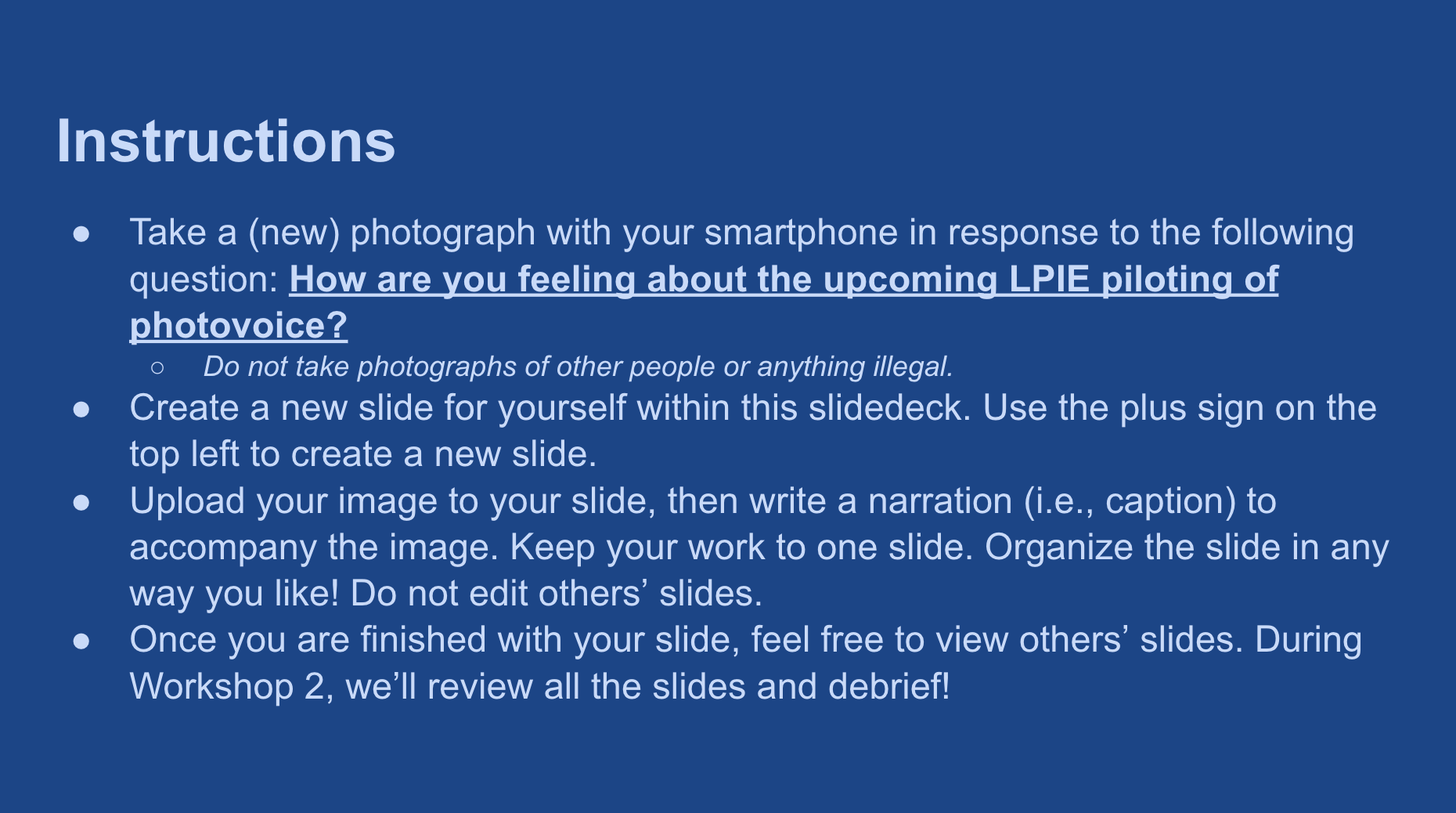
Here are the instructions in writing:
- Take a (new) photograph with your smartphone in response to the following question: How are you feeling about the upcoming LPIE piloting of photovoice?
- Do not take photographs of other people or anything illegal.
- Create a new slide for yourself within this slidedeck. Use the plus sign on the top left to create a new slide.
- Upload your image to your slide, then write a narration (i.e., caption) to accompany the image. Keep your work to one slide. Organize the slide in any way you like! Do not edit others’ slides.
- Once you are finished with your slide, feel free to view others’ slides. During Workshop 2, we’ll review all the slides and debrief!
During the beginning of the workshop, we viewed the slides, invited further narration, and then discussed how the school leaders experienced the activity. I had no idea how the activity was going to go, but I should have known better. It was marvelous. When you invite learners to lead, they really will blow your mind.
They expressed expectancy, excitement, positivity, and uncertainty, confusion. All to be expected. Their images were gorgeous, unique, curious, symbolic, and metaphorical. Through the activity, we had the chance to know each person and how they were feeling a little bit better. This was the start of a trusting community of educator-learners about to do something new together.
At the close of the webinar, which took place on June 2, and once we had the chance to see the students' work, my mind was blown once again. Not only did the students co-create the photovoice projects and the attending exhibitions, many also created videos about their experiences. This was a treasured—albeit unexpected—output of the work, which will undoubtedly go a long way in terms of impacting policy, the proliferation of photovoice within school settings, and more.
Balance Structure with Non-structure
It was through this project that the importance of some-but-not-too-much structure came right to the surface of my thinking about the photovoice methodology. I have really come into understanding the importance of menus within photovoice projects as a means of encouraging participation—beyond data generation.
Instead of inviting participation by asking simply questions like What should this project be about?, What should we take pictures in response to?, and How do we share the project once we have finished?, ask those questions and follow-up with a short list of potential answers. Picking something based on three options is a lot easier than picking something from a list of 50 options—or no options at all. Out-of-the-box thinking is wonderful, and it should come after inside-the-box thinking.
This need to balance structure with non-structure also came through as a practical methodological recommendation from the EASNIE project (see page five here). A delicate dance between guidance and creative freedom was necessary for the project to unfold successfully.
Relationships Are Everything
Engaging in photovoice work requires a context. And that context must be co-constructed with all parties involved. It involves building relationships through clear, caring, and thoughtful communication. It involves building trust. That means you need to do what you say you are going to do—and communicating when you cannot because we are all human. You must follow through and showcase your care for the project and the various people involved—especially the participants. Building a conducive context within which the photovoice project is carried out involves time. A lot of time.
Building relationships is inefficient. Successful photovoice projects require ample time, focus, and energy. There is a lot of pre-work, pre-planning, and early collaboration. Creating the data corpus can take several weeks. Patience is required when executing the exhibition(s) and working the policy window. And each step of the process involves being in right relationship with a variety of people and groups. The quality of those relationships makes all the difference.
The relationships you build with other people when working together on a photovoice project can be deep, powerful, and life-changing. When in doubt, circle back to the people and consider how your actions will impact those relationships. An exquisitely planned photovoice project will fail miserably if the relationships between those involved are not nurtured and cared for.
Saying yes this this consultancy opportunity was a good choice. A very good choice. It has been a joy and privilege seeing the work unfold over the course of about a year. The work created and shared by EASNIE is invaluable to those seeking to do similar work inside myriad school contexts. I implore you to have a look for yourself.
🥹 Thanks for spending a moment with me this Friday.
💌 If you’re new here, welcome! I hope this space becomes one you look forward to each week.
📬 Have a question you want me to answer in a future issue? Reach me at photovoicefieldnotes@gmail.com. I'd love to hear from you.
Thanks for being here.
Warmly,
Mandy
photovoice field notes
photovoicefieldnotes.com