four note friday 2.22 | What is auto-photovoice?

Earlier today, I read a journal article titled Auto-photovoice: A Reflexive Extension of Photovoice Methodology and Its Practice in a COVID-Quarantined Community Psychology Course recently published in the American Journal of Community Psychology (2026). This was my first time encountering the phrase auto-photovoice, so I wanted to learn more.

Perhaps more than an adaptation of the photovoice methodology, this piece represents an interesting application of photovoice as pedagogy. A photovoice project—co-designed by the faculty member and students enrolled—was embedded into an online graduate seminar in community psychology that took place during the pandemic, the summer of 2020.
The exhibition of the project came in the form of a website; see here. The site provides an overview of photovoice, images and captions from the project, and a space dedicated to taking action. These suggested actions are framed using an ecological frame work, which was useful. Even though we are now more than six years on from the pandemic, many of these suggested actions are valuable ways to interrupt inequities in a broad sense.

Within the four notes below, I outline my main take-aways from the piece, which I found really interesting. As always, reading this post is not meant to be a substitute for reading the article featured here. Give Mankowski et al.'s (2026) piece a read!
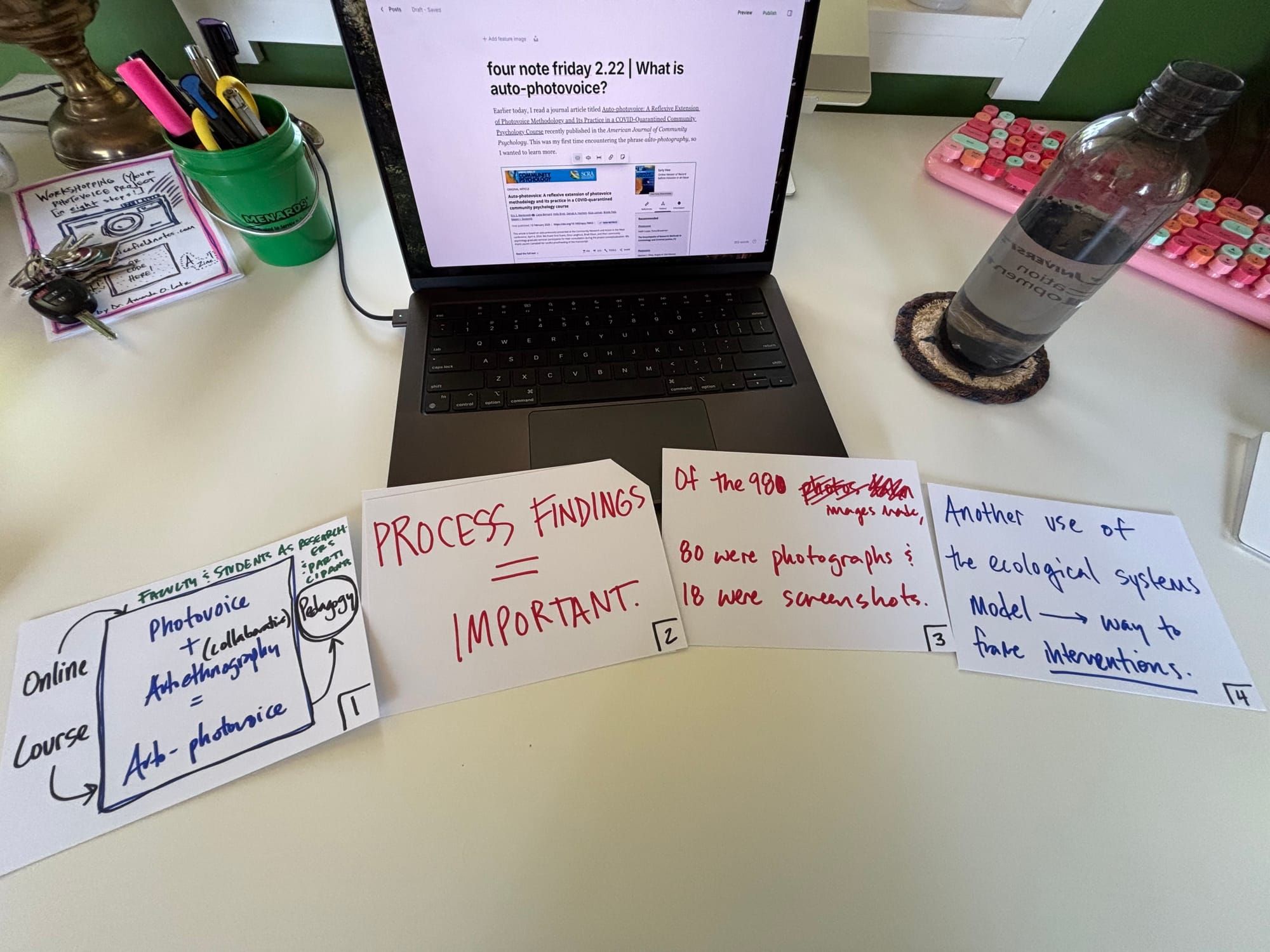
Photovoice + Collaborative Autoethnography = Auto-Photovoice
The simple math equation above sums up how I am conceptualizing auto-photovoice as a reflexive adaptation of photovoice. Though in the article, the equation was more like this:
Online Course (Photovoice + Collaborative Autoethnography) = Auto-Photovoice as Pedagogy
Either way, here we see yet another photovoice adaptation presented within this article, termed auto-photovoice.
Just how participatory does a photovoice project have to be, exactly, before it becomes an auto-photovoice project? That is an unanswered question that has been rolling around in my mind since reading this piece.
I suppose in a sense that the participants in the study (i.e., the faculty member and graduate students in the course) were deeply embedded in all phases of the project from the start had a significant impact on the total framing of the project. However, might this simply be a highly participatory and collaborative photovoice project deployed as a pedagogical tool? Maybe.
I am still thinking about these questions, among other.
Before moving on, it should be noted here that auto-photovoice is different from auto-photography (or autophotography) and the work of Robert Charles Ziller (see here, for example). I wrote briefly about auto-photography in my book, and how it, in some way, paved the path for photovoice—tracing the ways photography has been used within the various disciplines over time.
Process-related findings within photovoice projects are really important.
That the authors included two process-related findings as part of the paper delighted me. People who participate in photovoice projects typically experience some kind of meaningful benefits related to personal change/growth/development/critical consciousness building and also gain some tangible skills related to project management, critical reflection, communication (by no means an exhaustive list).
Sense of community and empowering pedagogy were the two process-based findings elucidated in the paper. Regarding the first finding, the work the class engaged in through the course encouraged a greater sense of community than what may have been typical in another, similar course. This was significant considering the timing—during the pandemic isolation was widespread. Regarding the second finding, the authors explained "empowerment was experienced through the discussion of our strengths as graduate students and ways in which we can address our concerns about the inequitable impacts of COVID‐19 and concerns in our community more generally, using our skills and resources available to us" (p. 10). Empowerment is a core tenet of pedagogies used within community psychology classes, thus making this pedagogical use of photovoice here particularly appropriate and useful. The feeling of empowerment catalyzed the creation of recommended actions based on the study, which are published within the paper and online.
Again, I was thrilled to see process-related findings, which we might also think of as methodological findings, within this piece. Too little attention is given to this vital component of photovoice work.
Do screenshots count as photographs within photovoice projects?
The authors noted that of the 98 images generated through the project, 18 of them were screenshots. Of those screenshots, most were news articles related to stories about the pandemic.
So, how to photovoice facilitators, groups, or teams make decisions about what constitutes a photograph?
Do screenshots count? Why wouldn't they count?
[Within photovoice projects, nearly all screenshots would be protected under Fair Use. See here and also check with your IRB/REB. Consider also checking in with a librarian as well.]
Within photovoice, the photographs matter. They really do. But what matters most is providing folks with appropriate vehicles to share their ideas, experiences, and meanings in ways that work best for them. People are experts in/on their own lives. They know which vehicles will work best when sharing their ideas, experiences, and meanings. Before asserting that screenshots don't count, get curious, and ask questions. Involve participants in decision making along the way.
My best advice is to have conversations early and often about photography/image making parameters. Provide participants with as much information as possible about the use(s) of their images and how ethical considerations and privacy concerns may play a role.
Years ago, one of my doctoral students was engaged in a photoovice project focused on food insecurity among community colleges students. She encountered instances of participants uploading screenshots taken on their phone, and some of those included images from the participant's banking app. In this case, it was critical to review the images for information that should not be shared or made public (e.g., account numbers).
In another example, if a participant uploads a series of images taken from a Google Images or lots of clip art that does not appear to be royalty-free and does appear to have copyright protections, that's another story altogether.
Ecological models continue to be important within various stages of the photovoice process.
As I have written about before, using ecological models as photovoice project thinking tools can be extremely helpful.
In this particular application, the authors used the ecological systems model to frame their interventions (i.e., their responses to the question what can I do?/their recommendations).
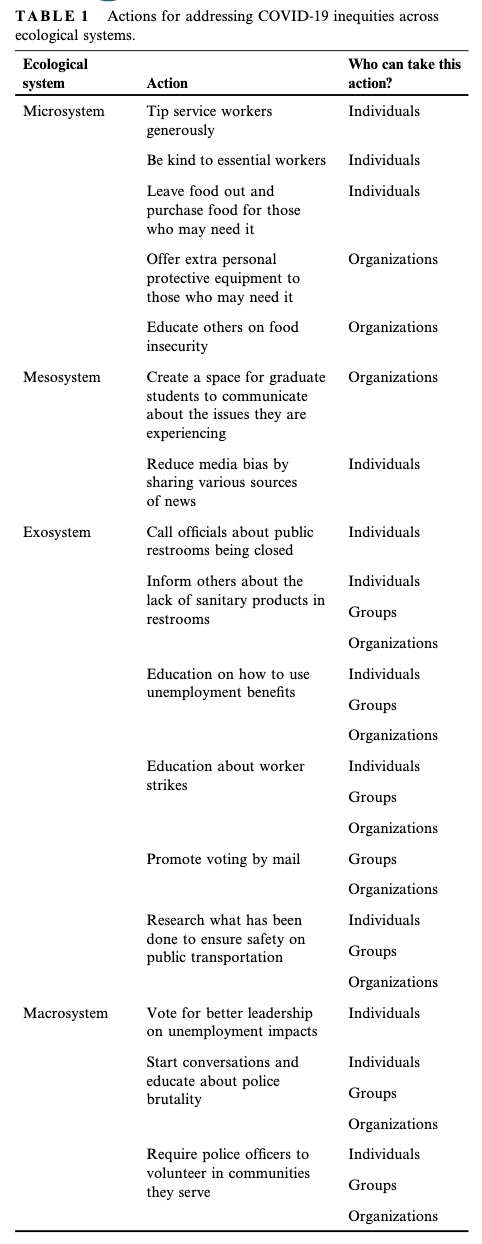
Page 6 of their paper includes a table (see below), which lays out actions for addressing COVID-19-based inequities, partitioned by level/layer within the ecosystem: the microsystem, mesosystem, exosystem, and macrosystem.
Thinking in terms of ecological models can be a useful heuristic when trying to make sense of a long list of actions/recommendations based on a study's findings. The authors of this paper take yet another step in the organization of actions process by adding a column in the table showing who can take the recommended step (individuals, groups, organizations). See below for a look at their table.
As you may know, I am considering a second edition of my book, and the recent scholarship out there on photovoice that has leveraged the utility of thinking in terms of ecosystems will be highlighted if/once a second edition is a go.
🥹 Thanks for spending a moment with me this Friday.
💌 If you’re new here, welcome! I hope this space becomes one you look forward to each week.
📬 Have a question you want me to answer in a future issue? Reach me at photovoicefieldnotes@gmail.com. I'd love to hear from you.
Thanks for being here.
Warmly,
Mandy
photovoice field notes
photovoicefieldnotes.com