four note friday 2.21 | Photovoice Workshop, Day 2 Reflections

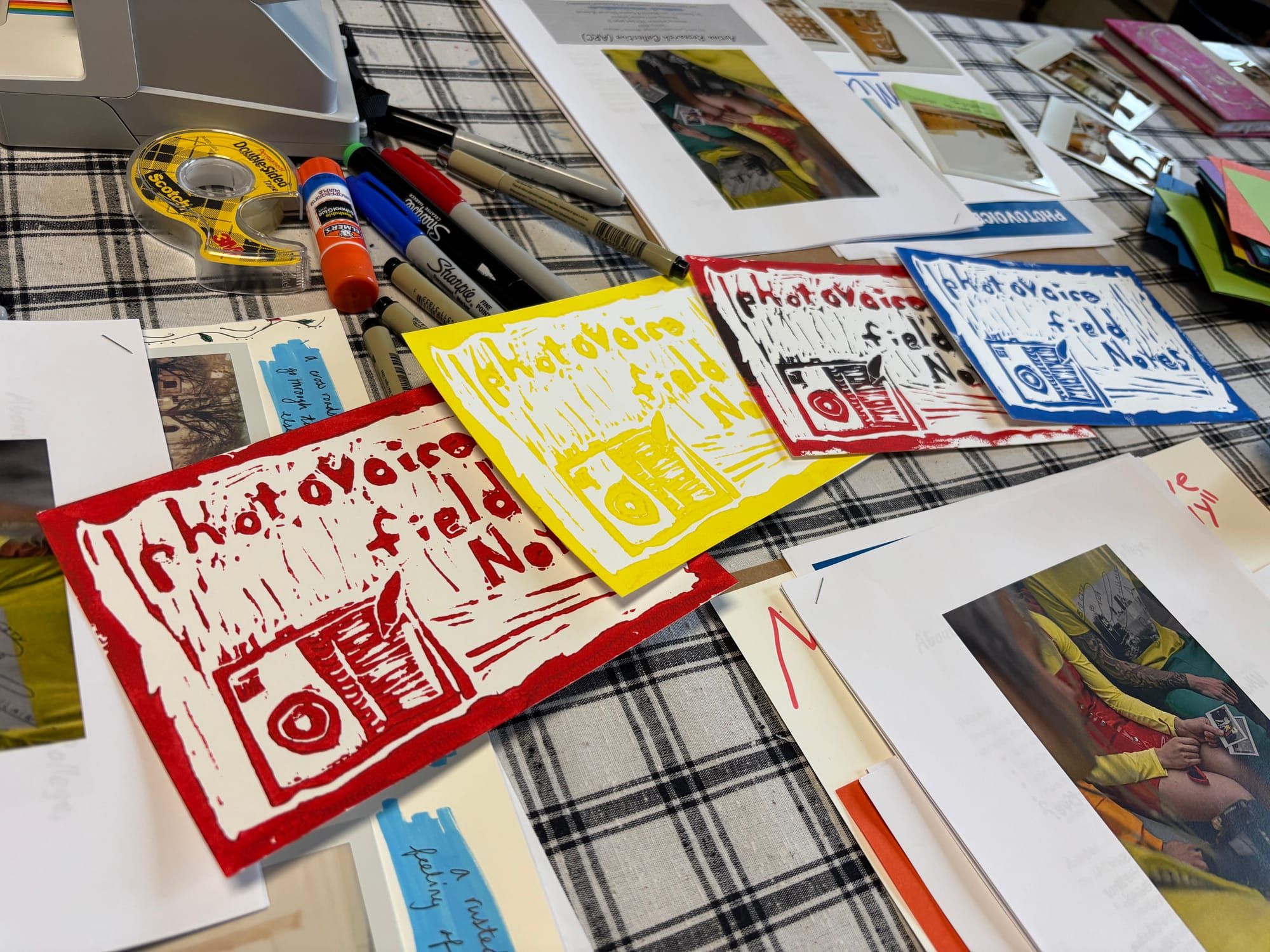
As promised last week, this week's post is dedicated to sharing ongoing reflections on the photovoice workshop I hosted last weekend. The event was such a blast overall—I miss the space, and I miss the people. The workshop was limited to six attendees; three people attended. And it was perfect. It was an ideal number, one that gave us the chance to really know one another. We had a unique opportunity to genuinely come together as a group and work through ideas and experience deep learning together. I just loved it.
Each attendee brought with them a specific project concept, so the learning was immediately contextualized within their individual project frames, which enhanced the experience for all. This was a key bit of learning for me going forward—asking attendees of such intensive workshops to purposefully attend with a project to workshop.
Within the four notes that follow, I will outline some additional reflections on the experience. Immediately following the workshop, I sketched out these notes in brief, which gave way to brainstorming new and different ways to deliver the workshop. That said, stay tuned, as some additional offerings may pop up on the website, which is in sore need of an update at present, in the coming weeks.
Practicing being a participant really matters.
One of the elements I infused throughout the workshop was placing the attendees in the role of participating in a photovoice project as a participant/collaborator/co-researcher to build empathic understandings of what that is like.
It's one thing to imagine what it would be like to be a participant in a photovoice project, but it's quite another to go out and actually do it.
Throughout the workshop, we did this in two ways. And I should emphasize again that we engaged in 100% analog photography using instant cameras. In fact, we hardly engaged with our phones at all; we were deeply in each moment. First, I asked the attendees to introduce themselves twice at the start of Day 1. The first time, it was strictly verbal. They responded to the questions who are you, and why are you here? Good, good, good. Second, I asked them to take a selfie without themselves in the photograph, which we would then use as an introductory elicitation device in a second round of introductions. As you can imagine, the introductions were different. The second round was more much interesting—another layer of selfhood was exfoliated and shared out. Anticipation built in the making, too. What is everyone's selfie going to look like? Afterward, we debriefed with the following questions, which generated fruitful discussion from which to move into the next sections of the workshop:
- What processes did you use to create your various introductions? How did they differ, if at all, and why?
- What did the various introduction activities feel like? How did those feelings differ, if at all, and why?
- In what ways can you map the relationships between the processes you engaged in and the feelings you had?
- Why might any of the above matter in the context of photovoice?
- What might this experience have taught you about photovoice? And how might that learning be applied?
Then later, toward the end of the Day 1, we engaged in an activity I termed Scrapbookvoice Lite. Attendees walked around outside the workshop space/building and were encouraged to take an entire roll of instant film. They took photographs in response to the prompt, which we jointly agreed on: What are your initial and enduring impressions of Muncie, Indiana? They then created scrapbook pages that included their (selected, not all) photographs, captions, and other visual elements (titles, color, borders, frames). See below.
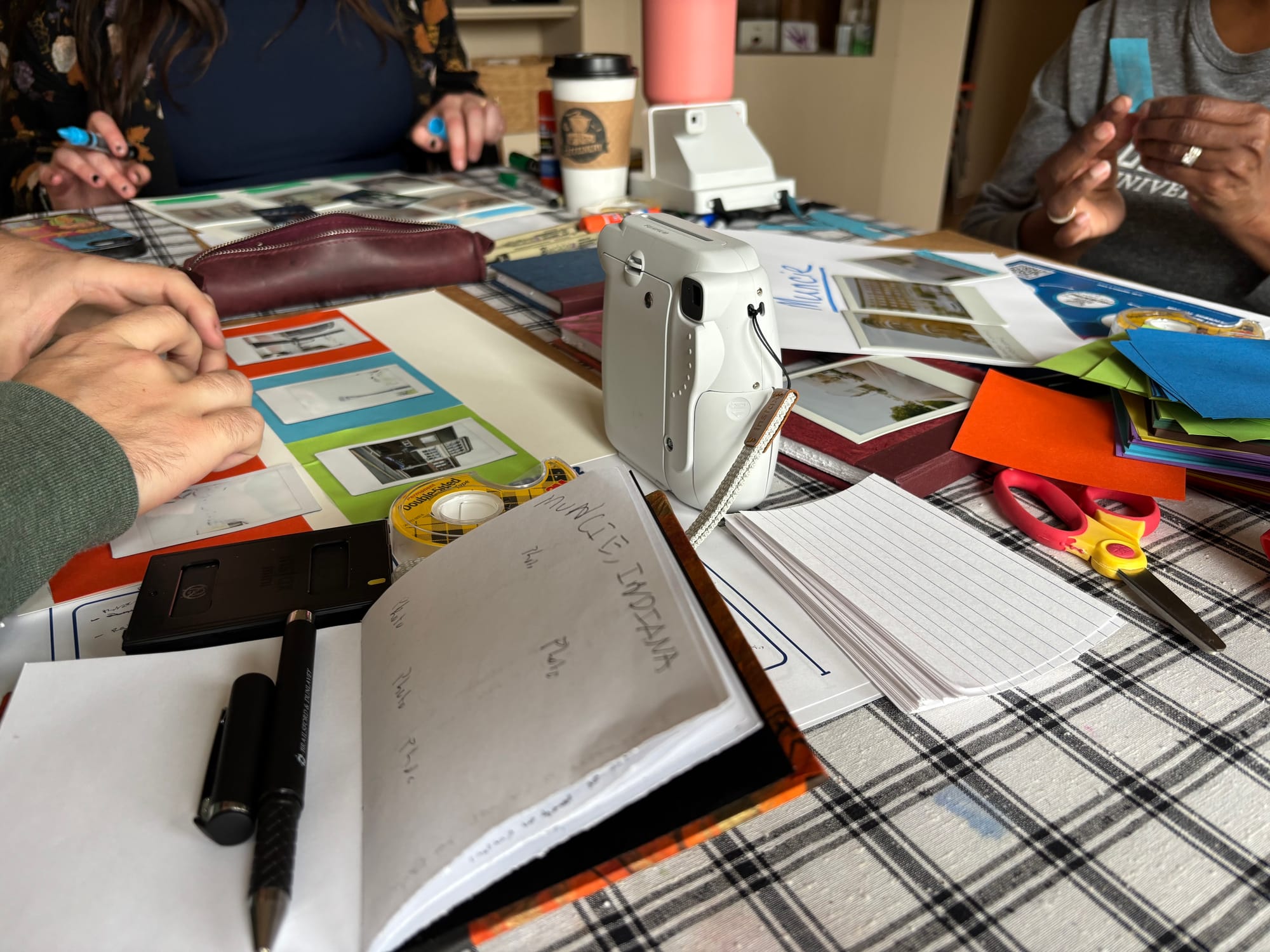
After everyone completed their scrapbook pages, we each shared and together engaged in a short focus group activity. After doing so, we brainstormed and then articulated three main themes, which we converted into findings, from which we then built recommendations.
Undergoing this process was eye opening. Each attendee got a strong sense of how the process can work from the perspective and vantage point of a participant, which is invaluable when building out their project's details.
Even a short photovoice simulation exercise can yield important findings and recommendations.
Building on from the note above, through engaging in a miniature-scale photovoice project across the two days, it became clear to me that important and actionable insights about any given topic can be generated from even a short photovoice simulation (i.e., scrapbookvoice lite).
Within the span of a few hours, the four of us really dug into the question What are your initial and enduring impressions of Muncie, Indiana? Our scrapbookvoice lite activity yielded three themes, three findings, and three recommendations. Ahead of the focus group, we established the policy makers we wanted to reach: Muncie Downtown Development Partnership (the workshop space was in the downtown), Chamber of Commerce, and the Mayor's Office. This framing helped focus our process.
While this was a simulation, the power of the exercise was evident in the quality and compelling nature of our data, the novelty and precision of our findings, and the real utility of our recommendations. I was very impressed with what we did in a very short period of time. Our simulation showed the potential of photovoice to encourage change. And this small project, if framed as a pilot study, could have prompted a more robust and comprehensive photovoice project, engaging more participants in different neighborhoods around the city.
Keep visual teaching materials as simple as possible.
There is a figure in my book that I am now completely rethinking. While I do not have the exact page number on hand right now (and I honestly do not want to revisit the image), it encapsulated my thinking—at the time—about what a complete conceptual framework for a photovoice study might look like. It was busy, overdone, and confusing. Perhaps at the time I, too, was busy, overdoing it, and confused (smile).
One of the attendees pointed that out upon/after complimenting the simplicity of the eight steps visual I created a few months ago and handed out in hard copy at the workshop. See below.
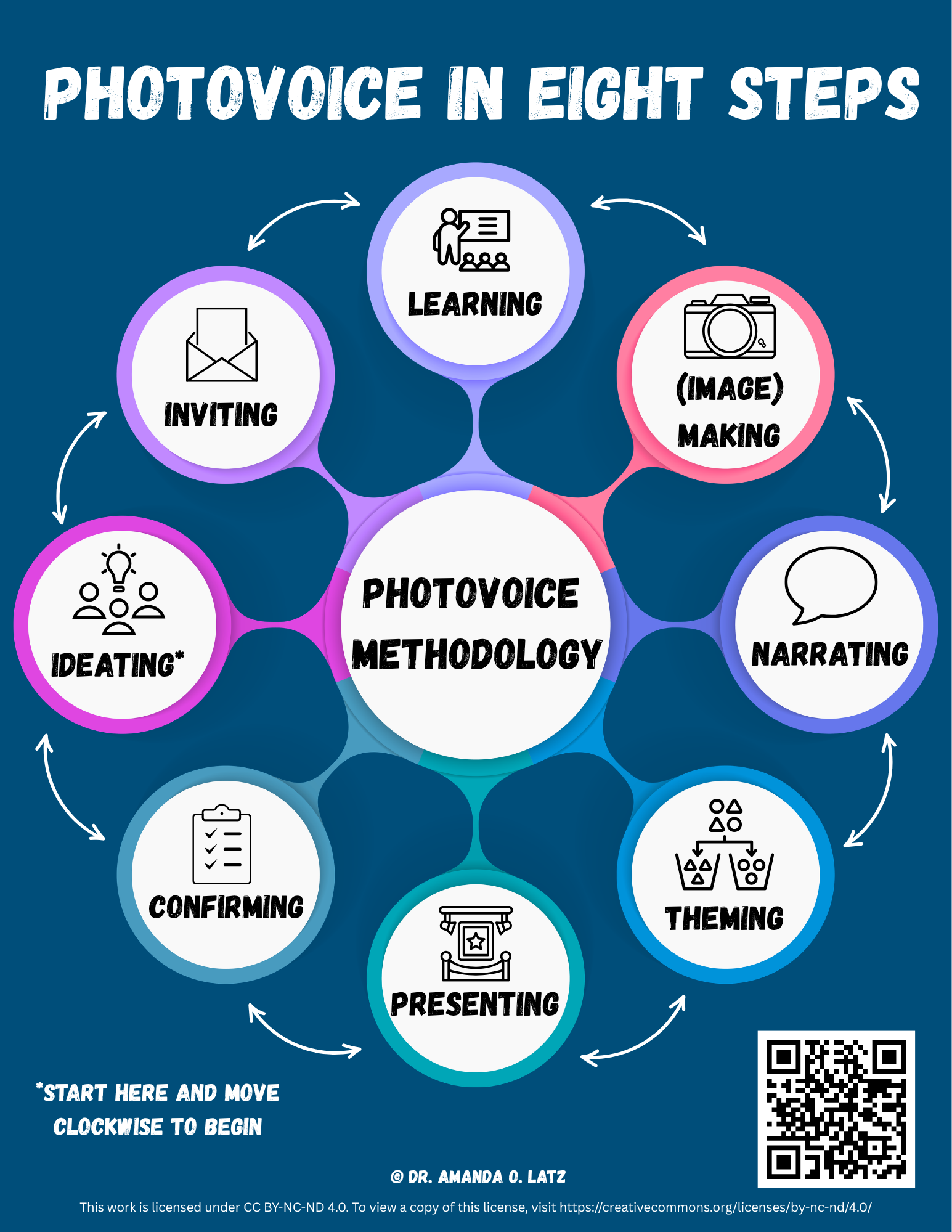
There was a stark contrast between the two images, to be sure! I'll take the above any day. I love a good graphic organizer or a visual depiction of a concept. I also love complexity. However, I am sitting with the notion that visual teaching materials do not have to be complex to convey complexity. Oftentimes, it takes a lot of complicated thinking to generate a simple, effective, and elegant visual design.
Photovoice is inherently ableist.
We used case studies as another tool to help attendees consider some of the what ifs related to photovoice—and there are many. Here is one of the cases we discussed:
You are meeting a group of participants in-person for the first time to further discuss the project and provide information on the total process. Upon arrival, you realize that one of the participants is blind. What do you do?
This case sparked a really animated discussion and highlighted some of the assumptions embedded within the photovoice concept. Sightedness and ocularcentrism being two examples. Yes, photovoice is inherently ableist.
Yet this does not make it a bad methodology; it simply points toward a need for expanding pathways for inclusion and participation, which the field is already embracing/has already embraced. We discussed concepts like sensory photography (https://lenscratch.com/2023/12/inner-vision-photography-by-blind-artists-the-heart-of-photography-by-douglas-mcculloh/) and 3D printing photographs (https://doubletaponair.com/feel-the-memories-3d-printing-photos-for-the-blind/; see video).
But the main take-away from the discussion is to simply talk with the person with blindness or low vision about how they imagine their participation to unfold. They know best. Because these cases were generated (roughly) from personal experiences, I was able to share the answers to the cases we explored. In the case above, the participant had already thought everything through and told me how their participation would unfold.
Another refrain throughout the workshop was the concept that the photographs were vehicles for meaning—data antecedents, really. So, if photography does not work for some participants (for whatever reason), other items or visuals could be made, collected, or even purchased as ways to address prompts.
Like I mentioned above, I am still missing the workshop space and the people who shared that space. And that said, I am excited and anxious about what the future might hold for photovoice field notes. Part of my summer thinking time will be dedicated to conceptualizing and building the next steps.
🥹 Thanks for spending a moment with me this Friday.
💌 If you’re new here, welcome! I hope this space becomes one you look forward to each week.
📬 Have a question you want me to answer in a future issue? Reach me at photovoicefieldnotes@gmail.com. I'd love to hear from you.
Thanks for being here.
Warmly,
Mandy
photovoice field notes
photovoicefieldnotes.com