four note friday 2.29 | Photovoice Pitfalls

Setting out to do a research project involves a lot of planning. The more prepared you are to carry out a study, the better, as those plans will inevitably change. Being prepared can give way to effective improvisation. What we think will happen is much, much different than what will actually happen. This is especially the case with qualitative approaches to research. And it is a feature, not a bug.
The unexpected things that turn up along the way are gifts—gifts in unfortunate packaging but gifts nonetheless. These are the things that make our research stories interesting, push our thinking, and force creative innovations.
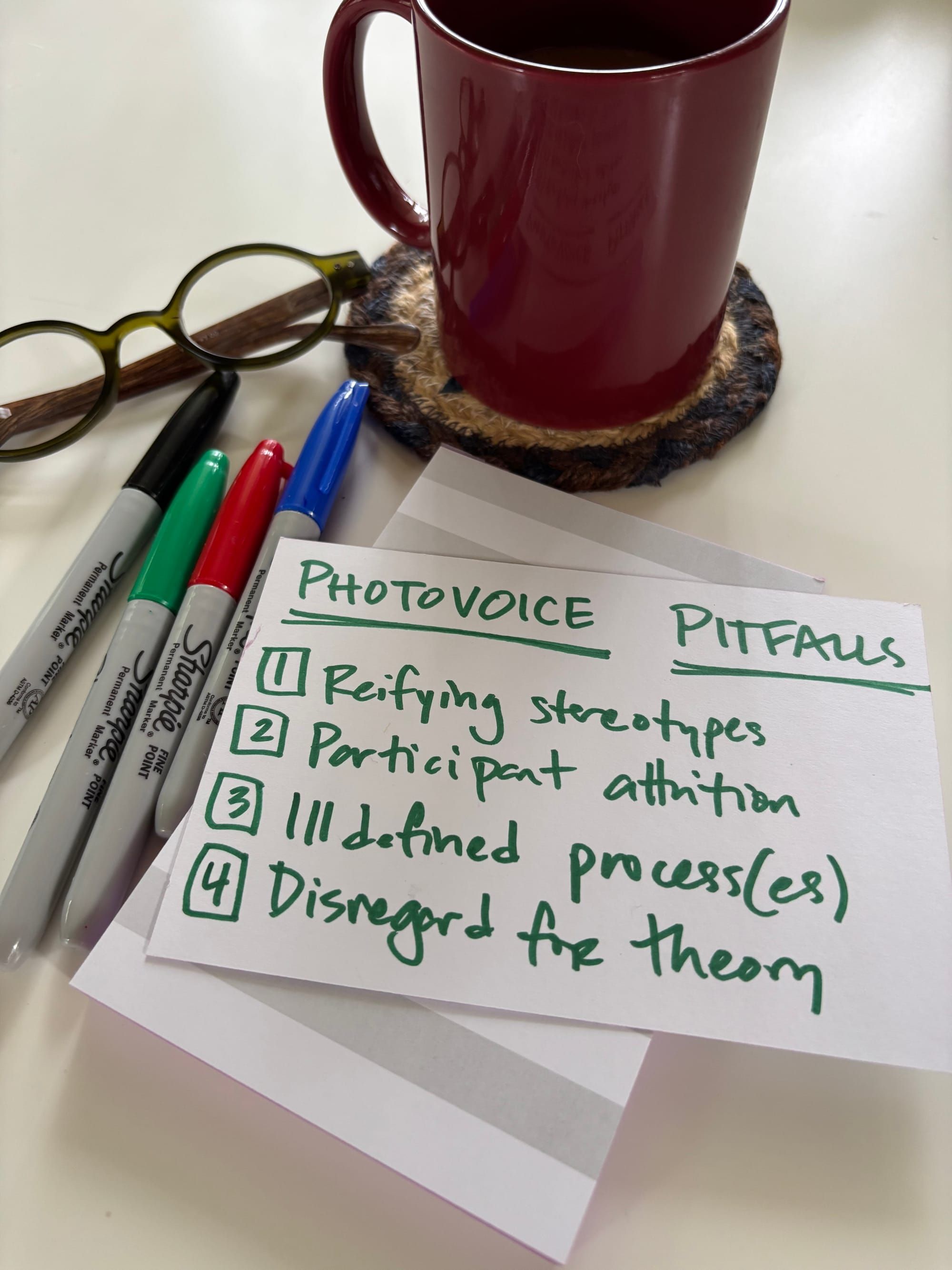
In the four notes that follow, I will outline four potential pitfalls that you may encounter or experience when facilitating a photovoice project. It should be noted that some of these pitfalls may come up and some may be brought on. I distinguish the differences below.
Reifying Stereotypes
This first pitfall is quite well-rehearsed in the methodological research on photovoice. Reifying stereotypes means that the images and text generated and shared through the project reinforce extant negative and inaccurate stereotypes about the participants with whom you are working.
This can cause harm and negate the potential positive and powerful impacts of photovoice.
Most of my photovoice project experience has come from partnering with community college students and faculty. Unfortunately, the community college remains stigmatized and negative stereotypes are plenty. In fact, the impetus for most of my scholarship has been upending these negative stigmas and stereotypes.
Many believe community colleges are inferior to four-year institutions, wrongly conflating price and quality. Many believe community colleges are for people who are not smart enough to attend a real college. These beliefs are simply wrong. Yet they persist.
One of the things I have had to keep in mind throughout the duration of these projects is the possibility of reifying these stigmas and stereotypes. At the same time, lovingly critiquing community colleges and their policies is much different than vilifying them. While I have not—to my knowledge—encountered a situation wherein the data generated and meanings made of those data have reified negative stigmas and stereotypes, it is something I've remained thoughtful about.
Usually this pitfall comes up instead of being brought on, yet ongoing positionality work and reflexive journaling are an important along the way, as this pitfall should be consistently considered.
Participant Attrition
Photovoice research is a much more involved process for participants than, say, survey research. It can take as few as five minutes to complete a simple, 12-item survey. On the other hand, participating in a photovoice study is a much longer commitment. And a bigger commitment can lead to participant attrition.
Only about one third of the participants who indicated interest in my photovoice dissertation persisted to the completion of the project. I was working with community college students, and these folks had A LOT going on in their lives.
While the work was unfolding, I was certainly disheartened and discouraged by this reality. I wondered whether I had done something wrong. Over time, however, I realized this is simply a function of how photovoice projects can unfold. When working with folks who have full and complex lives with a lot of roles and responsibilities, being a part of a photovoice project is simply not a top priority despite all the best intentions.
This pitfall is something that comes up, but it can also be brought on. Sometimes it just comes up, and you must realize that some elements of the work are not in your control. If you sense that it has been brought on, brainstorm ways to eliminate or reduce any barriers to participation. Barriers might include timing, schedule conflicts, money, childcare, or transportation.
Ill-defined Process(es) and Imprecise Language
Other pitfalls to be aware of are the deployment of ill-defined process(es) and the use of imprecise language. Both of these pitfalls are brought on, yet they occur at different stages of the process. And they are related. Imprecise language leads to ill-defined process(es), and ill-defined process(es) are replete with imprecise language.
Ill-defined processes are the result of too little pre-planning. While we want to invite participants—and perhaps others such as policy makers—into the project building process as collaborators, as the facilitator of the project, you have expertise that ought to be shared. In addition, you have a keen understanding of the expectations of the IRB/REB that approved the project. As the process is conceived of and enacted, every effort must be made to clearly define that process.
For example, what parameters are in place for the contents of the images generated for the project? How exactly will the images be shared or collected? What modes of communication will be used among the team? When and how will the project end?
To be sure, improvisation is necessary when carrying out any kind of research study. Yet, as mentioned, above thorough and ample pre-planning allows that improvisation to unfold gracefully.
As a scholar and an academic, I often peer review manuscripts for journals. I see journal articles as one among many ways to engage in the presenting step of the total photovoice process. When reviewing, I often note the use of imprecise language within such manuscripts, especially in relationship to methodology and methods.
Within journal articles showcasing the results of a qualitative study, ample attention must be given to the process. I realize that some journals have limiting page parameters, but I expect to see a clear and precise articulation of the methodology, methods, and data analysis processes deployed—and all research design decisions should be substantiated through strong citational practice.
You ought to have read and written about the methodological literature in the same way you read and wrote for your literature review section. If your language in the methodology and methods section of your paper is imprecise, that is an indication you must do more reading.
Disregard for Theory
When working with photovoice, it is important to be as theory-forward as possible throughout the duration of the project. Remember that photovoice, in its original conception, sits on a theoretical tripod. Think feminisms, critical consciousness education, and participatory documentary photography. These theoretical elements matter and should be kept top of mind throughout the project.
Atheoretical photovoice is not good practice, and it can actively cause harm.
Atheoretical photovoice disregards participants' viewpoints and lived experiences. Atheoretical photovoice is unconcerned about participants' well-being, agency, and involvement. Atheoretical photovoice does not value participants as documentarians, image makers, or narrative shapers.
When untethered from theory, photovoice processes go astray.
There are instances where the theories undergirding photovoice projects are altered—and for good reason. Even then, especially then, a continual circling back to the guiding theories of the methodological approach are vital. Otherwise, methodological congruence and integrity of process can be compromised.
This is a pitfall that is brought on—meaning it is under your control as facilitator. So keep theory close as you progress.
Have you seen or experienced any of these pitfalls? What others might you add? Are some more important than others? As always, would love to hear from you!
🥹 Thanks for spending a moment with me this Friday.
💌 If you’re new here, welcome! I hope this space becomes one you look forward to each week.
📬 Have a question you want me to answer in a future issue? Reach me at photovoicefieldnotes@gmail.com. I'd love to hear from you.
Thanks for being here.
Warmly,
Mandy
photovoice field notes
photovoicefieldnotes.com