four note friday 2.28 | Nonprofits, Photovoice, and the ECAA Effect

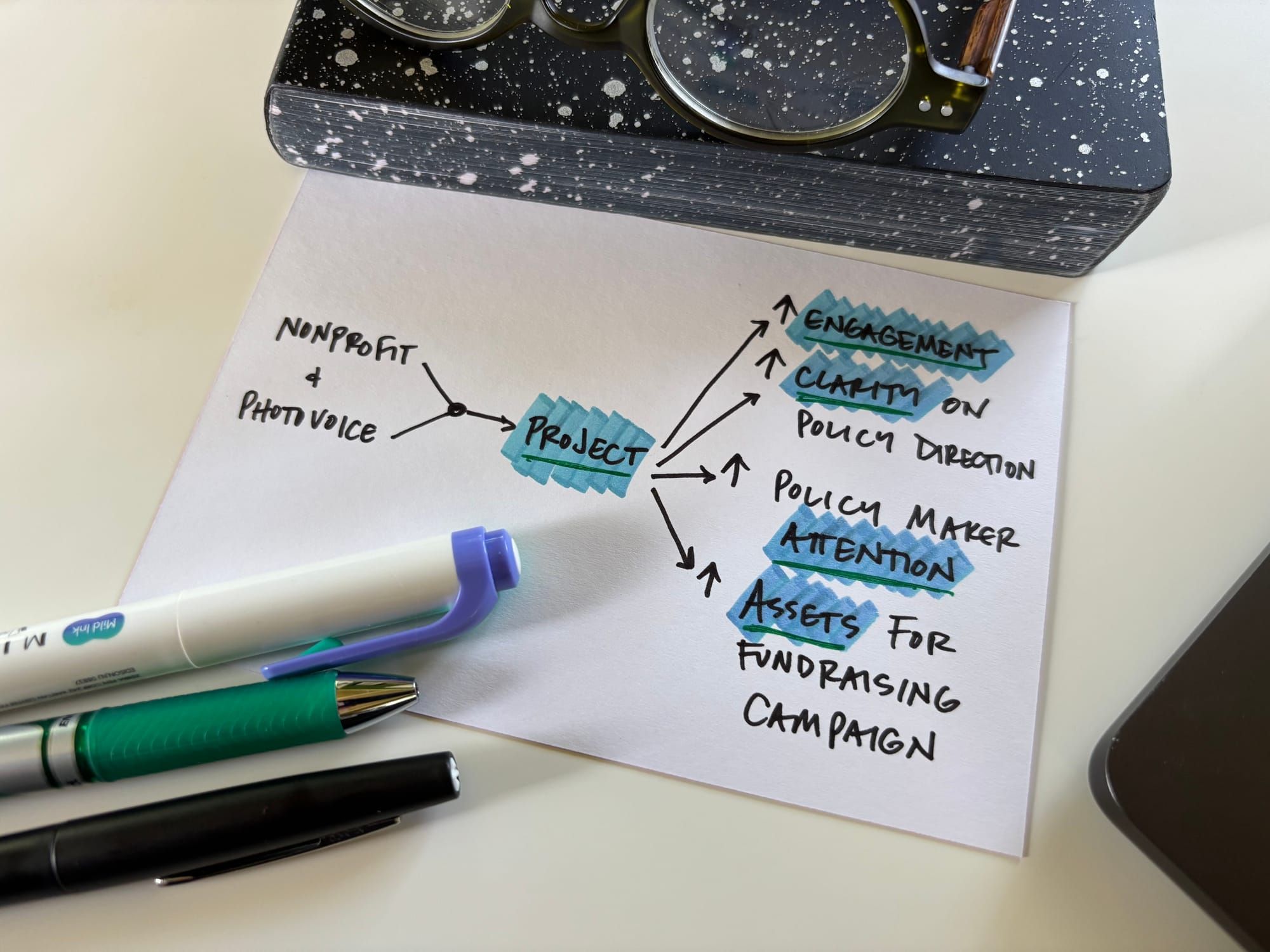
This week's post is about what can happen when nonprofits use photovoice. I've been thinking a lot about this as I consider ways to advocate for the use of photovoice to change the world for the better, one project at a time.
The four notes outlined below will comprise what I am tentatively calling the ECAA Effect. ECAA stands for engagement, clarity, attention, and assets. ECAA is what can result from nonprofits using photovoice to better understand the issues they are aiming to address and the people they are trying to serve. I have seen it happen.
To carry this post, I am going to use a local nonprofit with which I have some experience as an example: Muncie OUTreach. And who knows—a photovoice project might actually come to fruition!
The mission of Muncie OUTreach is to "[c]reate a safe space for LGBTQ+ youth and our community through support, empowerment, and education."
If I were to work with the organization on a photovoice project, I would start by talking with the Executive Director (ED), the Board, and the youth who engage with the organization. I would pitch a project that focuses on how the youth see the organization providing support, empowerment, and education. What does the mission look like in action? But this would just be the starting point. The ED, Board, and, most importantly, the youth would shape what the actual project looks like.
In the four notes below, I provide an overview of what I think such a project could do for Muncie OUTreach. Again, I am tentatively calling this the ECAA Effect.
Engagement
A project like the one I put forward above would affect engagement in a broad sense. The ED, Board, and youth would place their attention on the organization's mission and begin to think critically about what the mission looks like in practice—literally.
Most vitally, though, the youth—who would be the project's participants—would become engaged in helping the organization better understand the (mis)matches between espoused mission and reality. Essentially, the youth would be called upon to engage in organization building.
Recall that one of the aims of photovoice is to support the development of critical consciousness among participants—helping them understand the sociology of their positionality in the world as a key ingredient for changing that very world. What a powerful gift a photovoice project could be for queer youth.
Truly collaborating with the youth on the project from start to finish could be a powerful, meaningful, and enduring learning experience. Recall again the organization's mission. This project could actually be a further expression of that mission, as being a part of the project could most certainly provide support, empowerment, and education.
Clarity
Another aim of photovoice is policy change. Carrying out a photovoice project can generate clarity on which policies need changing.
In the case of Muncie OUTreach, the photovoice project might illuminate policies that need to be addressed at various levels. Everyone lives within a socio-geographic ecosystem, a socio-spacial context. The young people who interface with Muncie OUTreach exist inside a specific ecology or context.
For example, let's say the project's findings show that Muncie OUTreach helps youth cope with the following: (1) disaffirming family members, (2) hostile school environments, and (3) state laws that ban gender-affirming care for trans youth. The resources, support, and community provided by the organization provide a buffer from the harms caused within the various levels of the ecosystem. In this example, the family is the microsystem; the school is the mesosystem; and the state is the macrosystem.
The project, then, could yield clarity on how to focus policy change efforts. Upon review of the project's main themes, the ED, Board, and youth may coalesce around three initiatives going forward, all of which support the organization's mission.
In response to the first finding, the group realizes the closest PFLAG Chapter is over an hour away. The first initiative, therefore, could be establishing a local PFLAG chapter in Muncie. While this would not completely solve the issue of youth coping with disaffirming family members, it could certainly make a difference. Secondly, addressing school policies upstream of hostile environments may be another point of focus. Finally, (re)addressing state law might involve joining existing coalitions already embroiled in the fight.
Attention
After clarity on policy direction is established, now comes the important task of getting the attention of policy makers who can make the change(s) happen. And, thankfully, photovoice is built for this task.
Disseminating the project through a variety of exhibitions, broadly defined, is the key to catching policy makers' attention. Plus, a photovoice exhibition would pair exquisitely with a fundraising event. Providing potential donors with a direct way to sustain the organization and its mission through philanthropic generosity upon learning about the youth is a wonderful way to fully capitalize on such an exhibition.
But let's focus on getting the attention of policy makers.
To be sure, invite key guests to any in-person events planned to showcase the work. Have policy points in hand. Be ready for a conversation.
Beyond that, consider other tactics for attention-getting. Think op-eds in local news outlets; an infographic to share on the organization's website; a short slidedeck; a two-page executive summary; or a three-minute video for distribution on YouTube.
All these possibilities—and more—are key to reaching policy makers. And, again, keep in mind that photovoice was built for this.
Assets
Photovoice projects generate a lot of information in the form of photographs and text from interviews and/or focus groups. These pieces of information can be leveraged in numerous creative ways to support the organization. Think fundraising.
Not only can a photovoice project generate engagement, clarity, and attention, it can also generate assets vital for ongoing fundraising efforts and specific campaigns.
The corpus of data generated through a photovoice project contains a massive opportunity for organizational storytelling through a variety of media—including social media. These data can be seen as assets. They can be used to not only garner the attention of policy makers, but also to gain the attention of people who want to financially support the organization's mission through giving.
Once all those assets are in hand, the hard work of strategizing, curating, editing, and publishing the finalized products begins. This represents another opportunity to involve the youth in shaping the project's narrative for multiple audiences. A social media committee could thrive in this context. More engagement. More attention. Maybe even more clarity.
After having worked with a few nonprofit organizations on photovoice projects, the potential is clear. What I have termed the ECAA Effect meets and extends the built-in aims of photovoice through generating increased engagement, clarity, attention, and assets. And the organizational benefits are many!
🥹 Thanks for spending a moment with me this Friday.
💌 If you’re new here, welcome! I hope this space becomes one you look forward to each week.
📬 Have a question you want me to answer in a future issue? Reach me at photovoicefieldnotes@gmail.com. I'd love to hear from you.
Thanks for being here.
Warmly,
Mandy
photovoice field notes
photovoicefieldnotes.com