four note friday 2.19 | Photovoice, Evidence, Salience, and Power

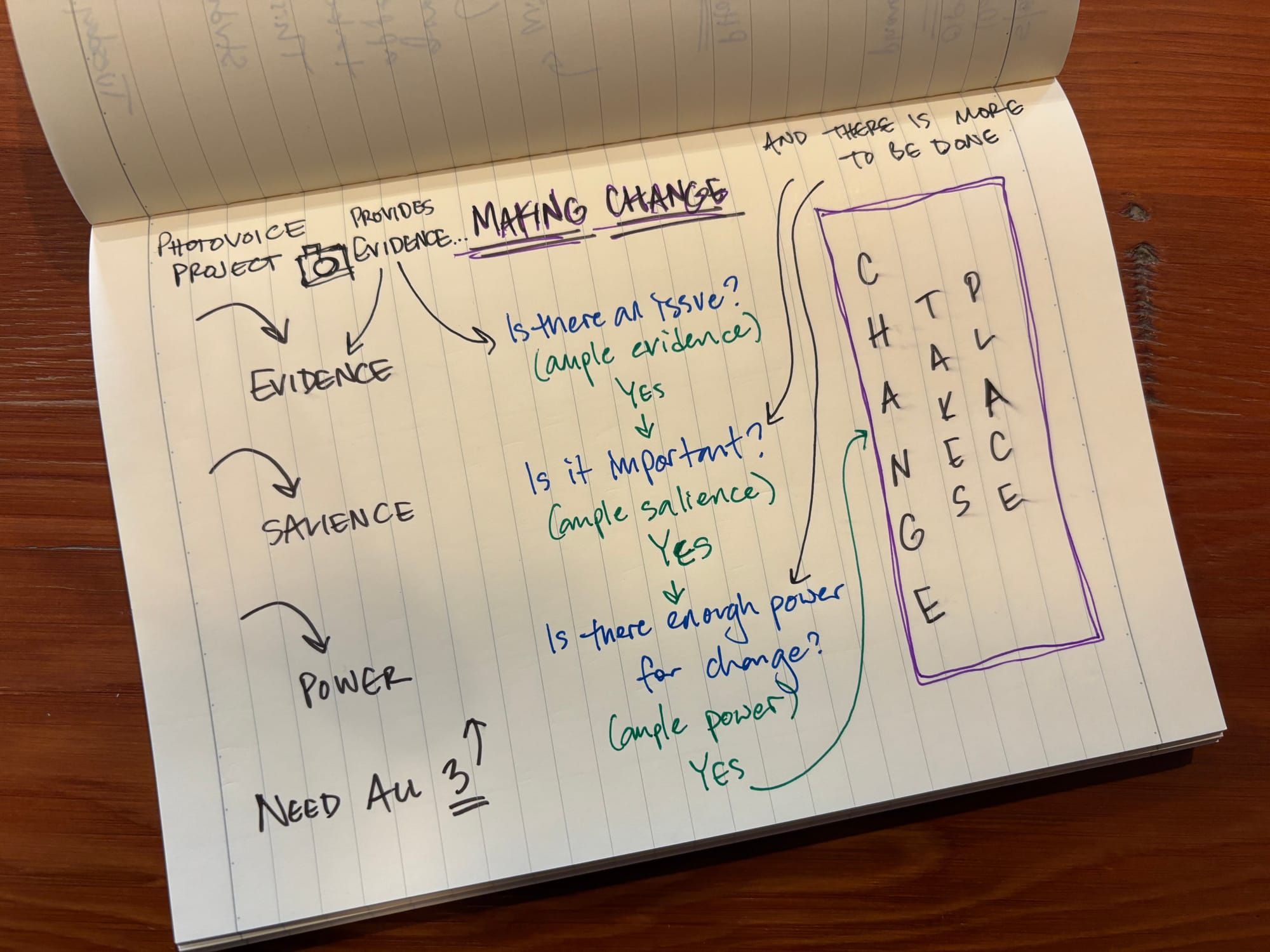
I've been thinking a lot about the policy and social change efforts that flow from photovoice projects. In previous posts, I have written about the aims of photovoice, one of which is reaching policy makers with the work, and the Multiple Streams Framework (MSF) as a useful tool in building understanding and strategy around policy change efforts.
More recently, I've been keen to read up on power mapping and its potential intersections with photovoice projects. I can envision the intersection of power mapping and photovoice as being especially helpful for nonprofit organizations and grass roots social change efforts.
As a starting point for this thinking-writing process, here I will focus on a publication from Runnymede Trust (a UK charity) titled Making Change: What Works? In the 2021 piece, Laurie Laybourn-Langton, Harry Quilter-Pinner and Nicolas Treloar argue that, plainly, sharing evidence is not enough to sway policy. Yet, evidence is largely what photovoice projects provide. So what do we do when the evidence from our projects is not enough to make change?
This week's four notes will be dedicated to unpacking this reality and considering what else can be done to instigate social and policy change.
There may be an evidence deficit, but evidence is not enough.
Let's start by unpacking the starting premise that evidence alone is insufficient to cause policy change. Many engaged in photovoice projects start with the premise that addressing an evidence deficit will be enough to create change. In other words, if we can show that a problem exists, that'll be all that's needed to get the problem addressed. The more you know, right? Well, Laybourn-Langton et al. (2021) disagree. Based on their study of successful change-making efforts, evidence alone is simply (and unfortunately) not enough.
While evidence alone is not enough to catalyze change, it is still critical. Photovoice projects can be leveraged to generate evidence that change is necessary. Our work can create robust images and narratives that literally show and tell the story of the problem. The cultivation of rich evidence is a hallmark of the photovoice methodology. Our work can also showcase the scope and scale of the problem/need for change as well as potential solutions.
Again, while evidence for the need for change of some kind is a vital first step in the social-policy change process, it is not sufficient on its own. The next step determining the importance of the problem.
Closing the salience deficit.
Once enough evidence exists that showcases a problem, issue, or concern, the next consideration is whether the problem is important enough for change to occur. Oftentimes, photovoice participants/collaborators/co-researchers showcase the importance of issue by literally showing its deleterious effects. For example, if no public transportation options are available for transit to a skilled nursing facility, staff members may resort to using Uber or Lyft for transit, which can be costly. As a result, health care staff members may seek employment elsewhere—locations navigable by public transportation. Staffing shortages mean residents are not cared for very well. A photovoice project could generate evidence for the problem and showcase its significant impact on staff attrition and its downstream effects on residents.
At the same time, what is important for some people may not be important for others. Laybourn-Langton et al. (2021) suggested that we must "find new and more effective ways of telling the story that speaks to people’s values, identities, and aspirations in order to change their minds" (p. 16). This should be kept in mind when curating exhibitions and project products or deliverables.
How can we convey the importance of the problems surfaced through our work? The amalgams of images (photo) and words (voice) through our projects are ideally crafted such that onlookers are affected deeply and viscerally. Visuals are powerful attention-getting tools. Yet what else can be done to convey importance? How do we build understanding, compassion, and empathy? How do we engage in work that connects with others' values, identities, and aspirations? These questions should be considered throughout the course of any given photovoice project—and beyond.
Even once evidence and salience are in-hand, the work continues on. We still do not quite have all we need. Power is the missing ingredient.
Closing the power deficit.
Once we get to the point where we (and others) know an important problem exists, people with power relevant to the context are needed to set the necessary change in motion. In an earlier post focused on the MSF, I wrote about the policy window. Yet I did not write about the concept of the policy entrepreneur. In the context of the MSF, the policy entrepreneur is the person (or persons) who enters the policy window with the issue and solution in-hand and champions the desired change. And to be effective, these individuals must have power relevant to the problem's/issue's context.
Consider leveraging the cumulative social capital of the project group to access legislators, administrators, officers of policy making bodies, the press/media, and other groups with similar values to generate power. Resisting the atomization of individual efforts and bringing people and other groups into an organized collective can bring power from numbers and more concentrated efforts.
And sometimes one key individual is all that is needed to bring the issue to the table and enact change. Discerning who that person is can be a challenge. Keeping this challenge top of mind throughout the project's duration can sensitize us to keeping ourselves open to possibilities.
Bringing evidence, salience, and power together for change making.
Photovoice is a uniquely effective methodology and form of critical participatory action research for closing evidence, salience, and power deficits, which can make change more possible. Put another way, photovoice was created as a useful approach to change generation that comes ready-made with processes (methods) adept at surfacing evidence. And when bridged together with the extant literature on policy change, it can also surface the salience and power necessary to spur on action.
Those engaged in photovoice projects must successfully address/close the (potentially many) deficits of evidence, salience, and power in order for (social and policy) change to occur. As others have noted (see here), we must continue to bridge between the photovoice methodology literature and the policy change literature—and we must write about building those bridges as well as what results. Too often photovoice projects are reported on prematurely, before any evidence of social or policy change is available. Yet we can change that with a longer term view of our projects and more outputs relative to their impacts on the world.
Some recent consulting work with the European Agency on Special Needs and Inclusive Education (EASNIE) has got me thinking more and more about how to leverage photovoice in support of social and policy change. That said, expect to see more and more on this topic from me in this space!
🥹 Thanks for spending a moment with me this Friday.
💌 If you’re new here, welcome! I hope this space becomes one you look forward to each week.
📬 Have a question you want me to answer in a future issue? Reach me at photovoicefieldnotes@gmail.com. I'd love to hear from you.
Thanks for being here.
Warmly,
Mandy
photovoice field notes
photovoicefieldnotes.com