four note friday 2.18 | Take-Aways from "Rebraiding Photovoice: Methodological Métissage at the Cultural Interface"

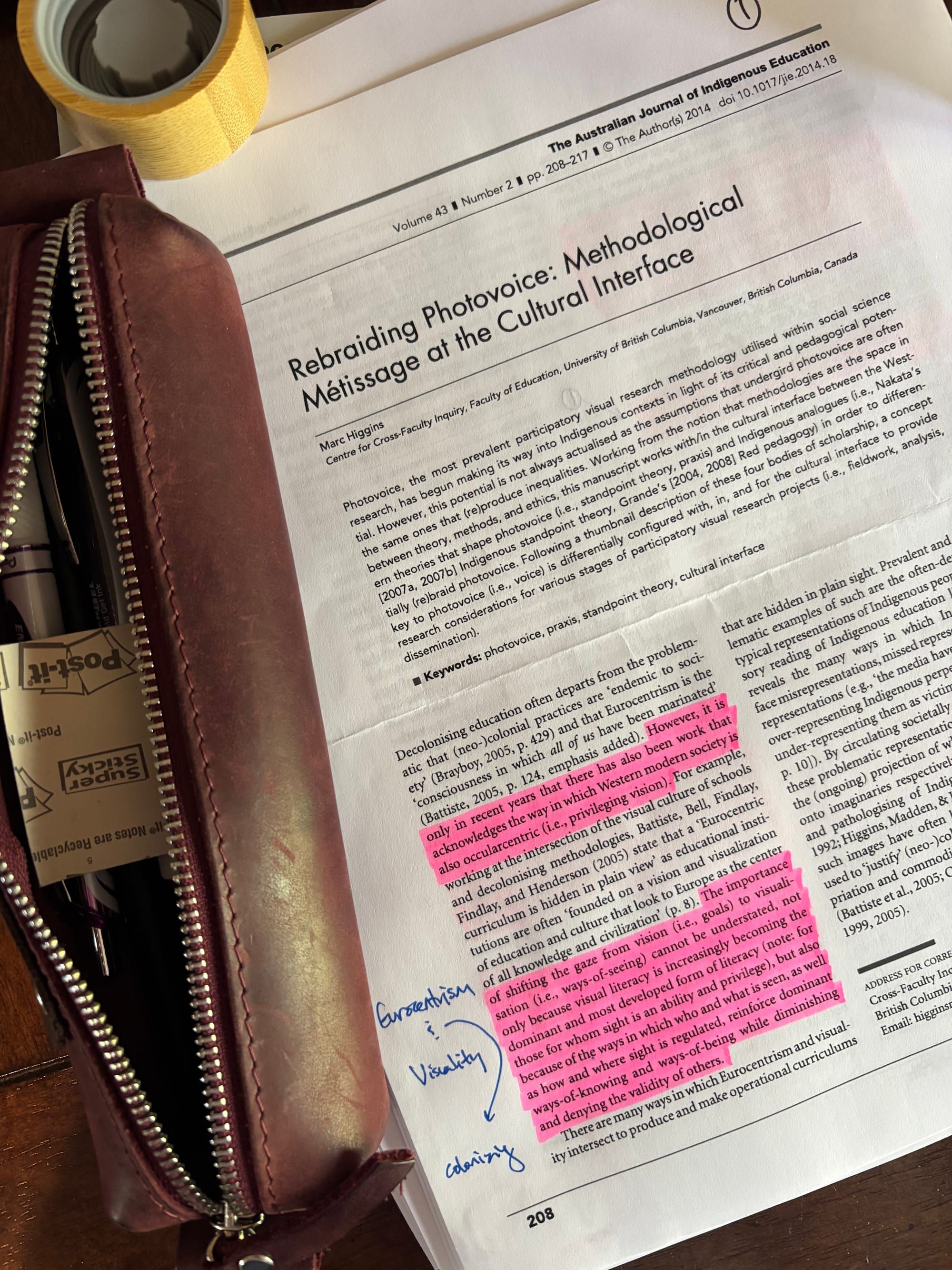
I've long admired Marc Higgins's contributions to the methodological literature on photovoice—so much so that I invited him to blurb my book. For this week's post, I've reread his 2014 piece titled "Rebraiding Photovoice: Methodological Métissage at the Cultural Interface," which appeared in The Australian Journal of Indigenous Education. My main take-aways are below.
When I create a post based on another scholar's work, take it as a given that you should read the original piece yourself. You might think of these posts as one-part journal article reviews and one-part fan mail. In any case, please read on, and please read Higgins's article.
The combination of Eurocentrism and visuality can be at play within photovoice applications in ways that can be problematic.
Higgins (2014) argued that "photovoice . . . offers a significant and productive methodological location to work within and against occularcentric Eurocentrism" (p. 209). Since its original conception, photovoice has been adapted in several ways. When applying an Indigenous epistemological lens, we begin to see that canonical photovoice applications often center Western knowledge systems and assume visuality in (re)colonizing ways. Within this article, Higgins addresses the following central question: "What does it mean to reconceptualise [sic] photovoice with, in, and for the cultural interface?" (p. 209)? He then goes on to ask "what would it mean to rebraid photovoice using corresponding bodies of theoretical literature that have been reconceived at the cultural interface?" (p. 209).
In using the term cultural interface, Higgins is referring to Martin Nakata's work and the idea that when Western and Indigenous epistemologies come together there is potential for many hybridities within that in-between cultural-knowledge space, which can be both problematic and productive, sometimes at once. How can photovoice be adapted for use with/in Indigenous contexts?
Thinking about (re)framing photovoice for use in that space (the cultural interface) necessitates adaptation. And in a previous post, I have provided some examples of such adaptations.
There is a (BIG) difference between braiding and suturing.
The cultural interface brings forward the potential of braiding together and/or suturing over. A fruitful hybridity comes from braiding together strands from multiple epistemological frames to create something new. Suturing (over) within the cultural interface favors one epistemology or another (usually Western).
Higgins (2014) explains that "Indigenous Métissage [see Donald's work here] is a research methodology that works to complicate Indigenous-non-Indigenous relationships by braiding together complex and contradictory de/colonial narratives around place" (p. 210). Furthermore, it is a sensibility, an approach to research that allows—and encourages—culturally relevant and sustaining methodological adaptation.
Indigenous Métissage encourages braiding together, not suturing over. The difference is substantial and consequential.
When rebraiding, go all the way to the theoretical underpinnings of the methodology (i.e., do not stop at methods).
Within the paper, Higgins shows how rebraiding is not just about the methods carried out under the umbrella of a particular methodology. He goes all the way down to the theoretical underpinnings of the methodology—the roots. This is where the rebraiding happens. The reverberations of the braid then expand throughout the conceptual framework of the inquiry.
Higgins asserts feminist standpoint theory and praxis (see Paulo Freire's work) as the roots of photovoice in its classic sense. He then argues for re-envisioning these two theories such that they are more closely aligned with Indigenous epistemologies by drawing on Indigenous standpoint theory (see works of Nakata here and here) and red pedagogy (see here) (i.e., Indigenous praxis).
Voice is not relegated to human beings.
When the theoretical underpinnings of a methodology are rebraided within the cultural interface, the approach changes. In most photovoice projects, that voice comes from human beings—and only human beings—is implied. That assumption is contested when Indigenous epistemologies are infused through the deployment Indigenous standpoint theory and Indigenous praxis.
Higgins (2014) gives a practical example of such reverberations: "Framing the photographic . . . process are questions and cues such as 'if this place could tell a story, what would it be?', not to speak for the place-site but rather to speak with it." (p. 214). This cue beckons participants to engage with the voices of the place-sites in visual dialogues. Higgins goes on to note that "the telling of stories with rather than about place and the other-than-human bodies within it is an important facet of Indigenous ways-of-knowing that could and should be utilized to frame the voices that arise through such projects" (p. 215, italics in original).
As I reread this article today, I am reminded why I love Higgins's contributions to the photovoice literature. His arguments are interesting, his writing is compelling, and his work encourages critical and deep thinking. He closed the piece by reminding us that methodological work at the cultural interface is ongoing and "never fully over" (p. 216). I fully agree.
🥹 Thanks for spending a moment with me this Friday.
💌 If you’re new here, welcome! I hope this space becomes one you look forward to each week.
📬 Have a question you want me to answer in a future issue? Reach me at photovoicefieldnotes@gmail.com. I'd love to hear from you.
Thanks for being here.
Warmly,
Mandy
photovoice field notes
photovoicefieldnotes.com