four note friday 2.9 | Photovoice and the Dissertation
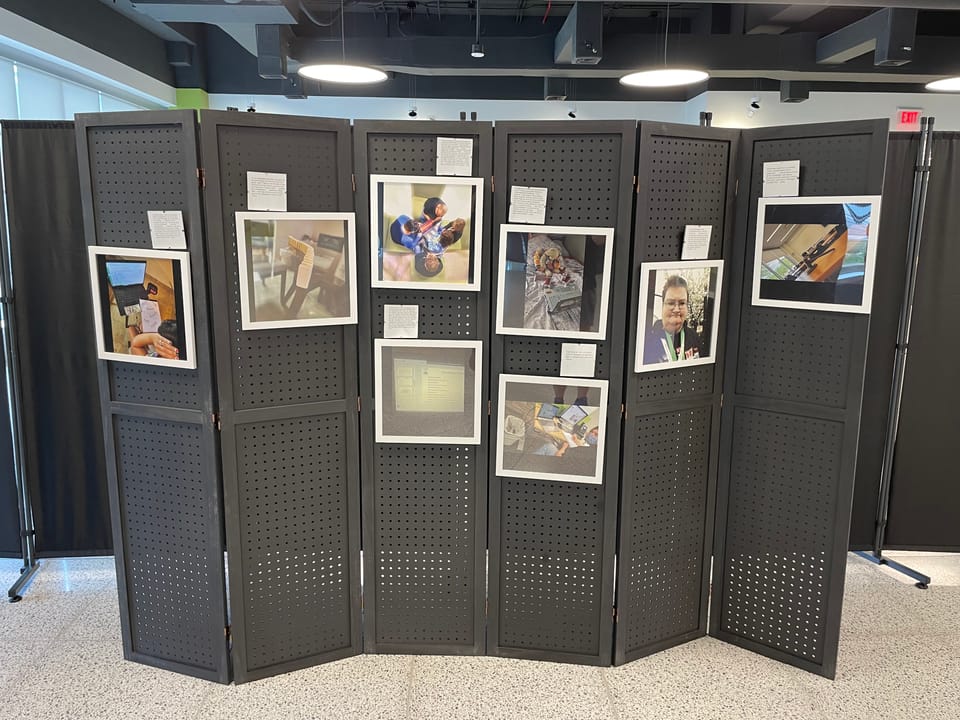
This is likely post one of a series. There is certainly a lot to think about when your dissertation is a photovoice project.
I am routinely in touch with doctoral students all across the globe who are using photovoice within/as their dissertation work. And a photovoice dissertation is quite a unique experience.
In what follows, I will share four notes—axioms for consideration, small pieces of advice, and suggestions—for doctoral students on the photovoice dissertation journey.
🟣 Deploying CPAR and Creating New Knowledge Are Compatible.
Using photovoice as critical participatory action research (CPAR) within the dissertation can absolutely generate significant original empirical findings, theoretical insights, and/or methodological contributions, all while centering, honoring, and amplifying participant voice and collective meaning-making. Photovoice projects can yield new knowledge and contribute to meaningful change.
Using photovoice as a tool for knowledge creation and liberation is not sidestepping rigor. It is framing systematic inquiry as both a vehicle for knowledge generation and a way to spur on positive change in the world, even if it is just one small corner of that world.
🟣 You Will Probably Be the Photovoice Expert in the Room.
Considering that photovoice not nearly as ubiquitous as other methodological approaches to inquiry, know that you may be the methodological expert in the room when your doctoral committee gathers or when you meet with your supervisor. And that is completely okay. The faculty with whom you are working likely have deep expertise in many other areas.
That said, be prepared to articulate why photovoice is the most appropriate approach for addressing your research question(s), what traditions it draws from, the steps you will take to carry out the work, and how rigor will be demonstrated at each stage of the process. Your design should be legible, justified, and grounded in established scholarship. When you can clearly explain your philosophical commitments, conceptual framework, study design, and ethical safeguards, your committee members and/or supervisors will feel at ease and be ready to learn more.
🟣 Protect Time for Positionality Work.
Photovoice dissertations require deep reflexivity. To the extent you can, block time for this important work. Write, write, write. Go for a thinking walk, a drive, or a cup of coffee. Make art to make sense. Ask yourself questions and go deep. Examine your assumptions, power, worldview, values, identities, and experiences. Allow yourself space and time to do the identity work of becoming a scholar. None of this should be an afterthought. It must be part of your design, and it will take up time, energy, and focus.
Many photovoice projects involve stepping into complex relational spaces. Unexpected things arise. For example, I had an incredibly difficult time exiting my dissertation. I felt grief when I expected to feel joy. Critical participatory action research can create powerful emotional moments. It is a very human experience. Documenting your reactions, tensions, and shifts over time is part of methodological rigor, not self-indulgence.
🟣 The Dissertation Can Be One Part of the Photovoice Project.
When I arrived at the exhibition stage of my (photovoice) dissertation, one of my participants asked whether the success of the exhibition would influence whether I got my degree. But by that point, I had already successfully defended my document and was preparing for graduation. The project was SO much bigger than my dissertation—and my dissertation was big!
It is hard to imagine when you are in the process, but sometimes photovoice projects are so profound that the fact you are also doing a dissertation actually fades into the background. The project is, and will be, far bigger than you.
Your commitments to the work and the co-researchers-collaborators-participants will transcend the dissertation. The dissertation is just one product of the project, one of a potential many. Yet dissertations are not accessible to most people. Accessibility of key information is necessary to affect change in the world. The dissertation could be thought of as a form of exhibition, but the project will likely demand multiple exhibitions, in multiple forms.
A photovoice dissertation is rigorous, relational, and often bigger than you expect it to be. If you are on this path, know that you are not alone. The tensions you may feel are part of the work, not signs that you are doing it wrong. More notes to come.
🥹 Thanks for spending a moment with me this Friday.
💌 If you’re new here, welcome! I hope this space becomes one you look forward to each week.
📬 Have a question you want me to answer in a future issue? Reach me at photovoicefieldnotes@gmail.com. I'd love to hear from you.
Thanks for being here.
Warmly,
Mandy
photovoice field notes
photovoicefieldnotes.com
Member discussion