four note friday 2.8 | Take-aways from 'Revisiting the Roots and Aims of Photovoice'
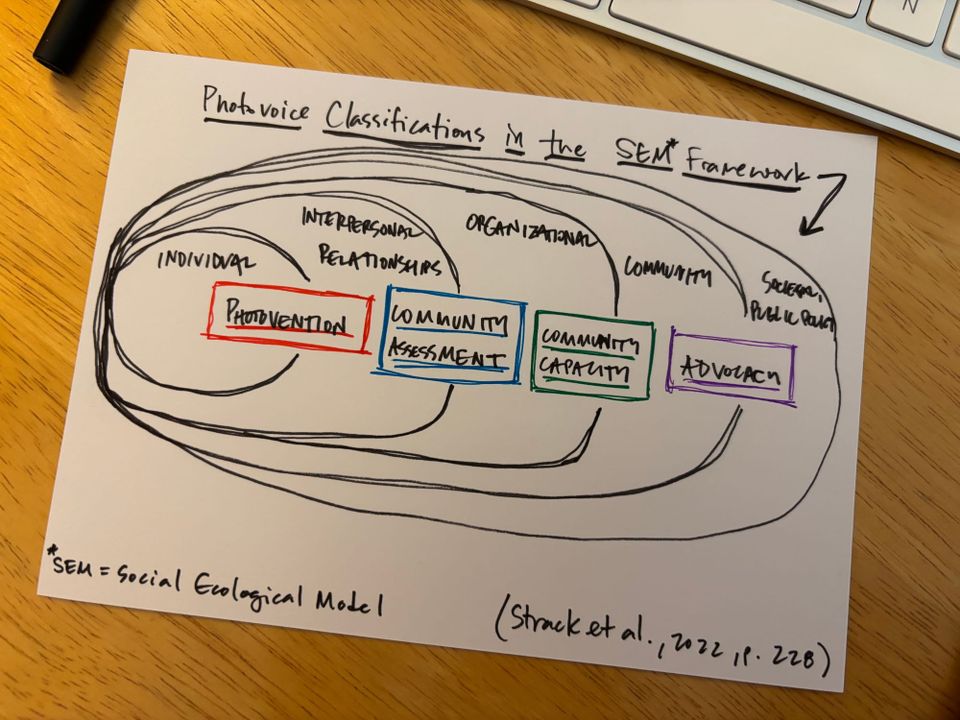
In this week's post, I share four take-aways from a semi-recent article (2022) by Robert W. Strack, Muhsin Michael Orsini, and D. Rose Ewald titled Revisiting the Roots and Aims of Photovoice. This piece was published in a special issue of Health Promotion Practice focused on photovoice.
This was a fascinating read wherein the authors weave together threads from Wang and Burris's first article on photovoice, published in 1994, together with threads from the social ecological model and a classification of photovoice projects framed as certain specific kinds of endeavors.
In doing so, they create a categorization of photovoice projects based on the aims (and outcomes) of the projects. In other words, they "propose a classification system that encapsulates the diverse purposes and desired outcomes of photovoice" (p. 223). This new heuristic can be helpful for others to think through when engaging with the photovoice methodology.
This article reminds me of some similar thinking-writing I did post-dissertation, when I questioned whether the participants in my study had enhanced their critical consciousness. You can read more here about how I later suggested a bifurcation of photovoice. In the Strack et al. piece, photovoice is broken into four potential sub-approaches. And, you guessed it, each one framed as a take-away below.
Photovoice as Individual-Level Intervention—or Photovention
Strack et al. (2022) explained that
When the primary goal of a photovoice effort is to promote change within the participants themselves and not to address community concerns or broader social conditions, it is serving as an individual-level intervention and might best be categorized as photovention. (p. 224, italics in original)
While some photoovice project facilitators may not start with this goal in mind, sometimes it becomes the sole outcome of the project. In the article of mine referenced above, I term this version of the approach photovoice for reflective consciousness building, yet I only came to understand this departure from photovoice's roots and aims after the project was completed. This categorization makes a lot of sense in the world of health promotion—and beyond. Yet broader impacts on policy may not play a significant (or any) role in this kind of work. What photovoice projects have you seen that might fit into this category?
Example Aim = enhancement of individual skills
Example Outcome = higher level of self-efficacy in specific domain
Photovoice as Community Assessment
Strack et al. (2022) noted that "[t]he role of photovoice in community assessment is to identify community strengths and weaknesses as interpreted by community members themselves" (p. 225), and includes the voices and viewpoints of those typically not included in traditional forms of needs assessment such as surveys. Through this process, again, community issues and assets may be revealed in novel, nuanced, and visual ways simply unattainable by other more typical modes of assessment. Here again, however, affecting policy change may not be a high priority for such projects, another significant departure from the methodology's original aims. Similarly, individual development toward critical consciousness is not necessarily a point of focus here. What photovoice projects have you seen that might fit into this category?
Example Aim = community needs assessment
Example Outcome = ranked list of community issues and assets
Photovoice as Building Community Capacity
When using photovoice to build community capacity,
Participants and the community can develop and exercise the power to accomplish things, the power to work with others toward a common goal, and the power over actions in one’s community. (Strack et al., 2022, p. 225, italics in original)
Here, it is important to note that a single photovoice project can do more than one thing (i.e., be an intervention and be a needs assessment and build community capacity). It can do more than one thing, and it can be more than one thing. Strack et al. (2022) emphasized that "[p]hotovoice as a means for producing systems and policy change, through individual voice, assessment, and empowerment, was the central aim of the method from the beginning" (p. 226). At this stage, however, its aim is to increase a community's capacity to act together efficaciously. Yet, we are still a distance away from policy change. What photovoice projects have you seen that might fit into this category?
Example Aim = increase collective community efficacy
Example Outcome = identification of emergent community leaders
Photovoice as Advocacy for Change
Strack et al. (2022) said
Photovoice is a practical and powerful tool for the community’s internal generation of knowledge and empowerment. The other applications of photovoice (i.e., photovention, community assessment, and community capacity building) are essential components of the method but, without additional planning and action, are by themselves less likely to achieve sustainable change leading to healthier living conditions. (p. 226)
Here we arrive at photovoice as advocacy for change, which has been a key aim of the approach since 1994. Reaching policy makers with the results of a photovoice project happens only through dedicated attention and effort. The potentially wide gap between photovoice projects and policy makers must be bridged thoughtfully and intentionally. This could happen in myriad ways, but it will not happen on its own. In a previous post, I enumerate potentially helpful frames for doing this important work. What photovoice projects have you seen that might fit into all the categories above?
Example Aim = access policy makers
Example Outcome = policy change
Strack et al. (2022) noted that "the classification system presented in this article highlights a hierarchical but dynamic relationship between the diverse purposes of photovoice in practice and encourages practitioners to maximize the impact of their efforts at every level" (p. 226). Ideally, all photovoice projects would ascend through all the levels articulated above. Yet that is not always feasible. This helpful heuristic adds to the photovoice lexicon and provides project facilitators with useful tools when implementing and writing about their work.
🥹 Thanks for spending a moment with me this Friday.
💌 If you’re new here, welcome! I hope this space becomes one you look forward to each week.
📬 Have a question you want me to answer in a future issue? Reach me at photovoicefieldnotes@gmail.com. I'd love to hear from you.
Thanks for being here.
Warmly,
Mandy
photovoice field notes
photovoicefieldnotes.com
Member discussion