four note friday 2.7 | (some) Photovoice Adaptations
In previous posts, I have written about how photovoice has been adapted over time. Two such examples have included online photovoice and endarkened photovoice. Here I will introduce four additional photovoice adaptations, all grounded in Indigenous epistemologies.
One beautiful characteristic of photovoice is its flexibility, which was built in from the start. In fact, its inception was spurred on by an openness to engage in trail and error within an iterative cycle long enough to arrive at a methodology useful for the context, purpose, and participants involved in the study wherein it was first used.
A lot has happened since the early 1990s, and photovoice has been adapted in so many beautiful ways over the last 30+ years. As it has proliferated, it has been adapted so as to be legible within a broad diversity of contexts and cultures.
In what follows, I give a mere snapshot of some key pieces illustrating example adaptations. They are as follows: Anishnaabe symbol-based reflection, postervoice, photoyarn, and CreativeVoice. No doubt, these kinds of adaptations will continue emerging over time. And, again, this is simply a snapshot.
At present, I am working on a journal article that maps the various adaptations of photovoice over time. So expect more posts like this one in the coming weeks!
Anishnaabe Symbol-Based Reflection
Title: Practical Application of an Indigenous Research Framework and Two Qualitative Indigenous Research Methods: Sharing Circles and Anishnaabe Symbol-Based Reflection (2009)
Author: Lynn F. Lavallée
🔗 URL: https://journals.sagepub.com/doi/10.1177/160940690900800103
An Indigenous method, Anishnaabe symbol-based reflection was influenced by photovoice in its conceptualization and creation. Rather than being asked to take photographs, study participants were given $30 and asked to create or purchase culturally meaningful symbols. Those symbols were then discussed in sharing circles, a method which Lavallée explains in detail in the article. These adaptations are congruent with Indigenous epistemologies, recognizing that knowledge may be embodied, symbolic, and sacred.
Postervoice
Title: Perspectives of Water and Health Using Photovoice with Youths Living on Reserve (2016)
Authors: Lori E. A. Bradford, Rebecca Zagozewski, and Lalita A. Bharadwaj
🔗 URL: https://onlinelibrary.wiley.com/doi/abs/10.1111/cag.12331
Whereas Anishnaabe symbol-based reflection differs from photvoice as it changes the means of image generation, postervoice differs from photovoice in the way the photographs are arranged, interpreted, and discussed. The authors explained that
Cameras were collected [from participants] and films developed on the fourth day. Pictures were returned [to participants] along with 24” x 36” poster-boards, markers, and glue sticks at the end of the week. Participants then shaped individual posters depicting their ideas and providing their perceptions, involving the use of humour and/or more serious messages. (pp. 183-184)
In postervoice, participants still take photographs in response to questions/prompts, but their representational work does not end there. The poster-making provides participants with time and space to reflect on the meta-messages and meanings they want to convey. Postervoice, as conceptualized in the article above, also included sharing circles, which was appropriate considering the context and epistemological grounding of the study. These participant-created posters can be seen as portable advocacy tools, further adapting conceptualizations of what photovoice exhibitions might look like.
Photoyarn
Title: Photoyarn: Aboriginal and Maori Girls' Researching Contemporary Boarding School Experiences (2017)
Author: Jessa Rogers
🔗 URL: https://search.informit.org/doi/epdf/10.3316/informit.906883787867788
Photoyarn is another arts-based Indigenous method influenced and inspired by photovoice. Further, Rogers was influenced by Lavallée's work, especially in relation to the use of sharing circles (p. 6). Photoyarn includes yarning circles as spaces where participants analyze their own photographs. Rogers noted that
The inclusion of yarning circles as a space for Indigenous students to discuss, analyse and theme their own images towards deciding on major themes and findings for dissemination through their own student-led and organised exhibitions in their own school communities formed the core of the photoyarn process. (p. 6)
If you are interesting in learning more about yarning as a method or methodology, I found this video very helpful: https://youtu.be/vX8rgwtXYaM?si=aLlCRxo3DN_f0UY8.
CreativeVoice
Title: Finding CreativeVoice: Applying Arts-Based Research in the Context of Biodiversity Conservation (2018)
Authors: Flor Rivera Lopez, Fern Wickson, and Vera Helene Hausner
🔗 URL: https://www.mdpi.com/2071-1050/10/6/1778
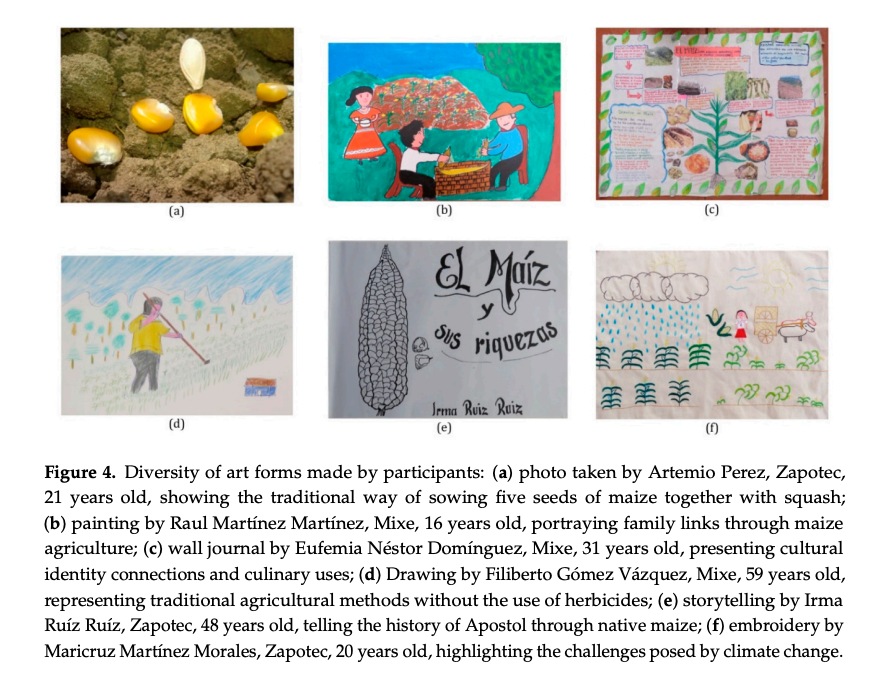
Within CreativeVoice, participants are not restricted to photography alone in the creation of responses to questions/prompts. Essentially, CreativeVoice expands modes of representation possible. See the image/screenshot highlighted above for examples that include: photography, painting, wall journaling, drawing, storytelling, and embroidery. The authors noted
Here, the major methodological amendment that we felt was important was to offer participants other forms of artistic expression in addition to photography as a way to communicate their lived experience. We felt that it was particularly important to open up forms of the creative arts that were more commonly used in the participants’ culture and that they may therefore feel more comfortable and capable working with. Since we were specifically aiming to work with elders (50+ years), adults (25–50 years), and adolescents (12–25 years) of both genders, we also felt that it was important not to only offer a single art form that may be more familiar or comfortable for one of these age or gender groups. While we were open to the use of any art form, nevertheless, we found it important to give examples of different types to help communicate the task. We did this by presenting three categories of creative arts: (1) photos/video, (2) poems/stories/songs, and (3) drawings/paintings. (p. 6)
The website housing this journal article also includes a video abstract, and I highly recommend viewing it to get a full sense of the methodology. CreativeVoice is yet another example of a photovoice adaptation that recognizes and honors Indigenous epistemologies.
Each of the examples above showcase culturally aware and responsive adaptations of photovoice. In all cases, Indigenous epistemologies, axiologies, and ontologies are honored through thoughtful and appropriate changes to photovoice's original configuration. Okay, it's now time to write that article!
🥹 Thanks for spending a moment with me this Friday.
💌 If you’re new here, welcome! I hope this space becomes one you look forward to each week.
📬 Have a question you want me to answer in a future issue? Reach me at photovoicefieldnotes@gmail.com. I'd love to hear from you.
Thanks for being here.
Warmly,
Mandy
photovoice field notes
photovoicefieldnotes.com
Member discussion