four note friday 2.4 | Considerations for Photovoice Exhibitions
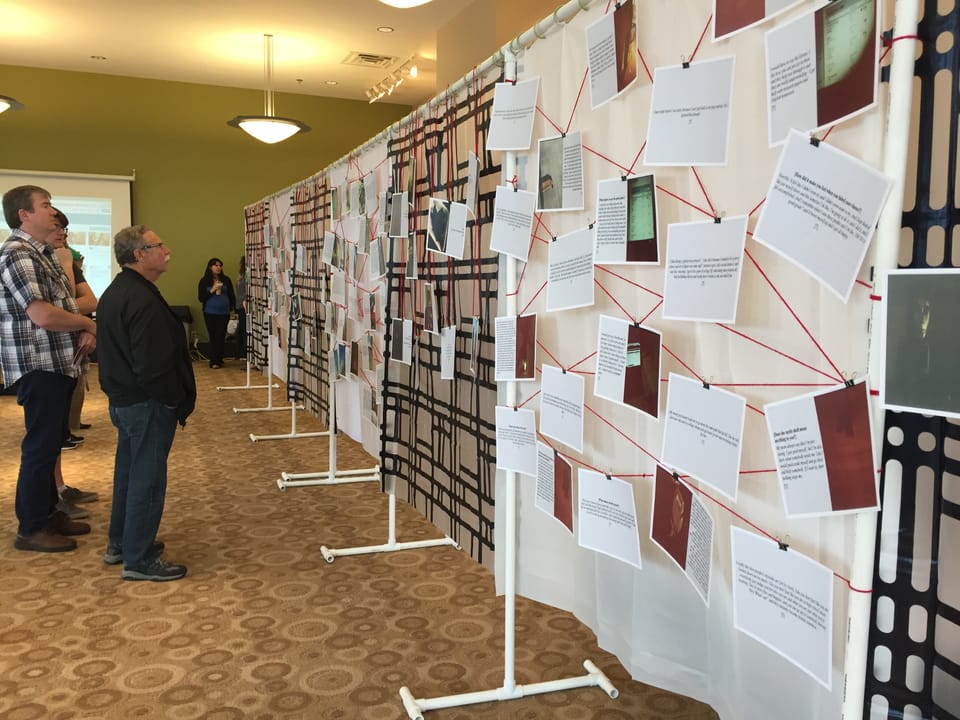
Photovoice project dissemination strategies should be top of mind throughout the duration of any given photovoice project. Because one of the aims of the methodology is to reach policy makers with the findings, implications, and recommendations of the work, sharing out relevant information—including the curated collection of photographs and narrations—is paramount.
But how do we do this?
Well, the answer to this question depends on a number of factors. Some examples include: Who are the policy makers we want to reach? What is the best way to reach them? How do we meaningfully connect participants/collaborators/co-researchers with those policy makers? What form(s) should the exhibition(s) take? What is our budget—if we have one?
In the four notes that follow, I'll overview some important considerations to keep in mind as you work toward the exhibition(s). Each note comes in the form of a question to ponder, which prompts consideration connected to four areas: audience, form, design, and attention.
Who is the audience for the exhibition?
The first consideration is audience. Once the audience for the exhibition is established, the rest of the pieces are much easier to discern. Often, photovoice research teams are well aware of their target audience before the very first photograph is taken.
Photovoice projects are meant to communicate. But with whom are we aiming to communicate?
When I was working on my dissertation, which focused on how community college students construct their educational lives, I had several audiences in mind. Because all my participants (and I) were connected to the same institution, I wanted the key findings of the work to reach administrators at that institution—those with power to take the insights we derived and put them to good use. We hosted a photovoice exhibition in a classroom at the college. Cobbling together a lot of tape, binder clips, lamps, snacks, and the images coupled with the narrations, we invited administrators, among many others, and put on a humble event.
We then later installed the exhibition at a local public library as a way to reach the local community, showcasing community college students as freedom seekers pursuing a credential through academically integrating into the college and balancing the demands of a very full set of roles. Highlighting the assets of these students-participants was critical in chipping away at the negative stigmas associated with community colleges and those who work, teach, and learn in that space.
I also wanted to reach a broader scholarly audience to highlight the importance of qualitative (and visual) understandings of community college student life. In short, I wanted my work to beget more and similar work so fuller understandings of community college students could take root and inform pedagogies, research, practices, and policies. So I published three journal articles and a book from the dissertation.
What form will the exhibition(s) take?
Exhibiting photovoice projects can take many diverse forms. Examples include art installations, traveling exhibitions, websites, films, YouTube videos, social media accounts and posts/content, zines, infographics, news articles, journal articles, podcasts, book chapters, books, posters, slidedecks, conference presentations, white papers, briefings, and the list goes on.
One key way to decide on form is to first consider audience and then work backward from that point. This is illustrated above and should sound very familiar. Many photovoice projects have more than one audience, which means a diverse array of exhibitions may be necessary to reach all audiences.
For example, if you want to reach school board members and are able to get on the agenda for an upcoming school board meeting, you might prepare an infographic or handout and a brief verbal presentations complemented with a slidedeck. If you want to reach students, teachers, and administrators at a specific school, you might inquire about building out an installation in a hallway display case or a series of display cases. If you want to reach school leaders within a specific state context, you might consider submitting a proposal to that state's leadership conference.
How should we design the exhibition?
Once you have a good sense of audience and form, it is now time to think about design. Intentionality is key here. Be thoughtful about design-related guideposts and guidelines already established within the exhibition's form.
For example, if you are planning a photovoice exhibition or installation, leveraging the available literature on museum learning can be helpful. I outline this in my book. To complement this, if at all possible, visit places that are already hosting an exhibition or installation. Not only is this a great way to generate ideas, it can be a way to talk to curators and others who may be able to give advice and spread the word about your event. Places like public libraries, galleries, museums, schools, public parks, airports, makerspaces, and places of business may host exhibitions and installations that can provide inspiration.
Website design has never been easier with so many templated and easy-to-build platforms out there, which require no coding skills at all. However, if the budget permits, enlisting the expertise of others is certainly appropriate to make that site really stand out.
In the case of more academic outlets such as journal articles, book chapters, and books, know upfront whether the publisher can handle the inclusion of (color or black and white) images and at what cost, if any. The inclusion of multimedia content into such outlets has never been more accessible given tools like QR codes and the affordances of online publishing. However, knowing the presentational possibilities up front is vital.
How do we get peoples' attention on the exhibition? (i.e., How do we get people to show up?)
The best exhibition in the history of the world will fall flat if no one is there to see it. If you build it, they might not come. If you build it and promote it, a lot of people might just show up!
If you are hosting a live and in-person event, you may want to have an RSVP system in place so you can appropriately plan. This planning includes elements like space, give-aways, tables, seating, food, and drinks. Consider creating an event using social media (Facebook or LinkedIn), building the event on a platform that matches the audience. You might also want to use a (free) ticketing platform such as Eventbrite or Humanitix. Again, consider the location of your audience and work backwards from there. A similar refrain by now!
In addition, there are A LOT of ways to spread the word. Think posters, flyers, social media, email lists, zines, and pamphlets. Think newsletter and newspaper advertisements. Write a press release and distribute it. Maybe an entire press kit is needed. If the budget permits, consider paid advertising options such as promoted and boosted posts on social media, billboards, and the sponsorship of other events like conferences or trade shows.
As you can see, there are A LOT of things to consider when planning a photovoice exhibition. The notes above are simply meant to get you thinking about how to get started. I have had some deeply meaningful interactions and moments with other people at these sorts of events. Similarly, I've felt totally moved and inspired and awestruck when engaging with photovoice websites, books, and journal articles. Getting the information into the hands of the right people is key when advocating for change. And the considerations above will help you do just that.
🥹 Thanks for spending a moment with me this Friday.
💌 If you’re new here, welcome! I hope this space becomes one you look forward to each week.
📬 Have a question you want me to answer in a future issue? Reach me at photovoicefieldnotes@gmail.com. I'd love to hear from you.
Thanks for being here.
Warmly,
Mandy
photovoice field notes
photovoicefieldnotes.com
Member discussion