four note friday 2.3 | Brilliantly Disrupting the Photovoice Canon
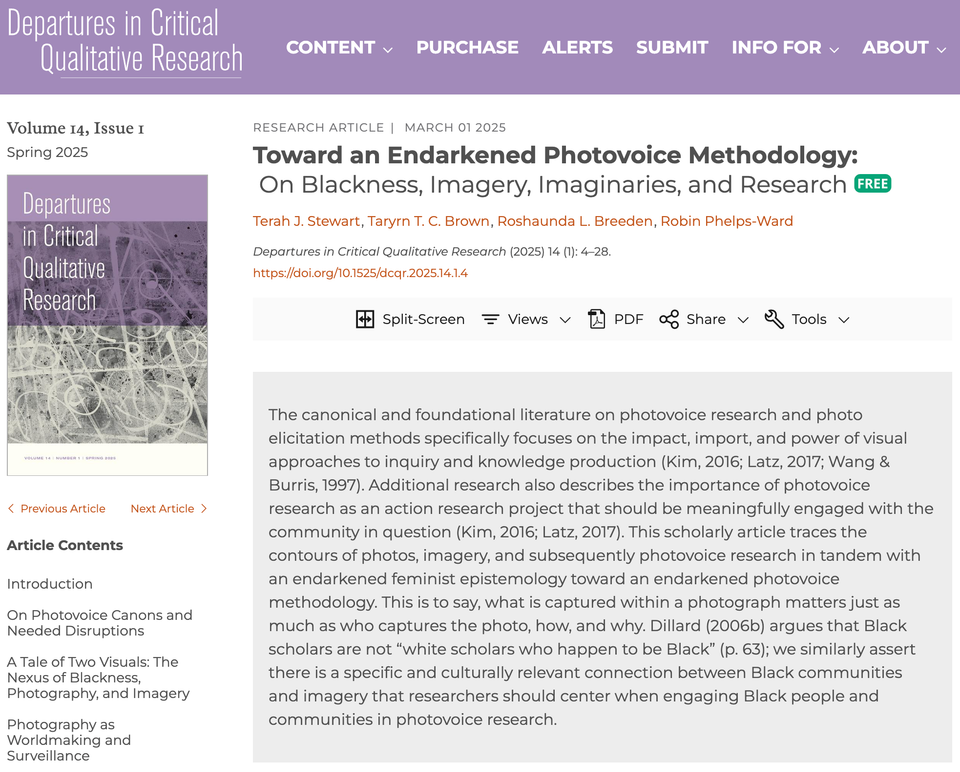
This post is a little love letter to some dear colleagues, Terah J. Stewart, Taryrn T. C. Brown, Roshaunda L. Breeden, and Robin Phelps-Ward, who have written a brilliant piece of scholarship—just one piece of an entire issue of a journal I am reading and working through, however slowly. After reading Toward an Endarkened Photovoice Methodology: On Blackness, Imagery, Imaginaries, and Research, I immediately knew I wanted to pen a post about the things I considered deeply upon reading this beautiful and skillfully crafted paper. This article is required reading for anyone engaging in photovoice projects, as it guides readers through a keen and important journey prompting deep and serious reflection and reflexivity.
While I do not identify as a Black scholar (this matters; please read the article), I am interested in empathy, identity, responsibility, and freedom. Photovoice, too, of course. So while I will not deploy an endarkened photovoice methodology, there is a lot to learn from such an approach—one that critically and smartly questions and sits with the extant canon (of photovoice literature) to make space for more relevant unfurlings.
There are so many, but here are four ideas from the piece that generated the most urgent and robust marginalia and enthusiastic highlights during my very embodied engagement with their work.
Images and Culture are Inextricably Connected
On page five of the article, the authors stated that "what is captured within a photograph matters just as much as who captures the photo (their contexts and histories) and how and why." They then noted that absent a grounding in an endarkened feminist epistemology (see the work of Cynthia B. Dillard), photovoice research "may miss or obscure the particularities of how Black people approach and use photos/imagery." Put another way, images require a (very) full context, which includes the (very) full subjectivity of the image maker and subject(s), noting they can be one in the same, for the images' full set of meanings and matterings to be fully understood, honored, and appreciated. Salient and striking examples are provided throughout. And here I must also note the absolutely exquisite use of Beyoncé's artisanship (sonic, visual, and so on) to bookend—open and close—the piece. So, so good. You must read it for yourself.
Images Can Empower and Actively Harm
An image can do many things at once. The authors noted that "[w]hile photography has served as a tool for empowerment, challenging stereotypes, and advocating for civil rights, it has also been used to perpetuate harmful and dehumanizing images. This duality underscores the importance of critically examining visual culture and striving for representations that honor the complexity and dignity of Black lives" (Stewart et al., 2025, p. 12). It is in that striving that we must critically question and engage in honest dialogue about the nature of the representations put forward in any given project. One element of this piece I particularly love is its precision with language. Use of the word striving is important here. The expectation is that we, as researchers, put in the work—that we strive—to do right by the people with whom we are working. Putting in the work does not mean getting it right all the time. It simply means that we must strive.
Guideposts Are Better than Tenets
Another thing I love about this piece is the authors' rejection of prescription. An example of this comes on page 14, where they said "we endeavor to articulate a pathway toward an endarkened photovoice methodology and provide key ideas as guideposts and urge researchers to lean into the spirit of what we offer here rather than overly strict prescriptions" (Stewart et al., 2025, italics in original). In this vein, they noted how flexibility and improvisation are crucial in the enactment of methodology, especially within the qualitative paradigm. Often, participants know so much better than we do. While our methodological actions might be grounded in the literature, they might not be grounded in the lived realities of our participants/collaborators/co-researchers. And as such, we must follow their leads and expand ourselves, and the literature, as a result.
Be Always Becoming
This precise use of language and refusal for prescription also shines through in the framing of the article, as well as its title. The authors are clear: "[o]ur intention with framing this article as being toward an endarkened photovoice is to emphasize the ongoing development required for the most useful qualitative methodologies. . . . we want to frame endarkened photovoice as always becoming" (Stewart et al., 2025, p. 16, italics added). Adopting a methodological onto-epistemology orientation of always becoming squashes the anxieties of aspiring toward prescribed processes and prefabricated outcomes. In fact, fruitful divergence from prescription is where all the interesting stuff happens.
This brief post should serve as a prompting to deeply engage with the original article. As I noted above, it is a must-read for those interested in photovoice. Every word was a gift, and I am better for reading all of them.
Before studying this piece, I never before thought of there being a photovoice canon. But seeing as we are in the fourth decade of the methodology's existence, it is clear that these kinds of disruptions to that canon are—and always will be—necessary as we move, mold, and shape this approach to inquiry toward and into the future.
🥹 Thanks for spending a moment with me this Friday.
💌 If you’re new here, welcome! I hope this space becomes one you look forward to each week.
📬 Have a question you want me to answer in a future issue? Reach me at photovoicefieldnotes@gmail.com. I'd love to hear from you.
Thanks again for being here.
Warmly,
Mandy
photovoice field notes
photovoicefieldnotes.com
Member discussion