four note friday 2.13 | A Second Edition of My Photovoice Book?
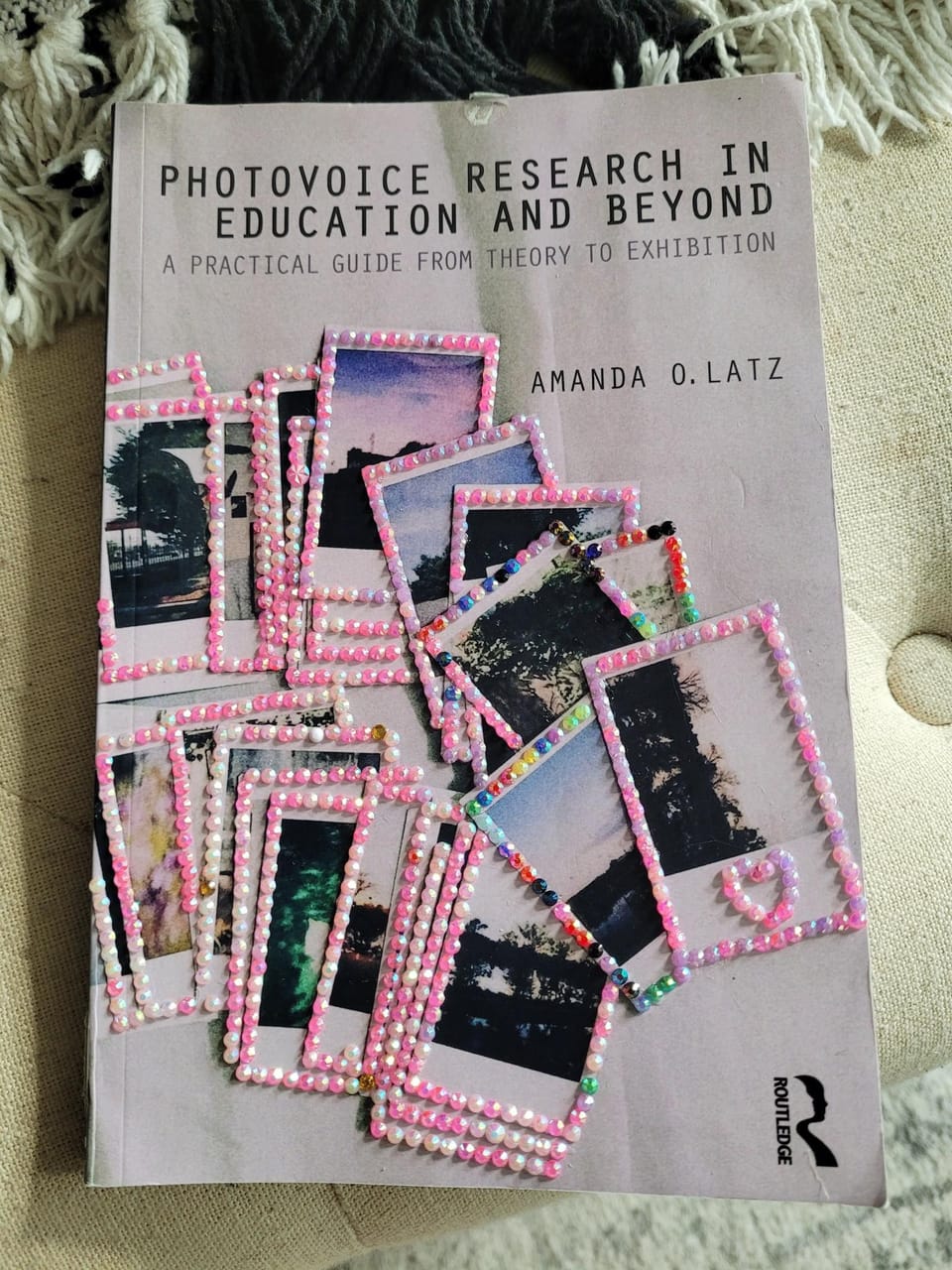
My book on the photovoice methodology (Routledge, 2017) was released nearly 10 years ago. See above for an amazing photograph of the book sent to me by Subarna Basu (had no idea book bedazzling was a thing)! It's hard to believe that it has been that long. Like it was yesterday, I remember holding it in my hand for the first time at the annual meeting of the American Educational Research Association in Toronto, Canada.
Since that time, my work as a scholar and an academic has developed and changed a great deal. In fact, during and after the pandemic, there was a period during which I bristled at the idea that my scholarly identity was bound up in photovoice. For some reason, I thought it would be better if I were seen as a topical expert rather than a methodological one. And as a result, I gravitated away from photovoice and toward other projects.
I carried out other kinds of studies, and I wrote other books (see here and here and here). But, then, in the spring of 2024, I brought photovoice back toward the center of my work again by building a team intent on creating an Action Research Collective (inspired by the fantastic work of Dr. Robin Phelps-Ward; see one example here) at the local community college.
And now, two years on, I am still in the process of re-remembering why I loved, and still love, photovoice so much in the first place. Bearing witness to so many amazing scholars take up the methodology has kindled a passion in me to keep thinking, writing, teaching, and advocating about/for photovoice.
And in doing so, I have been experimenting with different kinds of public scholarship efforts, such as creating these weekly posts, launching a podcast nano-series (on YouTube), hosting photovoice office hours, and (again) offering a workshop.
All this activity got me thinking about a more significant and concentrated effort in this area. Should I write another book? Should I just see what happens as I work these experiments through? Should I write a second edition of my 2017 book on photovoice?
While nothing is set in stone, I am considering a second edition of my book. And the following four notes are newer photovoice-related topics I believe need to be included.
Online Photovoice
When I was drafting my photovoice book in the mid-2010s, I had never heard of Zoom. Sure, Skype existed—and also WebEx, but I had never done an interview through Skype or WebEx. At the time, it seemed the in-person interview was the thing.
Enter the pandemic. After using WebEx to muddle through work communications for a while, I bought myself a subscription to Zoom, which felt much more user-friendly. The product was eventually institutionalized. And now it seems I am on Zoom every single weekday for a meeting (or several). It is now standard.
Zoom has also become a ubiquitous research tool. Physical distance is no longer as significant an obstacle as it once was. As such, many researchers moved photovoice online. See here for a recent post on online photovoice.
This movement can be seen through many vantage points. On the one hand, Zoom and an Internet connection opened possibilities otherwise closed to research projects, making the move liberatory in some senses. On the other hand, some Indigenous and place-based enactments of photovoice may be untenable when the place is online.
Back to the point. My 2017 book mentioned nothing of online photovoice. And while I do not think an entire chapter ought to be dedicated to the adaptation, the option of carrying out such as project online (wholly or partially) ought to be threaded through a second edition of the text.
(other) Photovoice Adaptations
Qualitative research methodologies and methods are in a constant state of flux. Researchers working within the qualitative paradigm are always remixing methodologies, methods, conceptual frameworks, theoretical frameworks, epistemologies, ontologies, axiologies, and positionalities. This said, photovoice has been adapted in several interesting ways over the years. Online photovoice is one among many adaptations of the methodology. See here and here for previous posts related to this topic.
Most of these adaptations were absent from the book's first edition. And while many of those adaptations existed before the book was published, there was only so much I could include.
Yet edition two will likely see a section dedicated to how photovoice has evolved and been adapted over time. These tweaks were born from necessity and aligning approach to context and culture.
Photovoice as Pedagogy
While I always tend to frame photovoice as a methodology, it can be much, much more. In this piece, co-written 10 years ago, we argue just that. Photovoice can be pedagogical. It can be a community building tool. It can be many, many things.
When the above referenced journal article was published, there were not many examples of photovoice as pedagogy in the literature. That has changed dramatically. A quick scan of the literature using a tool such as Google Scholar yields ample results at present.
While many such examples frame students engaging in the learning experience as participants in a study designed by the educator, there is more to consider.
I view photovoice as pedagogy as a vehicle to enmesh students in both content and research knowledge. In this conceptualization, students are project facilitators. While they may also be participants in the project, they are also researchers.
Framing photovoice as more-than-methodology (i.e., framing it as pedagogy) is appropriate for a book about photovoice and grounded in the field of education. There is unlimited potential here, and it demands consideration for a second edition of the book.
Photovoice and AI
I am writing this post the day after learning about Figure 03. It is very easy to imagine a future were teachers are replaced by robots and resultantly conjure an undue existential crisis. Rest assured, Figure 03 will never facilitate a photovoice project. At least not well.
At the same time, AI and photovoice are not mutually exclusive. This is an area that requires serious examination and deep (human) thinking.
And that work has already begun. In fact, AI Voice already exists. And a post on that topic is forthcoming.
The affordances and implications of AI are complicated. And they demand attention. The thought of using the assignment of writing a second edition of my book to learn, grow, and share is enticing and joyous.
As it happens, the process of writing this post supported my ongoing decision-making process about actually committing to a second edition. So much has changed since the 2010s. And now discerning between a second edition and a follow-up book is tough. But the grappling is worth it. Stay tuned.
🥹 Thanks for spending a moment with me this Friday.
💌 If you’re new here, welcome! I hope this space becomes one you look forward to each week.
📬 Have a question you want me to answer in a future issue? Reach me at photovoicefieldnotes@gmail.com. I'd love to hear from you.
Thanks for being here.
Warmly,
Mandy
photovoice field notes
photovoicefieldnotes.com
Member discussion