four note friday 2.11 | Photovoice Google Alert Article Roundup
As I argued in a previous post, keeping up with photovoice projects-in-motion around the world can be achieved, in part, by setting up a Google Alert. And in that previous post, I provided the details on how to do so. In this week's post, I'll showcase four projects that have recently hit my inbox.
In the four notes that follow, I will share the name of the article, the article link embedded in the Google Alert, a brief project overview, and some notes on what I found most interesting about the work.
🟣 Fall In Love with the Highway: Teens Lead Youth Photovoice Project in Alexandria
🔗 https://thezebra.org/2026/03/02/fall-in-love-with-the-highway-1be-youth-photovoice-alexandria/
This youth photovoice project was carried out by members of the Fairfax Prevention Coalition Youth Team. The project was focused on documenting life along Richmond Highway and developing (pun intended) a vision for positive change.
What I loved about this article was the focus on policy change. The youth not only hosted an exhibition, they also complemented that exhibition with a Q&A panel, which gave them a dedicated space to directly share their work and their vision(s) for change. The article highlighted the project-policy connection by noting how policy makers pledged their support for the work. A long-term (days, weeks, months) exhibition needs an opening, and a short-term (hours) exhibition needs a program with a mix of structured and unstructured elements. In each case, the opening or program ought to include time and space for participants to speak directly to policy makers.
🟣 Photovoice Exhibition Examines Mental Health on Campus
🔗 https://the-tartan.org/2026/02/23/photovoice-exhibition-examines-mental-health-on-campus/
This photovoice project was carried out by a student at Carnegie Mellon who became inspired to apply the methodology after taking a specific course. The student, Mo Fahad, received the Frank-Ratchye Further Fund to carry out the work.
What I loved about this article was how it showcased the exhibition as a site of further inquiry related to the photovoice project. From what I glean from the article, Fahad hosted an exhibition and during his opening remarks encouraged attendees to participate in the ongoing project. We typically think of photovoice exhibitions as taking place once a project is completed, but this example shows us that it could take place well before the end, and take the project into new and exciting directions along the way.
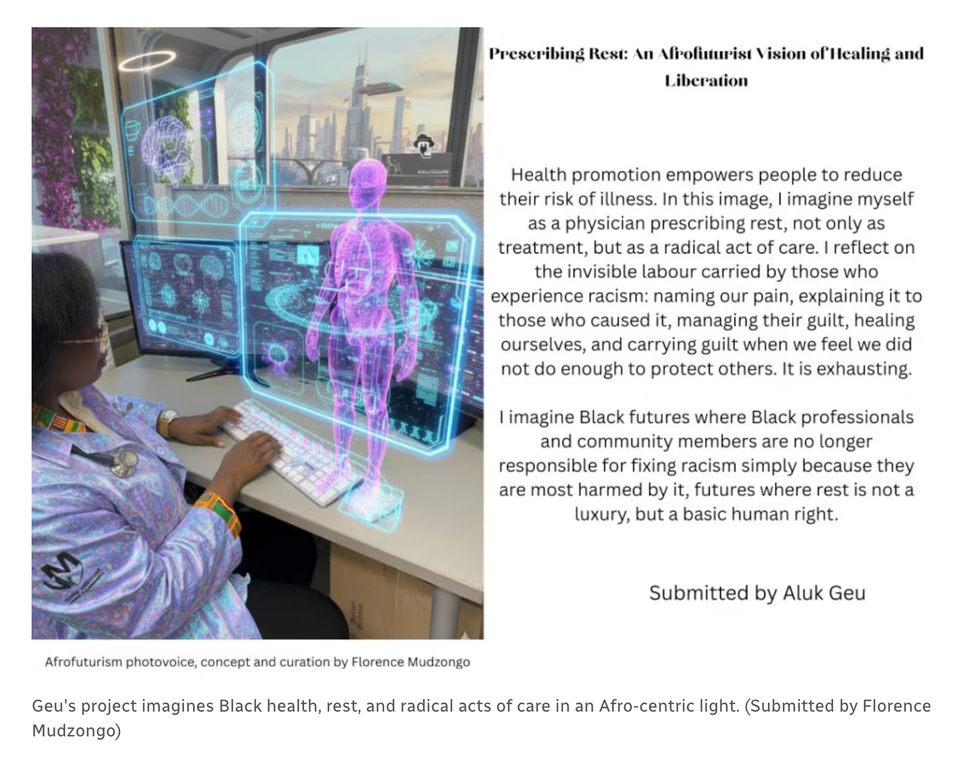
🟣 ‘We have a shared purpose’: U of S Documentary and Student Exhibit Explore Allyship and Black Futures
This project took the shape of an Afrofuturism Photovoice exhibit created by Black students at the University of Saskatchewan (Canada). During an on-campus event held during Black History Month, this photovoice exhibition was paired with the screening/viewing of a documentary titled Nia: A Shared Purpose. Through the project, participants were asked to take photographs of aspects of their lives and then use artificial intelligence (AI) to transform the images into possibilities for the future. See the image/screenshot above for an example.
What I loved about this project was the infusion of AI and future world building as part of the photovoice process. The full intersection of photovoice and AI is still yet-to-be-seen, but this project is fascinating to me. It gives us a glimpse into new possibilities. I imagine this project generated all sorts of insights among the participants. Critical consciousness building indeed!
🟣 New Research Leads European Cities to Tackle Pollution from a Social Perspective
🔗 https://www.tuni.fi/en/news/new-research-leads-european-cities-tackle-pollution-social-perspective
Air and noise pollution are the focus of the photovoice work touched upon in this article. Within five European cities, participants will engage with multiple citizen science approaches to help the multidisciplinary research team collect data. Photovoice is one of those approaches. City residents will have the chance to showcase their experiences with pollution as well as their role in reducing it.
What I love about this project is how photovoice is framed as a form of citizen science. While I have often thought of the photovoice approach in those terms, I have not seen them put together in the broader research context. So this piece was refreshing!
As mentioned prior, setting up a Google Alert for photovoice can keep you up to speed on how folks are using photovoice across the globe. Through reading four short articles, my mind became ablaze with new possibilities and ideas. Hope the same goes for you!
🥹 Thanks for spending a moment with me this Friday.
💌 If you’re new here, welcome! I hope this space becomes one you look forward to each week.
📬 Have a question you want me to answer in a future issue? Reach me at photovoicefieldnotes@gmail.com. I'd love to hear from you.
Thanks for being here.
Warmly,
Mandy
photovoice field notes
photovoicefieldnotes.com
Member discussion