four note friday 1.9 | Photovoice and Policy Change
One of the aims of the photovoice methodology is to attract the attention of policy makers with the ultimate intent of impacting policy and practice. But how do we do this, exactly?
Unfortunately, the literature on this topic is unclear and underdeveloped. Many published photovoice studies do not address, interrogate, or evaluate the project’s policy impacts or long-term outcomes within their reports (see here and here).
And while some researchers have attempted to bridge literature on the photovoice methodology and the literature on policy (or social) change (see here), more guidance is needed on how those engaging with photovoice can effectively affect policy.
Fortunately, this represents an interesting opportunity to start building the bridge. And my current consulting work is taking me in that very direction.
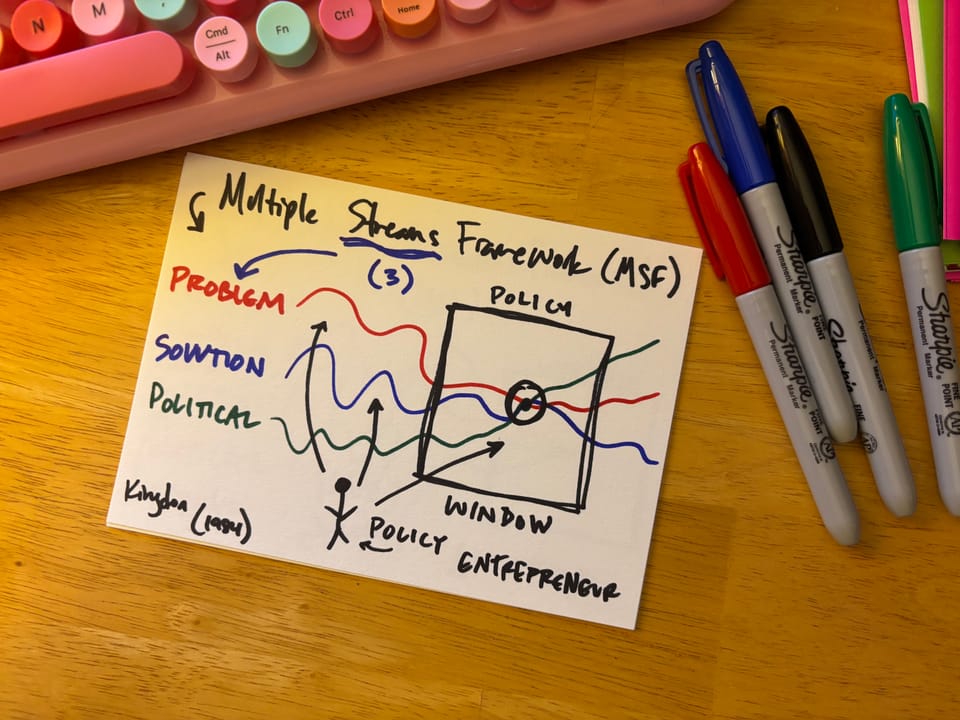
So, this week we’re looking at how photovoice can influence policy change using John Kingdon’s Multiple Streams Framework (MSF). It’s a way of understanding how problems, solutions, politics, and timing line up to open opportunities for action.
1️⃣ Problem Stream: Identifying the Issue
🔍 What’s the problem?
- The results or findings of a photovoice project may represent problems solvable through policy change.
- Photovoice helps communities and groups define and showcase issues in ways that are hard to ignore. Issues that need addressed make up the problem stream.
- Through images and stories, the lived experience of an issue becomes visible. Onlookers can see the problem, giving them a more complete understanding of the issue.
- Problems must be clearly defined before they can be addressed or solved.
2️⃣ Solution Stream: Generating Ideas
💡 What could be done?
- Once problems are established and defined, possible solutions for each problem must be generated.
- Many photovoice projects generate recommendations. These recommendations make up the solution stream.
- There are many ways to solve a problem. Think of the most realistic solutions, then put those forward as recommendations.
- Participants ought to be a part of the solution-generating process to the extant they are willing and able.
3️⃣ Political Stream: The Context
🏛️ What’s happening politically?
- Policy change hinges on whether the political climate is receptive.
- Depending on the context of the policy making environment, those looking to make change can forefront problems most likely to be attention-getting.
- Think about what is happening in the context that might make one solution more viable than another.
- Those involved with photovoice projects can connect with others fighting for the same cause to make their shared problems more visible and their solutions more refined.
4️⃣ Policy Window: The Opportunity
⏰ When can change happen?
- Sometimes, all three streams—problem, solution, and political—line up. This alignment creates a policy window.
- When the streams align to create a policy window, this is the time to act on the policy change. The opportunity has arrived, and the conditions are right.
- Those involved in photovoice projects can act as policy advocates, advancing the problem and solution into the policy-making space.
- Adding or subtracting from the problem or solution streams can change the flow, changing the chances of alignment.
🌟 Final Note
The Multiple Streams Framework is a helpful mental model when thinking about photovoice and policy change. Using photovoice to create policy change is about knowing when the three streams align and how to make that alignment more possible. When those streams intersect, the policy window opens, and change can happen.
🥹 Thanks for spending a moment with me this Friday.
💌 If you’re new here, welcome! I hope this space becomes one you look forward to each week.
📬 Have a question you want me to answer in a future issue? Reach me at photovoicefieldnotes@gmail.com. I'd love to hear from you.
Thanks for being here.
Warmly,
Mandy
photovoice field notes
photovoicefieldnotes.com
Member discussion