four note friday 1.23 | The Photonovel and Photovoice
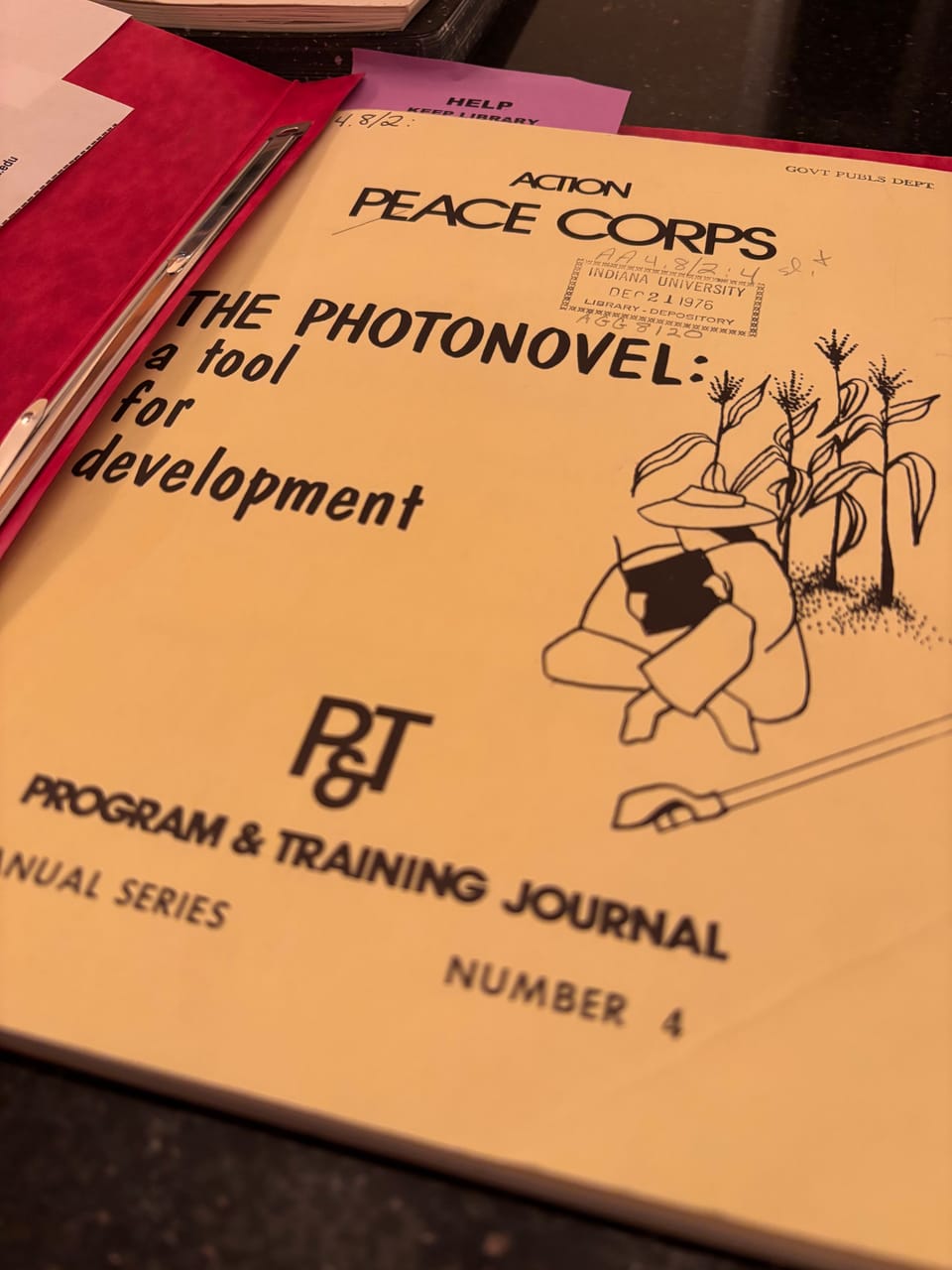
A few weeks ago, I became interested in learning more about a Peace Corps training manual written by Daniel Weaks titled The Photonovel: A Tool for Development. It had been referenced in early writings on photovoice, and, well, I became intrigued. The manual is available online, but I wanted to flip through an original analog version. Interlibrary loan came through, and here we are.
In their pre-photovoice photovoice work published in 1994, Caroline Wang and Marry Ann Burris published an article titled Empowerment through Photo Novella: Portraits of Participation. Yet in the years that followed, they moved from the term photo novella to photovoice, noting in their 1997 article Photovoice: Concept, Methodology, and Use for Participatory Needs Assessment that "the process to be described here is significantly different [from photo novella]; hence, the term photovoice" (p. 369, italics in original). Clearly, the photonovel was inspirational to early photovoice work.
Here are my four take-aways from that manual by Weaks, including some connections I see to more modern approaches to photovoice.
🟣 There is power in the mash up.
On page one of the manual, Weaks noted that "a blend of the comic book and the motion picture, the photonovel creates an interpersonal experience between the reader and the image, much as exists between the audience and the film."
Photovoice is also a productive mash up in terms of bringing together photographs and voices—narrations of those photographs. The images do not stand alone. The voices do not stand alone. Together they synergistically they evoke the reader and spur on emotionality.
Sometimes 1 + 1 = 3. The whole is greater than the sum of its parts. You get the idea. There is power in the mash up.
🟣 Education comes before policy change.
Weaks notes that the photonovel is an important educational medium. Photovoice exhibitions, too, broadly conceived, are important educational mediums. By showcasing the project's findings, those engaging with the exhibition learn about the issue(s) at hand. Policy will not change if policy making are not presented with a compelling argument on why change is necessary.
In fact, Weaks also notes that "the story of the photonovel shows readers the 'how' and 'why' of an idea, and illustrates in terms familiar to the reader how he [sic] may benefit as an individual" (p. 3). Similarly, photovoice can provide the evidence for a compelling argument related to a specific policy change that may benefit many. Education comes before policy change.
🟣 Layout is critical.
Much like a comic book, the images and words on the pages of the photonovel must be laid out in such a way that readers follow the story easily. Several examples of good and bad layouts are presented on page 23.
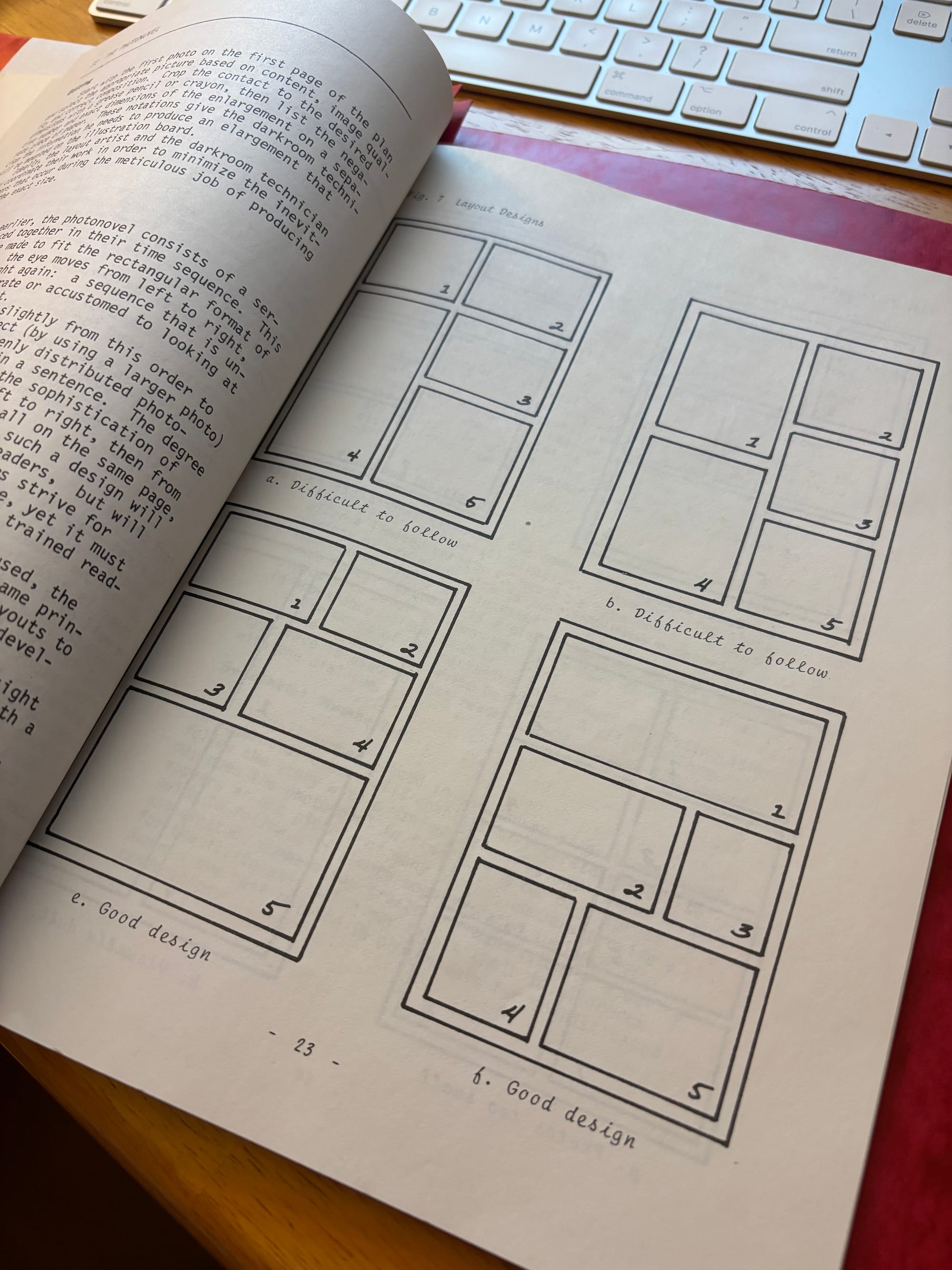
Weaks's assertion here regarding layout reminds me of how I leveraged museum learning concepts within my 2017 book to discuss effective ways to physically arrange a photovoice exhibition such that attendees are interesting and engaged. Anticipating and removing friction in the learning process is key. Layout is critical.
🟣 Funding matters.
Though the photonovel may be inexpensive to create, there are expenses nonetheless. Weaks noted that "the photonovel is too expensive to be paid for by a Peace Corps Volunteer, or even a group of Volunteers" (p. 37). There is a whole section within chapter 7 of the manual called How to Ask for Money.
Most of the photovoice projects I have facilitated were funded by very modest grants, internal to my institution in most cases. Not only must we derive funds for materials for the project, we must also think about appropriate and fair ways to compensate participants. That will certainly look different from project to project, but time spent on a photovoice project, for participants, is often time spent not working, not earning a wage.
Just like financially planning ahead for a photonovel, photovoice facilitators must also consider ways to fund projects. Funding matters.
History is important. Working on this website and generating these posts has provided me with reasons to dig more deeply into all things photovoice, including the foundation of ideas that foregrounded it, which gave it something to be built upon. Engaging with this manual transported me to the mid-1990s and what Wang and Burris must have experienced upon reading through its pages. To be sure, examining one block of the foundation at a time can help you see the whole structure much better. It also provides fodder for ongoing methodological innovation.
🥹 Thanks for spending a moment with me this Friday.
💌 If you’re new here, welcome! I hope this space becomes one you look forward to each week.
📬 Have a question you want me to answer in a future issue? Reach me at photovoicefieldnotes@gmail.com. I'd love to hear from you.
Thanks for being here.
Warmly,
Mandy
photovoice field notes
photovoicefieldnotes.com
Member discussion