four note friday 1.12 | Take-aways from 'The Tai Qi of Photovoice'
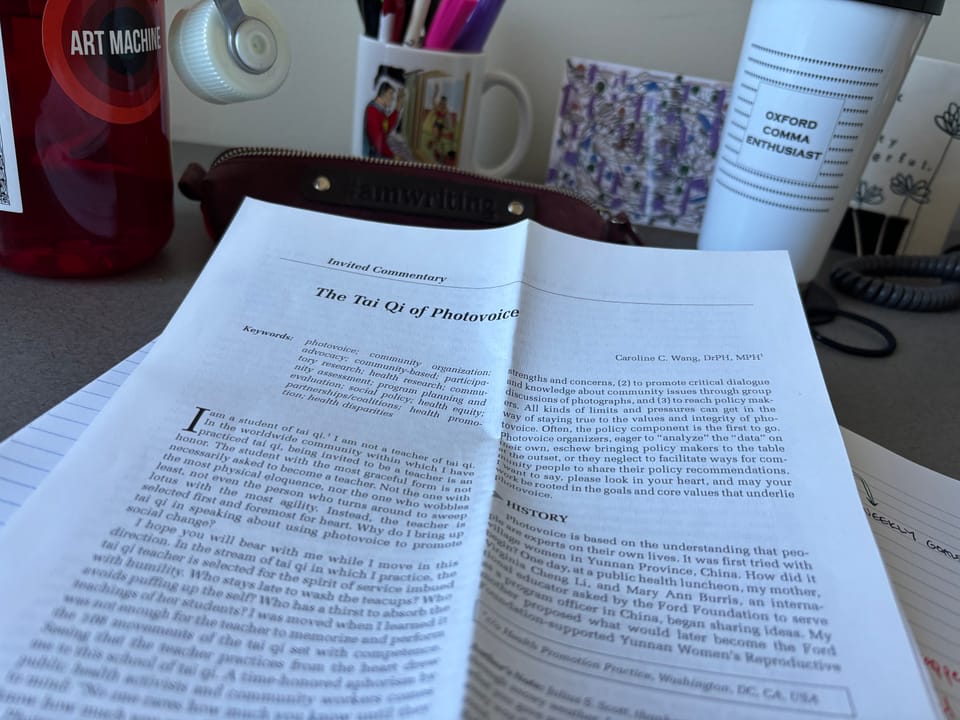
A little while ago, I came across a recent (2022) article written by Caroline C. Wang, one of the original creators of the photovoice methodology.
When I was writing my dissertation, I tried to reach Dr. Wang by email, and this piece helps me understand why a response was never received. She left the University of Michigan in 2006—just when I was starting doctoral education.
She wrote: "But I have not been able to keep up with what has happened in the print and multimedia world of photovoice over the past 15 years. . . . I regret that my health condition often kept me from responding [to reader messages]. Had it been in my power, I would have given you the moon" (p. 209). That takes my breath away.
This article is like a love letter—sincere, impassioned, and from the heart. Reading it was like pouring warmth into my body. It was soothing. Using the practice of tai qi as a vehicle for reflecting on photovoice, Wang provides readers many treasures within five and a half short pages.
I implore you to read the piece.
My take-aways are articulated below, but, again, you should read the piece. It is very short, and it is very sweet. In what follows, I provide my take-away, followed by an illustrative excerpt from the article, followed by some reflections.
🌀 Take-Away One: Photovoice was a project before it was a methodology.
📝 "Noreen was my dean and guide, and one night over Chinese food in Ann Arbor, she helped me see that our work was far more than a project; we had created and described a methodology by which community people could reach policy makers" (p. 206, italics in original).
I love this excerpt. Here, Wang is referring to the work she'd done with Mary Ann Burris in China (see this article). Photovoice has humble beginnings. A series of creative problem solving exercises resulted in the creation of a successful project, and, in the process, a new methodology was born. But it took time and an outsider's perspective for the generators of photovoice to realize, fully articulate, and name what they had done.
And what an amazing things they did! Pulling back the curtain on methodological insights take shape is so rare, but so necessary if we are to model the way for others in a realistic manner that shows the messiness inside the struggles and tensions. Wang's humility and generosity here is unmatched—and so welcomed.
🌀 Take-Away Two: Explore failures; explore the heart.
📝 "I encourage the reader to explore depths of failures as well as the depths of heart in looking at one's use of the methodology. 'Encourage the reader' may be fitting words because the practice of owning failures and flaws can be humbling. The name of an apt tai qi movement comes to mind: 'touch sea bottom'" (p. 208).
📝 "I want to say, please look in your heart, and may your work be rooted in the goals and the core values that underlie photovoice" (p. 205).
I love these excerpt, too. Yes, two were needed for this take-away. Failure is oftentimes an unknown or repugnant concept-experience for folks who have done well enough in school to arrive in graduate education and encounter a diversity of research methodologies. Yet failure is an inevitable gift given and received when inquiry is undertaken. It is a gift because it is instructive. It says, take another direction. Try another approach. Give it a go from a different angle.
Failure and photovoice go hand in hand. Any considerations of perfection are absurdities. You will try your best after diligent study and earnestness of purpose. You will do well. You will also fail. And that is how it will be. Failures are information. Failures are not stoppages. Truly, failure is a gift. Take another direction, but do not stop moving. I have made many, many mistakes and had plenty of failure when facilitating photovoice projects. I am still here. Still here doing this work.
Are you ontologically aligned with the core values of photovoice? This is a question that goes unasked and unanswered too often. Yet it is vital. Think about its theoretical underpinnings: feminisms; critical consciousness education; and participatory documentary photography. It is one thing for our work to be rooted in something. It is another for us to be rooted in something. Both are necessary for a photovoice project to sing.
Go to the depths of the failure. Go to the depths of your heart.
🌀 Take-Away Three: People are experts on their own lives.
📝 "Photovoice is based on the understanding that people are the experts on their own lives" (p. 205).
You guessed it—I love this excerpt as well. This stance really cuts against the grain of the binary of researcher and subject. And that binary should be questioned and sliced open for further consideration.
Hubris is thinking you know more about a stranger than the stranger knows about themself.
We must inquire before we interpret. Yet the critical and participatory nature of photovoice put even our interpretations into question. To the extent they are willing, photovoice participants-collaborators-co-researchers walk with us, as facilitators, side-by-side during the entirety of the process. As facilitators, we are researchers-teachers-learners. There is no place for hubris when we are ontologically aligned with the underpinnings of the methodology.
🌀 Take-Away Four: Labor and resourcefulness are needed for policy change to occur.
📝 "Recruiting policy makers takes labor and resourcefulness. Social and political power is so unbalanced in society that if organizers do not put effort and commitment toward policy change, well, then—it gets tossed away" (p. 209).
Yes, indeed, I love this excerpt. Recently, I have been working hard on this very topic—hoping to be of serve to an important series of photovoice projects happening across five European nations right now.
We must keep building and walking across bridges that span the photovoice literature and the literature on policy change/making. It is easy to exit a photovoice project prematurely, without regard to change that might make the lives of the community materially better. We must not exit too soon.
Labor and resourcefulness beyond getting that presentation-publication are inscribed into any action research endeavor, which does not value knowledge production that does not also make life a little bit better.
✅ 📖 Wang’s words here are required reading for anyone doing or learning about photovoice. In case you were unsure, I absolutely loved the piece. It was warm, it was affirming, it was a loop coming to a close.
🥹 Thanks for spending a moment with me this Friday.
💌 If you’re new here, welcome! I hope this space becomes one you look forward to each week.
📬 Have a question you want me to answer in a future issue? Reach me at photovoicefieldnotes@gmail.com. I'd love to hear from you.
Thanks for being here.
Warmly,
Mandy
photovoice field notes
photovoicefieldnotes.com
Member discussion