four note friday 1.10 | What is online photovoice?
During the 30+ years since its inception, photovoice has been adapted and reshaped to fit various contexts. The COVID-19 global pandemic represented a new context for those engaged in research of all kinds, and photovoice was no exception. There were countless new challenges and significant considerations to be made about individual and public health.
Online photovoice came into prominence during the COVID-19 pandemic. Researchers and practitioners quickly adapted the methodology to virtual platforms, creating new opportunities for connection, dialogue, and visual-digital storytelling at a distance. This shift sparked both innovations and challenges.
This week's four notes come in the form of four journal articles I selected to review in building my own deepening understandings of how this photovoice adaptation came to be and has been put into practice. I start with two recent pieces then trace back to the origins of the adaptations.
📱🎥 Article 1
Title: From Photos to Performances: Exploring the Digital Transformation of Photovoice Through Velfies (2025)
Authors: Lucian Ciolan and Loredana Manasia
🔗 URL: https://journals.sagepub.com/doi/10.1177/16094069251337872
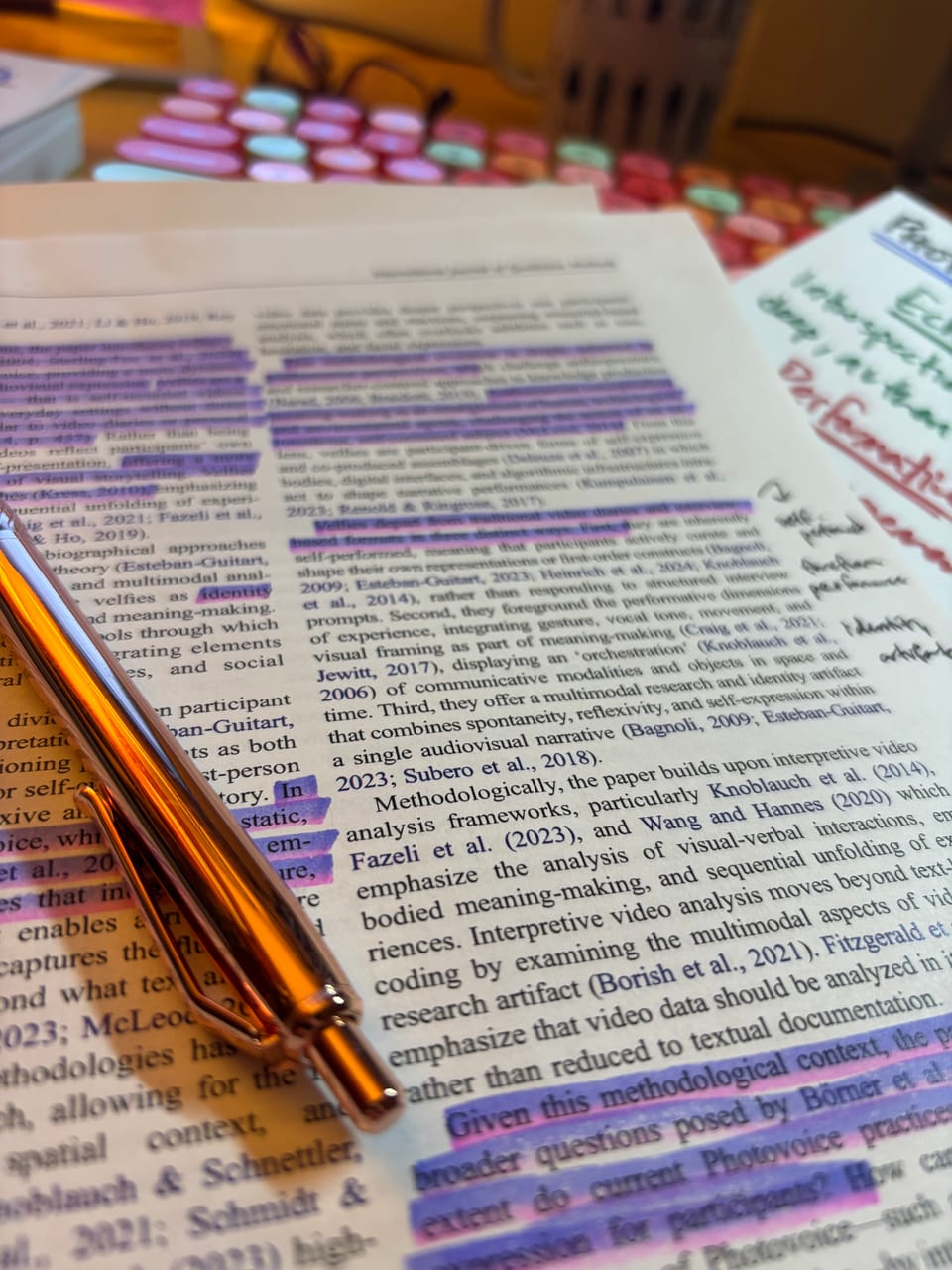
The authors of this piece argue that video selfies, or velfies, have the potential to adapt and even transform the (online) photovoice methodology. During their study, which took place in Romania and was focused on college students' experiences with innovative pedagogies across a three-semester time frame (over a year, March 2021 to June 2022), some of the participants expressed feeling constrained by both the online platforms being used and the photographs and text they were contributing. In an early example, a participant reflected on the use of WhatsApp as one of the study's platforms: "I love WhatsApp because I have my emoticons and gifs. I cannot write without them!" (p. 6) One of the participants later noted "I could have just taken a picture of my desk, but that wouldn't show how I actually feel. In the video, you can see my tired face, you can hear my voice—it's different. It's more real" (p. 7).

The participants organically steered the project toward a more broad and open set of online communication tools and strategies. Photos and voices bubbled over into blends of texts, images/symbols, and videos yielding more dynamic and nuanced expression, which enriched the data. In this context, velfies were seen as self-generated performances situated as identity artifacts. Participants created two types of velfies: echo and performative. Echo velfies were recorded alone with included deep and authentic introspection. Performative velfies were recorded in social contexts and included dynamic movement.
This article was extremely interesting and worth the read! It showed that while online photovoice is relatively new (about five years), it has already been adapted-in-practice. This piece is a great example of a piece situated atop a growing body of literature on online photovoice. Yet the question remains, what exactly is online photovoice? Let's keep reading.
💻👴🏼 Article 2
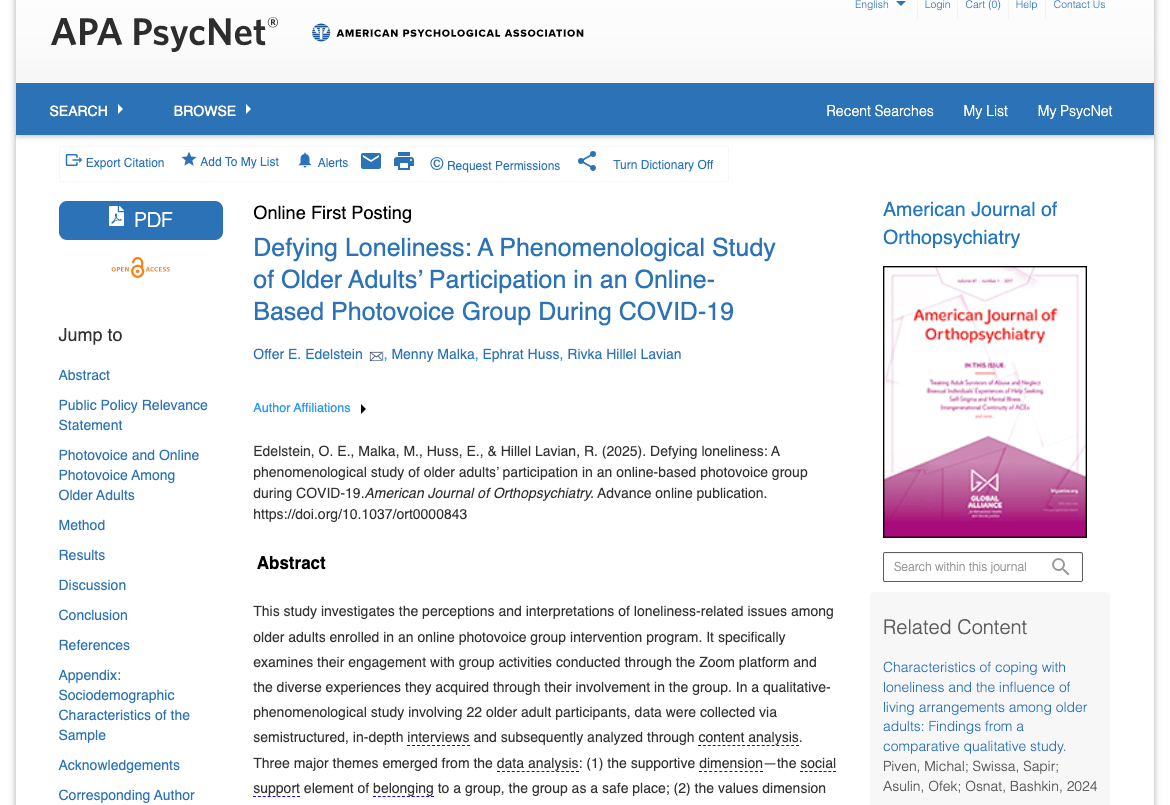
Title: Defying Loneliness: A Phenomenological Study of Older Adults' Participation in an Online-Based Photovoice Group During COVID-19 (2025)
Authors: Offer E. Edelstrein, Menny Malka, Ephrat Huss, and Rivka Hillel Lavian
🔗 URL: https://psycnet.apa.org/fulltext/2026-03056-001.html
This study took place in Isreal and focused on older adults' experiences with loneliness during the pandemic. In this context, photovoice was framed as both an intervention and a research study—an online-based photovoice group (online photovoice-like?). Rather than it being simply a project, it was much like a program. In other words, being part of the program helped participants feel less lonely and it help the facilitators learn about loneliness among older adults during the pandemic.
The main tool used in this study was the Zoom video conferencing platform, which really took off during the pandemic. Group meetings and individual interviews took place on the platform. Researchers stayed in touch with the participants via phone and WhatsApp during the program. Notably, the article contained no photographs (which is the case with about half the photovoice literature), and how the photographs were shared/showcased among the total group was unclear.
My main take-away here was that Zoom works really well for(online) photovoice projects. It is affordable, accessible, and easy to use. Furthermore, the older adults in this study learned the platform quickly and had no issues with its use. The authors noted that the "Zoom-based photovoice intervention emerged as a notably accessible and cost-efficient method for loneliness reduction, devoid of the necessity for complex apparatus and high-cost training" (p. 8).
Another great piece! But, the definition of online photovoice is still eluding me. Perhaps some earlier work will make this clear.
🧰 🖥️ Article 3
Title: Adapting Qualitative Methods during the COVID-19 Era: Factors to Consider for Successful Use of Online Photovoice (2021)
Authors: Nadia Rania, Ilaria Coppola, and Laura Pinna
🔗 URL: https://nsuworks.nova.edu/tqr/vol26/iss8/20/
Research did not cease when the pandemic began. But collecting traditional face-to-face data during the pandemic had to be remote. Being among others in close proximity was simply not safe, advisable, or possible during that time. This article is about factors to consider when doing online photovoice, all within the context of the COVID-19 global pandemic.
This piece was drawn from a study focused on the practical and emotional aspects of living with COVID-19. The participants were comprised of over 100 young adults in college residing in northwest Italy and enrolled in the University of Genoa.
Meetings were facilitated through Teams. How the photographs were shared was, again, unclear. During what they called Phase 4 of the project, groups of participants co-created PowerPoint presentations to use at a later time with local stakeholders and policy makers.

One of the findings of the study was related to factors important to the implementation of online photovoice. Those factors are as follows:
- Presence of Climate of Tension. Breaking the ice was difficult in the online context of the study.
- Employing Group Technology Skills. Not all participants were highly skilled in the technologies used. Information and help were generously offered.
- Investing Greater Time. Online photovoice projects may take more time than in-person projects. This can be burdensome for some participants.
- Technical Aspects of Being Connected. Background noise, variable access to the internet, and a lack of nonverbal communication were obstacles.
- Definitions of Rules and Strategies. Early development and deployment of rules and strategies are key. For example, must cameras be on during video conference sessions?
- Developing Parallel Communication. The chat feature of Teams became an important communication vehicle for some participants.
- Absense of Microalliances. Notably absent from the space was a way to find your people through gestures like head nodding or laughing.
- Composing Group. Small numbers within groups seem to work better than large numbers.
All these factors, among potential others, are important to take into account when preparing for an online photovoice project. In sum, even though "challenges are not lacking," online photovoice "can be a valid tool for carrying out research" (p. 2723).
This piece provides a bit more information about the details of online photovoice, and I am seeing some consistencies across these three pieces far. Are you? However, I am starting to get the sense that online photovoice is ill-defined in the literature, or perhaps that is the point, that it can be whatever it needs to be based on the context?
⌨️ 🍽️ Article 4
Title: Online Photovoice to Explore and Advocate for Muslim Biopsychosocial Spiritual Wellbeing and Issues: Ecological Systems Theory and Ally Development (2020)
Authors: Ahmet Tanhan and Robert W. Strack
🔗 URL: https://psycnet.apa.org/record/2020-23418-001
Pinning down the first mention of online photovoice as a concept is difficult because it has a lot of potential synonyms. Think virtual photovoice, digital photovoice, and hyflex photovoice. However, this article by Tanhan and Strack is at least one of the earliest to use the phrase online photovoice explicitly.
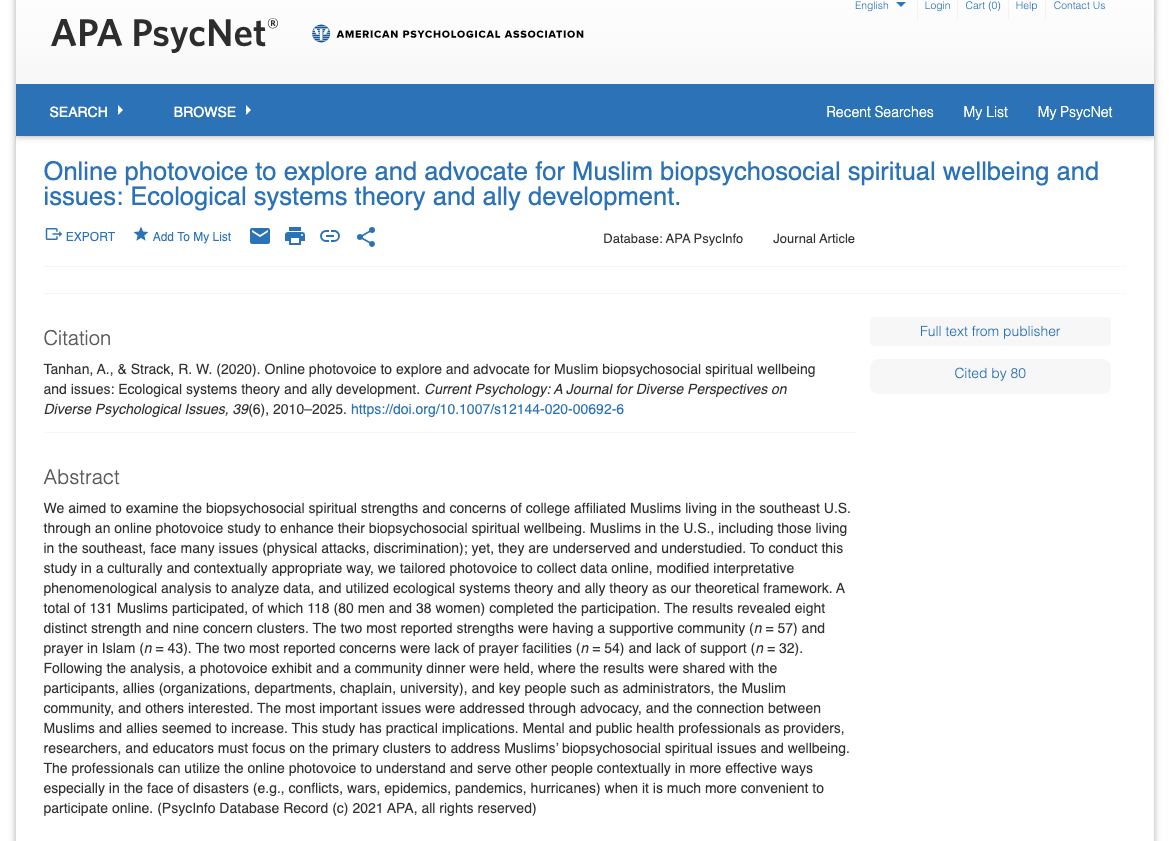
This study took place in the United States and was focused on Muslim collegians. Similar to the above study, there were over 100 participants. Because this paper was published in late March of 2020, the study took place prior to the pandemic. The authors wrote the following: "Mental and public health professionals can benefit from using . . . online photovoice to understand and serve other people contextually in more effective ways especially in the face of disasters (e.g., conflicts, wars, epidemics, pandemics, hurricanes) what it is much more convenient to participate online, which is the case for this current study due to many Muslims not feeling safe to openly advocate for their issues and wellbeing" (p. 2012).
Though prompted to upload two photographs, to participate in the study, eligible participants simply had to upload one photograph and an accompanying caption related to a strength or a challenge they faced related to their college experiences. Data were collected through Qualtrics. Within the Qualtrics form, video explanations of the project were provided. Participants were also invited to borrow tools cameras or tablets.
There were a total of five possible steps through the duration of participation:
- Identifying a support/strength and a concern/barrier.
- Taking photos of strengths and concerns.
- Submitting photos and writing captions.
- Identifying a theme of metaphor (related to the photos and captions).
- Voluntarily attending a photovoice exhibition, community dinner, and prayer.
Upon reading this paper, it is clear the impetus for using an online format for the work was safety and cultural relevance and not a global pandemic. What struck me was the totally online, individualized, and asynchronous nature of the data collection followed by an analog synchronous and highly social photovoice exhibition.
Based on these four examples, there are many, many ways to do online photovoice. In fact, online photovoice is many, many things!
✨ As you can see, online photovoice is much more than one thing. Online photovoice existed before the pandemic, but its use surged during the pandemic.
Context and technology will always influence how we do photovoice, just as it has over the past 30+ years. What do you think about all this? Which of these articles stood out most to you? I’d love to hear your thoughts.
🥹 Thanks for spending a moment with me this Friday.
💌 If you’re new here, welcome! I hope this space becomes one you look forward to each week.
📬 Have a question you want me to answer in a future issue? Reach me at photovoicefieldnotes@gmail.com. I'd love to hear from you.
Thanks for being here.
Warmly,
Mandy
photovoice field notes
photovoicefieldnotes.com
Member discussion